
Littelfuse Unveils Current Sensor Family for Electric and Hybrid Vehicles
The automotive-qualified current sensors feature an open-loop hall-effect design, providing isolated current measurement for battery, motor, and safety systems.
Littelfuse has released a family of six automotive-qualified current sensors targeting electric and hybrid vehicle platforms. The sensors utilize open-loop hall-effect technology to deliver isolated current measurement across battery management, motor control, and safety-critical applications in high-voltage architectures.
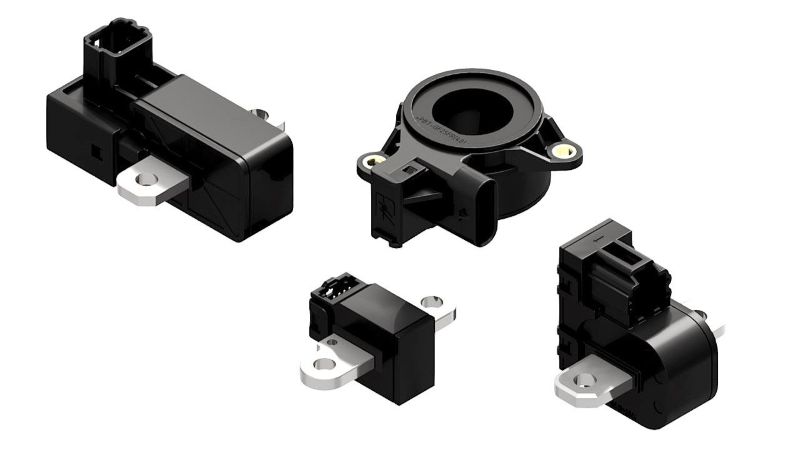
Littelfuse’s family of automotive-qualified, open-loop hall-effect current sensors. Image used courtesy of Littelfuse
Automotive Current Sensors
Littelfuse’s new automotive-qualified current sensor family operates across nominal current ranges up to ±1500 A, with the company citing improved total-error performance and minimal thermal drift. Models incorporating CAN 2.0B communication include AUTOSAR E2E Profile 1A diagnostics and achieve ASIL-C safety-critical current measurement capability. This functional safety compliance enables integration into battery control units and disconnect modules that require fault detection and safe-state operation.
The sensors mount directly to busbars in compact form factors, with output options including ratiometric analog voltage signals or digital communication via CAN and LIN protocols. The digital variants provide built-in diagnostics and integration paths for vehicle control networks, while analog versions offer fast response characteristics suited to high-frequency switching environments.
Littelfuse has designed its current sensor family for battery, motor, and safety systems. Video used courtesy of Littelfuse, Inc.
Product Variants and Differentiation
The current sensor family is divided into three application-specific categories. The battery management sensors (CH1B02xB, CH1B032B, CH1B040B) provide current measurement up to ±1500 A with either analog or CAN-based outputs for BMS, DC link, and HV junction box applications. The motor control sensors (CH1B02xM, CH1P01xM) deliver low-noise, ratiometric analog operation up to ±1500 A (±900 A for CH1P01xM variants) for fast-switching inverter circuits.
The pyro-fuse trigger module (CH1B050P) represents a specialized implementation that directly activates pyro-fuses within microseconds of detecting overcurrent conditions. According to Littelfuse, this approach provides response times that are more than three times faster than those of conventional signal-path architectures, addressing thermal runaway prevention in high-voltage battery systems.
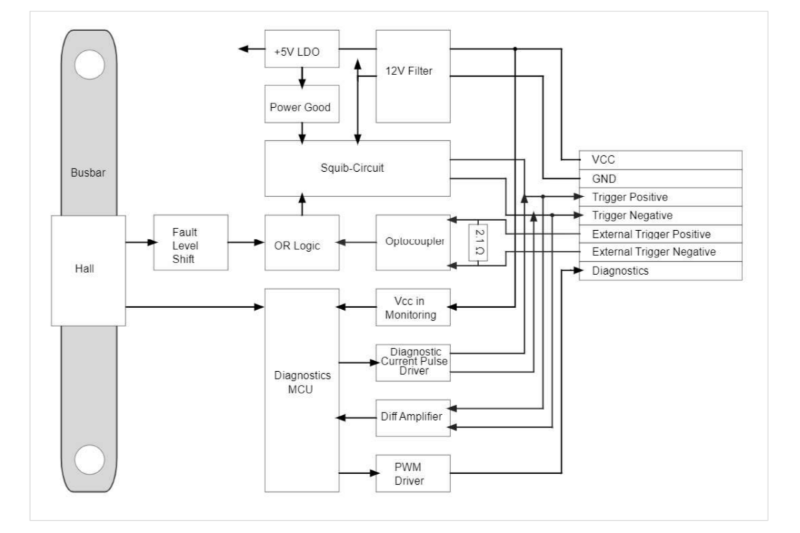
Functional block diagram of the CH1B050P pyro-fuse trigger. Image used courtesy of Littelfuse
System Integration and Applications
Littelfuse has positioned its sensors to complement its existing high-voltage circuit protection and power control components, including contactors, fuses, thyristors, and TVS diodes. Target applications span battery management systems, motor inverters, HV junction boxes, power relay assemblies, starter generators, and DC/DC and AC/DC converter modules.
Designers implementing these sensors will find them compatible with existing busbar mounting schemes and automotive connector standards. The scalable current ranges and configurable outputs support integration into both new platform designs and retrofit applications within legacy EV architectures. The combination of analog and digital output options provides design flexibility for systems requiring either direct analog interfacing or network-based communication with supervisory controllers. Industry-standard automotive qualification and functional safety compliance also address the growing requirements for accuracy, response time, and reliability in electric vehicle current-sensing applications.


