Meet Flux, the AI “Intern” Assisting in Concept to Creation for Hardware Design
The AI-powered hardware design platform can research parts, create schematics, and optimize supply chains; all while handling multi-step workflows that streamline the design process.
The integration of AI into engineering workflows continues to progress, with new tools emerging to support tasks previously necessitating manual input. Flux, a company specializing in AI-powered hardware design, has recently announced an updated version of its platform that introduces an AI assistant capable of handling multi-step hardware engineering tasks. The new tool, colloquially referred to as an AI “intern,” aims to streamline the design process from initial concept to a ready-to-build bill of materials (BOM).

Flux, the new AI “intern,” is designed to assist users by executing full, multi-step design workflows, including part research, schematic creation, and board routing. Image used courtesy of Flux
From Concept to Component Selection
The most notable update to the Flux platform is the ability of the AI to execute multi-step workflows. Previously, the tool was limited to one-off tasks. This new functionality allows the AI to serve as a copilot, guiding users through the initial stages of a project. The process begins with a focused conversation in which the user provides design requirements. The AI then refines these requirements, offering a range of options and discussing trade-offs. This interactive dialogue is meant to help users solidify their project specifications.
Once the requirements are clear, the AI begins its research. It can autonomously search for and evaluate components, which can be a significant time-saver in the early design phases. Instead of manually sifting through datasheets and part inventories, engineers can rely on the AI to propose a complete list of suitable components. The Flux tool can also generate a block diagram, which provides a high-level visual representation of the circuit, and then automatically transitions from this diagram to a complete BOM. This capability reduces the time spent on administrative tasks and allows engineers to focus on the more complex aspects of their design.
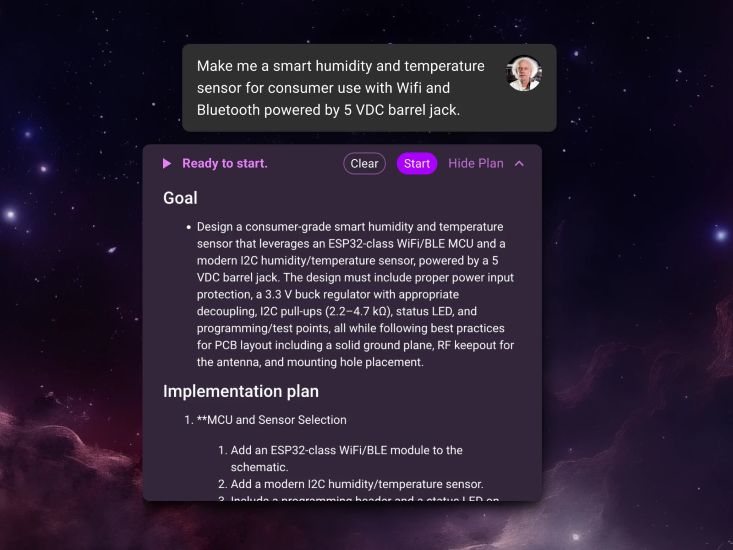
Users can tell Flux their project requirements, and it creates and follows a design plan, from researching parts to creating the layout and checking in for feedback along the way. Image used courtesy of Flux
Schematic Creation and Optimization
Beyond the initial planning stages, the new Flux AI can also assist in the creation of schematic designs. The tool can translate the chosen components and block diagram into a schematic, including the correct connections and pinouts. While users will still need to verify and refine the schematic, the AI can provide a strong starting point, eliminating a significant amount of manual labor. This feature can be particularly useful for quickly prototyping ideas or for creating standard circuit blocks that can be reused in multiple projects.
Furthermore, the platform’s AI capabilities extend to supply chain optimization. The tool can assist in selecting components based not only on technical specifications but also on their availability, cost, and lead times. This is a critical consideration in modern hardware development, where global supply chain issues can cause significant delays. By integrating this intelligence directly into the design process, Flux aims to help users create more resilient and manufacturable products.
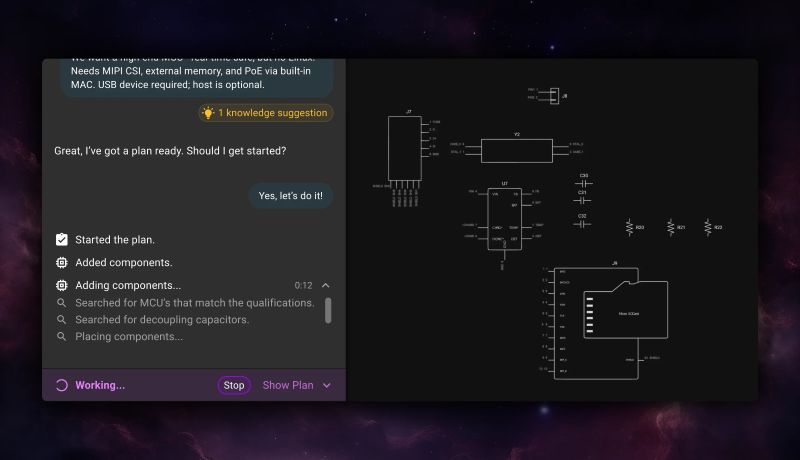
Flux can execute full, multi-step workflows inside the editor, handling structured tasks like component research, schematic wiring, and board routing so users can focus on higher-level decisions. Image used courtesy of Flux
AI-Assisted Hardware Design
The new capabilities of the Flux AI platform demonstrate a growing trend in the use of AI as an augmentation tool. By automating repetitive and time-consuming tasks like parts research and schematic generation, the tool allows users to focus on higher-level problem-solving and innovation. This can lead to faster design cycles and more robust, optimized products. The platform is designed to be a collaborative tool, where the AI works alongside humans, providing assistance and expertise.
The Flux AI intern’s capabilities have a wide range of potential applications. In product development, it can be used to quickly create product requirement documents and initial circuit designs. For educational purposes, it can help students understand the design process by providing guided assistance. In industry, it can optimize supply chains by identifying the best components based on a variety of factors. This shift towards AI-assisted hardware engineering suggests a future where these tools become an indispensable part of the design process, making that process more accessible and efficient for designers at all levels.