Broadcom Aims to Solve the Distributed AI Networking Challenge
The new Jericho4 router uses 3.2T HyperPorts and deep buffering to enable lossless RoCE performance, connecting massive XPU clusters across facilities separated by over 100 km.
Broadcom has begun shipping its Jericho4 ethernet fabric router, a purpose-built chip designed to address one of the biggest challenges in modern artificial intelligence: the physical and power limitations of a single data center. As AI models become increasingly massive, Jericho4 aims to provide the high-bandwidth, lossless, and secure backbone needed to connect over a million XPUs distributed across multiple facilities.
The Distributed AI Infrastructure Challenge
For electrical engineers and system architects, the explosive growth of AI has created a new class of design problems. Large-scale training clusters for foundation models now require power envelopes measured in the tens or even hundreds of megawatts, exceeding the capacity of most individual data centers. The logical solution is to distribute the compute resources—the XPUs (a general term for CPUs, GPUs, and other accelerators)—across several geographically separate locations.

Data centers continue to grow, but Broadcom aims to remove geographical boundaries for AI calculations. Image used courtesy of Wirestock (stock.adobe.com).
However, this distribution introduces a significant networking challenge. Traditional data center fabrics aren’t designed for the massive east-west traffic of AI workloads, especially not over the 100km+ distances between regional facilities. AI training is particularly sensitive to network performance; packet loss and unpredictable latency can bring a multi-million-dollar training run to a grinding halt. This requires a new type of router that can create a single, seamless, and lossless Ethernet fabric that spans cities, not just rooms.
HyperPorts and Lossless Fabric Over Distance
At the heart of the Jericho4 architecture is HyperPort technology, a novel approach to link aggregation. A single 3.2 Tbps HyperPort logically combines four individual 800GE links. For system designers, this is more than just a bigger pipe. It eliminates the complexities and inefficiencies of traditional load balancing across multiple links, which often leads to underutilization. By creating one unified logical port, Broadcom claims HyperPort can boost network utilization by up to 70% and simplify traffic management across the fabric.
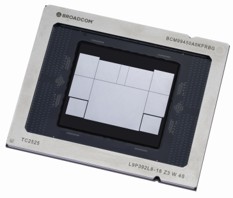
The Jericho4 — 51.2 Tb/s StrataDNX scalable Ethernet switch router. Image used courtesy of Broadcom.
To address the needs of AI workloads, Jericho4 is engineered for lossless performance using RDMA over Converged Ethernet (RoCE). It integrates deep buffering and sophisticated congestion control algorithms that prevent packet drops even under heavy load and across long distances. This ensures that the high-throughput, low-latency communication required for distributed training is maintained seamlessly over links stretching 100km or more, effectively making a collection of separate data centers behave as a single, unified compute cluster.
Silicon-Level Engineering and Security
Manufactured on a leading-edge 3nm process node, Jericho4 packs immense performance into an efficient power envelope. A key feature for board-level and system engineers is its advanced 200G PAM4 SerDes. Broadcom states the SerDes has industry-leading reach, which allows it to connect directly to optics without the need for external retimer chips. Eliminating these extra components directly translates to a lower system bill of materials (BOM), reduced power consumption, and improved overall reliability by simplifying the PCB layout.
With data flowing between physical facilities, security is paramount. Jericho4 addresses this by integrating line-rate MACsec encryption on every port. This “encrypt-everything” approach provides robust security without incurring a performance penalty, ensuring that the massive volumes of data moving between XPU clusters are protected from eavesdropping.
An Open, Standards-Based Ecosystem
Critically, Jericho4 is fully compliant with specifications from the Ultra Ethernet Consortium (UEC). This commitment to open standards ensures interoperability with a broad ecosystem of UEC-compliant NICs, switches, and software from various vendors. For engineers and infrastructure managers, this prevents vendor lock-in and fosters a competitive, innovative market. By positioning Jericho4 alongside its Tomahawk family of switches, Broadcom offers a complete portfolio to build open, standards-based AI networks, from the connections within a rack to the fabric that ties entire data centers together.
Feature image background used courtesy of Wirestock (stock.adobe.com).