
Murata Launches Isolated DC-DC Converter for PoE, Compliant With IEEE802.3af
The new series of compact, isolated DC-DC converters is specifically designed for Power over Ethernet (PoE) applications, providing a data and power solution for devices like security cameras and biometric readers.
Murata Manufacturing has expanded its line of power products with a new series of isolated DC-DC converters, addressing the growing demand for efficient power solutions in Power over Ethernet (PoE) applications. This launch directly responds to the increasing proliferation of network-connected devices, such as security cameras, access control systems, and biometric readers, which rely on PoE for data and power. The new converters are engineered to meet the IEEE802.3af standard, providing a compact and reliable power management solution for powered devices (PDs).
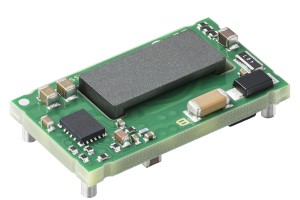
Murata’s new isolated DC-DC converter module is compliant with the IEEE802.3af standard. Image used courtesy of Murata
What Is Power Over Ethernet (PoE)?
Traditional power delivery methods for network devices often require separate power supplies and complex wiring. The PoE standard simplifies this by enabling power to be supplied over the same twisted-pair Ethernet cable that carries data, reducing installation costs and improving system flexibility. The challenge for many designers, however, is sourcing a power module that is not only physically small but also highly efficient and robust enough to handle the electrical isolation and transient conditions inherent in Ethernet systems.
Isolated DC-DC Converters for PoE
Murata’s new IEEE802.3af-compliant isolated DC-DC converters for PD are designed to integrate seamlessly into these systems. The isolated DC-DC architecture is critical for meeting the safety and performance requirements of the PoE standard, as it provides a galvanic barrier between the power source (the power sourcing equipment) and the end device (PD). This isolation prevents ground loops and protects sensitive electronics from common-mode noise and voltage spikes that can travel along the Ethernet cable.
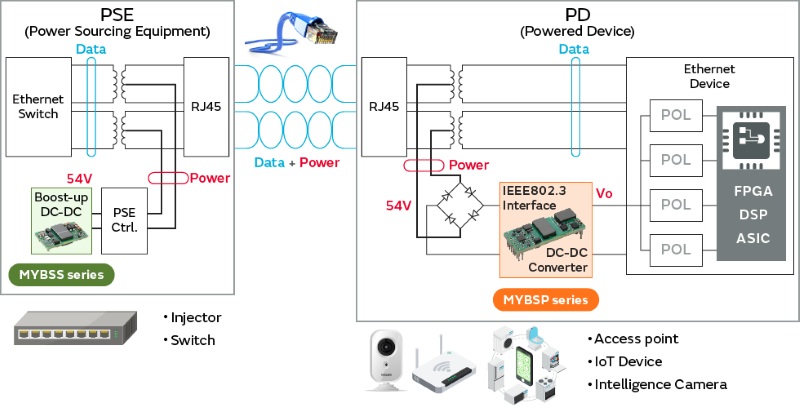
Murata’s new DC-DC converters enable data and power transfer via an Ethernet connection. Image used courtesy of Murata
A Compact Power Module
From a technical standpoint, the new converters are designed to offer a complete power solution within a small footprint. They are optimized for the typical input voltage range of a PoE system, with a 42.5 V to 57 V range for all models.
The module’s integrated design is particularly beneficial, as it simplifies the board layout and reduces the need for external components. The module incorporates filtering and protection circuitry, including undervoltage lockout, short-circuit protection, and over-temperature shutdown. These features are essential for a reliable system and can significantly shorten the design cycle. The high-efficiency design also helps to minimize heat generation, a critical factor for compact enclosures with limited thermal management capabilities.
The physical size of the converter is a notable feature. As the adoption of PoE expands into smaller devices and confined spaces, a compact form factor becomes a primary design constraint. The new modules are miniaturized, allowing them to be placed closer to the load, which can reduce I²R losses on the PCB traces and improve overall system efficiency.
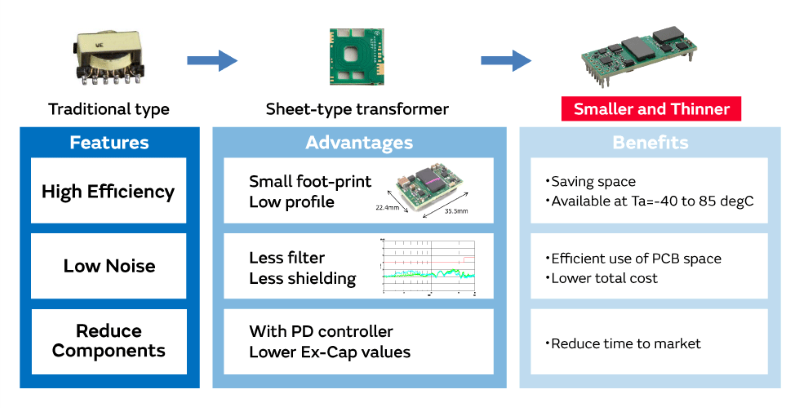
Murata’s isolated DC-DC converter for PoE utilizes a sheet-type transformer for compact efficiency. Image used courtesy of Murata
IEEE802.3af-Compliant Devices
Murata’s new isolated DC-DC converter series provides a practical solution for engineers working on a range of PoE-powered devices. The modules’ compliance with the IEEE802.3af standard, compact size, and integrated protection features make them well-suited for various applications. These include networked security cameras, VoIP phones, wireless access points, industrial IoT sensors, and building automation systems. The product represents a focused engineering effort to meet the specific demands of the modern PoE ecosystem, simplifying the power design process and enabling the creation of more compact and reliable end products.


