
Murata Scales Capacitance Density With Seven New AEC-Q200-Qualified MLCCs
The company’s latest automotive multilayer ceramic capacitors (MLCCs) offer increased capacitance for their size, targeting advanced driver assistance systems and autonomous vehicles.
As the complexity of advanced driver assistance systems (ADAS) and autonomous driving (AD) technologies grows, the demand for electronic components that offer higher performance in smaller footprints has intensified. Murata Manufacturing has responded to this need by beginning mass production of seven new multilayer ceramic capacitors (MLCCs) designed specifically for the automotive sector. These AEC-Q200-qualified components achieve what the company identifies as the largest capacitance available for their respective rated voltages and sizes.
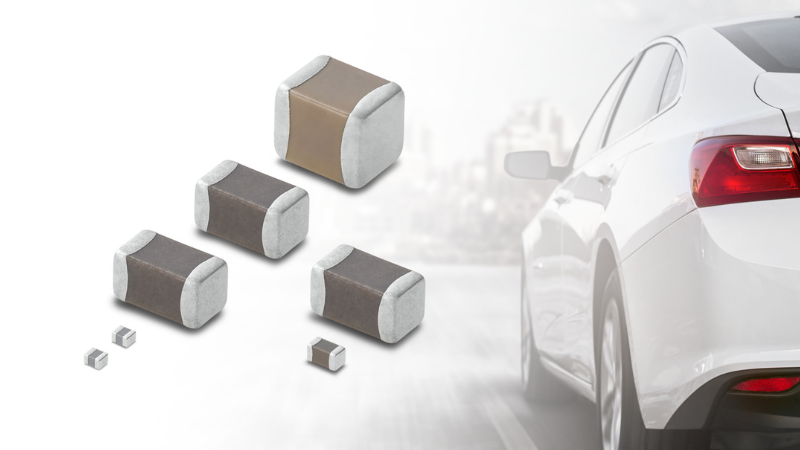
Murata has launched seven new AEC-Q200-qualified MLCCs for automotive applications. Image used courtesy of Murata Manufacturing
The integration of advanced sensing and processing technologies into modern vehicles requires a higher volume of MLCCs to ensure the stable operation of IC peripheral circuits. However, as component count increases, designers face increasingly stringent PCB space constraints. Murata’s new product lineup addresses these challenges by leveraging refined ceramic materials and improved particle uniformity to provide higher capacitance without increasing the component footprint.
Automotive Multilayer Ceramic Capacitors (MLCCs)
The new MLCC lineup includes five GCM series parts rated for low-voltage applications between 2.5 VDC and 4 VDC. These components are primarily intended for use in the peripheral circuitry of ADAS and AD systems where voltage fluctuations are common. Notable entries in this group include the GCM32ED70G227MEC4, a 3.2 mm × 2.5 mm capacitor that provides 220 µF at 4 VDC. In the 3.2 mm × 1.6 mm size, Murata has achieved 100 µF for both 2.5 VDC and 4 VDC ratings, representing a 36% reduction in mounting area compared to previous 3.2 mm × 2.5 mm alternatives.
For smaller form factors, the company introduced 0.6 mm × 0.3 mm MLCCs with a 2.2 µF capacitance at 2.5 Vdc and 4 Vdc. This allows for significantly higher density in miniaturized modules where space is a critical limiting factor.
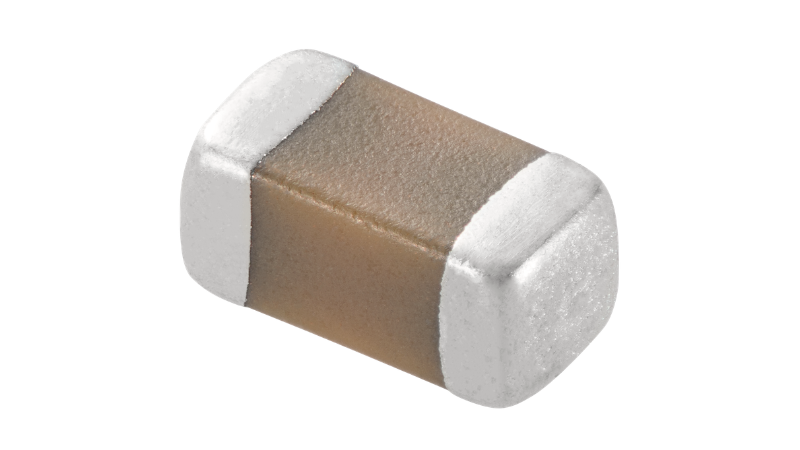
Murata has designed its MLCCs to provide high-density power stabilization for modern automotive electronics while saving critical PCB space. Image used courtesy of Murata Manufacturing
The medium-voltage lineup consists of two parts rated at 25 Vdc and targets in-vehicle power-line applications. The GCM155D71E105KE36 provides 1 µF of capacitance in a 1.0 mm × 0.5 mm package. This advancement enables a reduction in mounting area of approximately 61% compared to the 1.6 mm × 0.8 mm size typically required for this capacitance level. Additionally, a 3.2 mm × 1.6 mm component, the GCM31CC71E226ME36, offers 22 µF at 25 Vdc to support higher power density requirements.
Design Impact and Applications
By achieving higher capacitance in smaller packages, Murata intends for its MLCCs to stabilize power lines and IC operations while reducing the overall number of components on a PCB. This miniaturization contributes to lighter assemblies and lower material usage during manufacturing. The primary applications for these seven MLCCs include ADAS and AD controllers, sensing cameras, RADAR, LiDAR, and various in-vehicle infotainment systems. Beyond automotive use, their high capacitance density and reliability make these components suitable for power line stabilization in data centers and industrial servers.


