
Murata’s High Cutoff Frequency Common Mode Chokes for Automotive Interfaces
The new DLM11C_HH2 series of 0504-inch size common mode choke coils reduces high-frequency noise over 7.5 GHz in automotive high-speed differential interfaces like USB and SerDes.
The proliferation of advanced driver-assistance systems (ADAS) and integrated infotainment platforms has accelerated the demand for high-speed data transmission within the automotive sector. Modern vehicles are now routinely equipped with multiple Gbps-class interfaces, such as USB 3.2, LVDS, and SerDes, often serving features like in-vehicle entertainment and connection ports for personal devices. This rapid increase in data rate density necessitates sophisticated solutions for electromagnetic interference suppression, particularly for common-mode noise that can compromise signal integrity in differential pairs.
In response to this technical challenge, Murata has expanded its lineup of noise suppression components with the introduction of the DLM11C_HH2 series of chip common mode choke coils. This new series is engineered to address the stringent EMC requirements of high-speed differential interfaces found in contemporary and future automotive architectures.
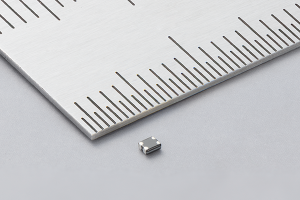
Murata has released the DLM11C_HH2 series of common mode chokes for use in high-speed differential interfaces in automotive applications. Image used courtesy of Murata Manufacturing
High Cutoff Frequency Common Mode Chokes
The DLM11C_HH2 series is characterized by its compact form factor, measuring in the 0504-inch size (1.25 mm by 1.0 mm). This small footprint is critical for integration into densely packed electronic control units and connectivity modules where real estate on the PCB is limited.
Murata utilized a proprietary lamination technology during development to achieve the requisite noise suppression characteristics. The primary technical strength of the DLM11C_HH2 series lies in its high cutoff frequency, which enables it to reduce high-frequency common-mode noise effectively. Specifically, the component is capable of suppressing noise above 7.5 GHz. This level of suppression targets high-order harmonics and stray emissions that become more pronounced and problematic as digital signaling transitions move into the multi-gigabit range.
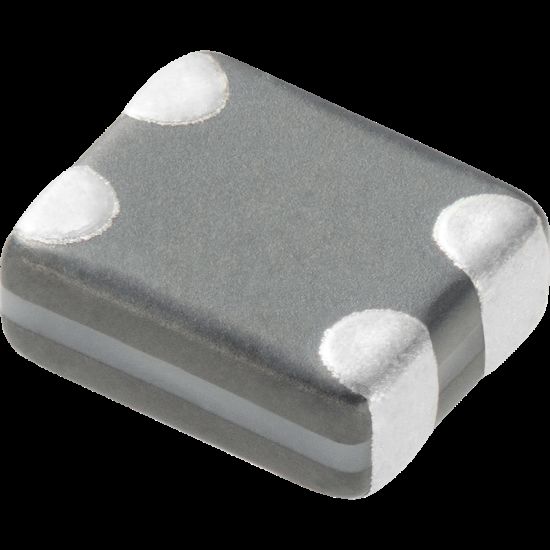
The DLM11C_HH2 series reduces high-frequency noise over 7.5 GHz. Image used courtesy of Murata Manufacturing
Noise Suppression in Automotive Interfaces
For engineers specifying the component, the series offers defined electrical parameters. Taking the DLM11CB120HH2 part number as an example, the component provides a common mode impedance of 12 Ω ±5 Ω when measured at 100 MHz. This impedance value is tailored for signal integrity applications where a high impedance characteristic in the common mode path is necessary to attenuate noise while maintaining minimal insertion loss for the differential signal. The component is also rated for a current of 100 mA.
In addition to its high-frequency noise suppression capabilities, the DLM11C_HH2 series meets the rigorous qualification requirements for use in vehicle electronics. The choke coils are AEC-Q200 compliant, confirming their suitability in harsh operating environments. This compliance is supported by an operational temperature range spanning from −55°C to +125°C. This thermal performance ensures stable operation across the full range of conditions encountered in automotive systems, including engine compartments and exposed cabin locations.
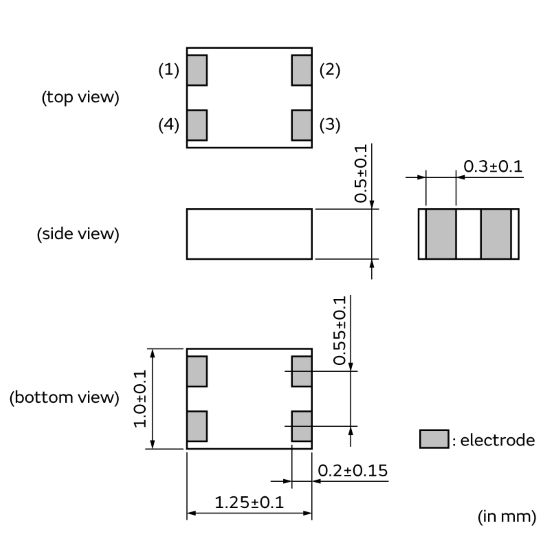
The chip common mode choke coils measure just 1.25 mm x 1.0 mm for use in space-constrained designs. Image used courtesy of Murata Manufacturing
Reducing High-Frequency Noise
Murata’s DLM11C_HH2 chip common mode choke coil series provides electrical engineers with a fact-based solution for mitigating high-speed common mode noise in modern automotive designs. The proprietary lamination technology enables high-frequency noise reduction above 7.5 GHz within a compact 0504-inch size. This combination of small dimensions and robust performance makes it suitable for integration into sensitive high-speed links, particularly LVDS, SerDes, USB, and HDMI interfaces, where maintaining signal integrity is paramount for connectivity and ADAS functionality.


