
Intelligent Tire Monitoring: BANF Integrates Silicon Labs’ Bluetooth LE SoC Into iSensor
The iSensor pairs the BG22 Bluetooth LE SoC with a proprietary wireless power transfer to deliver 4 kHz in-tire sensing for autonomous and commercial fleet vehicles, without the need for a battery.
For decades, tires have been one of the least instrumented components on any vehicle. Traditional tire pressure monitoring systems (TPMS) alert drivers when pressure drops below a threshold — useful, but nowhere near sufficient for detecting misalignment, incipient tread wear, or a lug nut vibrating loose at highway speed. The engineering barriers are real: the interior of a spinning tire is a hostile environment for electronics, with high heat, centrifugal forces, and steel belt construction that behaves like a Faraday cage. Coin cell batteries, the default power source for conventional TPMS sensors, can’t sustain the high data rates needed for meaningful real-time analysis.
Korean intelligent tire system company BANF, working with Silicon Labs, has tackled this problem at both the power-delivery and wireless-connectivity ends with a sensor platform called the iSensor.
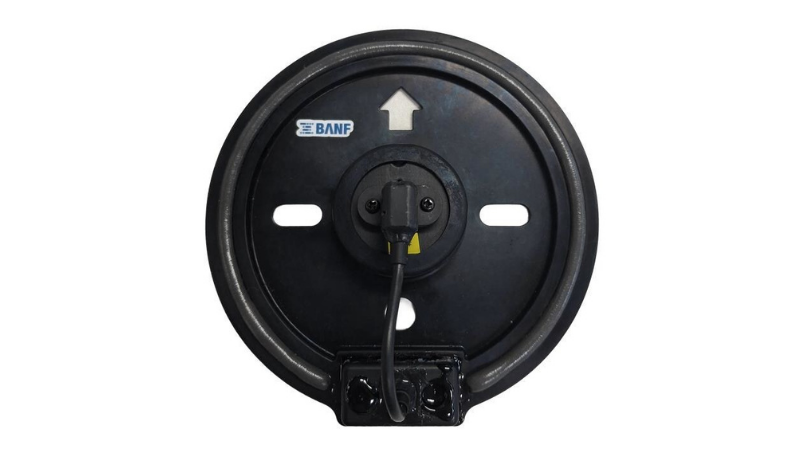
BANF has teamed up with Silicon Labs to create the iSensor tire pressure monitoring system. Image used courtesy of Silicon Labs
Introducing the iSensor for Intelligent Tire Sensing
The central innovation enabling the iSensor is BANF’s proprietary wireless power transfer architecture. A unit called the Smart Profiler mounts on the vehicle’s mudguard or fender and connects to the vehicle’s electrical system. It uses magnetic resonance to deliver continuous power to the iSensor embedded in the tire’s inner liner, without requiring the close static contact required by typical wireless charging standards. Because the Smart Profiler is optimized specifically for a rotating environment, it can maintain power delivery through the full range of wheel speeds.
The practical result is that the iSensor runs continuously without an onboard battery, sampling three-axis acceleration, pressure, temperature, and tread depth at 4 kHz. Compared to a traditional TPMS, this represents a significant increase in data density, enabling measurement capabilities that threshold-based systems cannot support, including slip angle detection, road surface classification, and load estimation.
BANF’s iSensor integrates Silicon Labs’ ultra-low-power Bluetooth LE BG22 SoC. Image used courtesy of Silicon Labs
BG22 Bluetooth LE SoC for Ultra-Low-Power Operation
The Silicon Labs BG22 Bluetooth LE SoC handles data processing and wireless communication inside the iSensor. Getting a reliable RF link out of a tire is non-trivial; steel belts substantially attenuate wireless signals, and the BG22’s receiver sensitivity is a key reason the design works in practice. The SoC’s ARM Cortex-M33 core enables edge processing directly on the sensor, so the system doesn’t transmit raw accelerometer noise. Instead, it filters the signal locally and sends concise alerts — wheel-nut loosening signatures, slip events, friction changes — to the Smart Profiler, with latency in the 20-100 ms range.
Security is handled through Silicon Labs’ Secure Vault technology integrated into the BG22. For AV fleets, where sensor data feeds directly into chassis control and autonomous driving algorithms, protection against data tampering or spoofing is a functional requirement, not just a compliance checkbox.
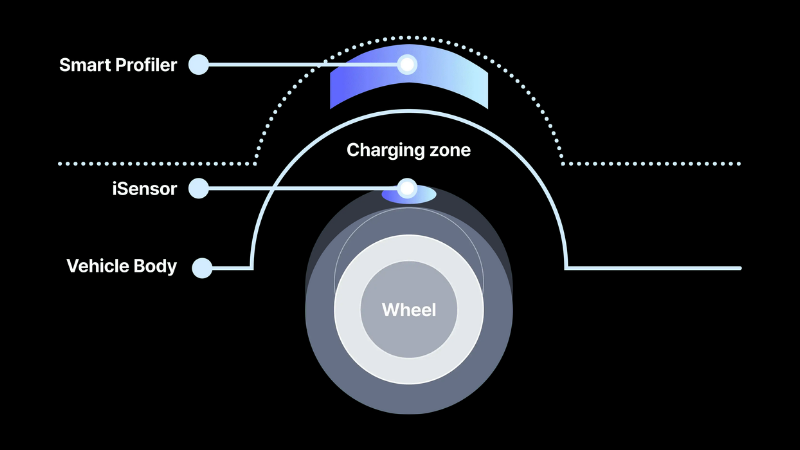
The Smart Profiler, attached to the fender or mudguard, wirelessly transfers power to the iSensor mounted in the tire. Image used courtesy of BANF
A TPMS for Fleet and Autonomous Applications
The case for high-resolution tire data is straightforward in commercial fleet operations: BANF’s figures indicate up to a 20% improvement in fuel efficiency from real-time pressure and alignment optimization, along with early detection of conditions that precede tire-related accidents. The iSensor also addresses a persistent challenge in dual-wheel commercial vehicles: conventional TPMS systems can struggle to distinguish between adjacent sensors. BANF pairs each tire with a dedicated Smart Profiler, sidestepping the auto-location ambiguity that plagues shared-channel systems.
For autonomous vehicles, the argument is more fundamental. A driverless system has no human driver to feel a pulling sensation or notice handling degradation. Real-time tire data from a platform like the iSensor can feed traction control and stability systems with ground-truth information that cameras and IMUs alone can’t provide. The BG22’s combination of low-power operation, edge compute capability, and security makes it a practical choice for embedding this kind of sensing at the wheel, one of the few places on a vehicle that still hasn’t been thoroughly digitized, that is, until now.


