
MWC 2026: Nordic Semiconductor Showcases Low-Power Cat 1 bis Module
The nRF93M1 is an LTE Cat 1 bis module delivering 10 Mbps downlink, Wi-Fi location services, eSIM support, and built-in nRF Cloud integration for asset tracking and IoT devices.
Nordic Semiconductor used Mobile World Congress 2026 (March 2-6 in Barcelona) as the stage to introduce its nRF93M1, a new family of LTE Cat 1 bis modules aimed at IoT applications that need more throughput than LTE-M or NB-IoT can offer, without abandoning the low-power design principles Nordic is known for.
Cat 1 bis, standardized under 3GPP Release 14, uses a single antenna rather than the two required by the original Cat 1 specification, which makes it a practical choice for space-constrained IoT hardware. The nRF93M1 supports both FDD and TDD LTE bands across a wide 617 to 2,690 MHz frequency range, operates at Power Class 3 (23 dBm), and is certified for global and regional deployments under GCF and PTCRB.
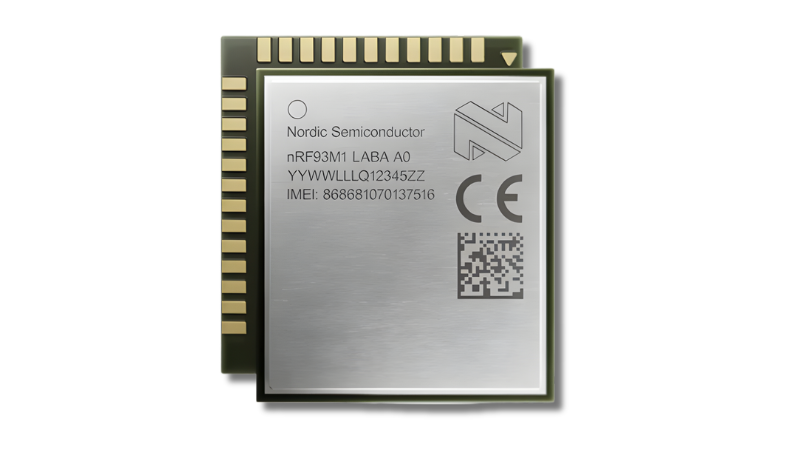
Nordic Semiconductor unveiled its nRF93M1 LTE Cat 1 bis module at Mobile World Congress 2026. Image used courtesy of Nordic Semiconductor
Two Variants, One Global Footprint
Nordic is offering the nRF93M1 Cat 1 bis module in two hardware variants to address different regional requirements. The nRF93M1-LABA covers LTE bands for Europe, Asia, the Middle East, and Africa, while the nRF93M1-LACA extends coverage with a wider band set and additional certifications for worldwide deployments. Both variants are (e)UICC/eSIM compliant with the SGP.32 IoT profile, as well as a SoftSIM framework for deployments where a physical SIM isn’t practical.
On the connectivity side, peak data rates reach 10 Mbps on the downlink and 5 Mbps on the uplink — a meaningful step up from LTE-M’s typical ceiling of around 1 Mbps. Peripheral interfaces include high-speed USB, UART, GPIO, and a coexistence interface for designs that share RF resources with other radios.
Location Without GNSS
One of the more interesting aspects of the nRF93M1 is its approach to location services. Rather than integrating a GNSS receiver, the module uses Wi-Fi scanning and cellular eCID (Enhanced Cell ID) positioning, both managed through Nordic’s nRF Cloud platform. For many asset-tracking and logistics applications, this kind of location capability is sufficient and avoids the power overhead of maintaining a full GNSS subsystem.
Power consumption is managed through standard cellular power-saving mechanisms, including eDRX and PSM, as well as Nordic-specific optimizations layered on top.
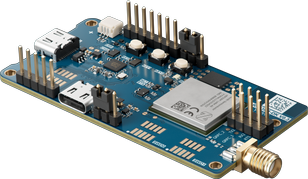
Users can begin development with the nRF93M1 development kit. Image used courtesy of Nordic Semiconductor
nRF Cloud Integration and Developer Tools
Out of the box, the nRF93M1 connects to Nordic’s nRF Cloud platform, which handles over-the-air firmware updates, remote debugging, modem observability, and location services. The module communicates with a host MCU via AT commands over UART or USB, keeping the integration model familiar to developers who have worked with other Nordic cellular modules.
Nordic is also releasing the nRF93M1 Development Kit, which pairs the module with an nRF54L15 host MCU. Development is supported through the nRF Connect SDK and Nordic’s existing suite of developer tools.
Target applications listed by Nordic include asset tracking, gateways, fleet management systems, security devices, advanced metering infrastructure, and consumer electronics — essentially any category where LTE-M or NB-IoT throughput is a constraint but a full Cat 4 or higher modem would be overkill.
Data-Intensive Cellular IoT
Lead customers are currently integrating the nRF93M1 into products, and Nordic has scheduled general availability for mid-2026. The nRF93M1 is part of a broader portfolio expansion Nordic announced at Mobile World Congress 2026, which also included updates to the nRF91 series and the introduction of the nRF92 series targeting next-generation LTE-M/NB-IoT applications with satellite NTN support and an integrated NPU.


