
New Hybrid ReDriver ICs Restore High-Speed Video Signals
Supporting up to 12 Gbps for HDMI 2.1, these ReDrivers from Diodes Inc. enable 8K video and simplify design with intelligent power management and a flexible hybrid operating mode.
As digital video standards like HDMI 2.1 continue to push the boundaries of bandwidth and resolution, maintaining signal integrity over PCB traces and cables becomes a critical design challenge. In response to this, Diodes Incorporated has introduced the PI3HDX12311 and PI3HDX6311, two new 3.3 V, quad-channel hybrid ReDrivers aimed at restoring signal quality for high-speed video transmission. These devices are designed as intermediaries between a video source, such as a GPU, and a display sink, compensating for the signal degradation that occurs over physical transmission lines.
Targeting High-Resolution Video with Hybrid Operation
The PI3HDX12311 is the higher-performance of the two, catering to the demands of HDMI 2.1 with support for up to 12Gbps per channel via the Fixed Rate Link (FRL) protocol. This enables an aggregate data rate of 48 Gbps, which is a key enabler for 8K video resolution. The device also supports Transition-Minimized Differential Signaling (TMDS) at up to 6 Gbps, ensuring backward compatibility. For designs targeting HDMI 2.0, the PI3HDX6311 provides a solution with a 6 Gbps per-channel TMDS data rate. Both devices also support DisplayPort Dual-Mode (DP++) V1.1 level shifting.
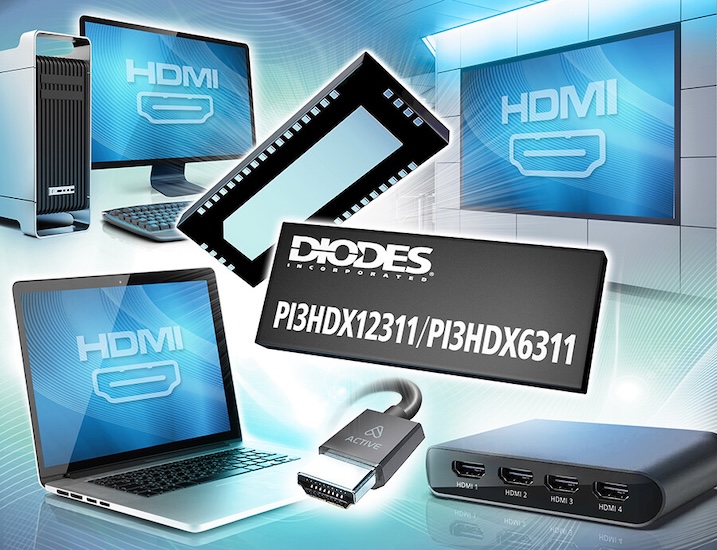
Diodes’ new ReDrivers improve signal quality by restoring lost signal strength and compensating for signal degradation over longer cable runs or PCB traces. Image used courtesy of Diodes Incorporated.
A primary technical feature of these new ReDrivers is their hybrid operating mode, which simplifies design across different HDMI standards. For legacy HDMI 1.4 applications, the devices function as limited ReDrivers. In this mode, the differential output swing is pre-defined by pin-strapping settings, ensuring that the signal levels remain compliant with the HDMI 1.4 specification at the connector.
In contrast, for HDMI 2.0 and HDMI 2.1 applications, the ReDrivers operate in a linear mode. Here, the output swing is directly proportional to the received signal, a characteristic that allows the device to function as a trace canceller. This linear mode is transparent to the link training signals, which is a necessary condition for modern high-speed protocols. The ability to switch between these two modes offers designers flexibility and reduces the need for multiple discrete components to handle different standards.
Self-optimization Monitoring for Superior Power Management
Beyond their core redriving function, the PI3HDX12311 and PI3HDX6311 incorporate several features aimed at simplifying system integration and managing power. They include integrated Display Data Channel listeners that snoop the HDMI Forum Vendor Specific Data Block (HF-VSDB) and Status and Control Data Channel Structure offset registers. This allows the devices to automatically select optimal transmitter settings for power and signal integrity.

Block diagram of Diodes PI3HDX12311 3.3V Quad-Channel Hybrid ReDriver. Image used courtesy of Diodes Incorporated.
Power consumption is further managed by monitoring the hot-plug-detect (HPD) pin. If the HPD signal remains low for more than 2ms, the devices automatically enter a low-power state, reducing quiescent power draw when no display is connected. The devices also provide flexibility with AC or DC coupling of the input and output signals, with built-in short-circuit detection available for DC-coupled configurations.
The physical footprint of the new ReDrivers is a compact 2.85 mm x 4.5 mm in a 32-pin X1-QFN2845 package, making them suitable for space-constrained designs. They are rated for operation across a temperature range of -40°C to +70°C and have a typical power dissipation of 726 mW.
Summary
By combining high-speed capabilities with intelligent, flexible operation and a small form factor, Diodes’ new hybrid ReDrivers provide a measured solution for engineers tackling the challenges of modern high-resolution video interfaces.


