
Nordic Integrates nuSIM Into nRF91 Series SiPs, Boosting Cellular IoT Robustness
This leverages the secure Arm TrustZone to eliminate the physical SIM and socket, reducing BOM, minimizing device size, and increasing ruggedness and power efficiency for high-reliability deployments.
The integration of subscriber identification functionality has long posed a challenge for engineers designing cellular Internet of Things (IoT) devices. Traditional SIM card integration requires a physical socket and a removable card, introducing both mechanical failure points and non-trivial Bill of Materials (BOM) overhead.
To address these concerns, Nordic Semiconductor has announced the integration of the nuSIM standard into its nRF91 Series cellular IoT System-in-Packages (SiPs), specifically the nRF9151 and nRF9160 modules. The nuSIM approach utilizes a software SIM (iSIM) architecture, moving the provisioning and credential management process from external hardware into the device’s main processor.
The nuSIM integrated SIM eliminate the need for a physical SIM and socket. Image used courtesy of Nordic Semiconductor
Architecture and Implementation
The nuSIM standard is implemented as a dedicated software component operating within the secure, protected memory area of the application processor. In the nRF91 Series, this secure enclave is the on-chip Arm TrustZone® environment. By leveraging the TrustZone, SIM credentials are encrypted and isolated from the main application, satisfying industry security requirements for integrated SIM solutions. This integration method eliminates the need for both the physical SIM card and the associated socket, directly reducing the hardware component count for the cellular module interface.
The integration process for developers involves a one-time software action utilizing the nRF Connect SDK (Software Development Kit). The firmware is modified to include the Redtea Mobile nuSIM integration library, which manages the operating system in accordance with the open nuSIM specification.
Engineering Gains in BOM and Robustness
The shift from an external hardware component to a software-defined function yields quantifiable engineering benefits, particularly for devices deployed in challenging environments.
By removing the SIM socket, product developers can achieve:
- Reduced BOM and Board Space: The component and associated routing for the external SIM hardware are eliminated, allowing for smaller board footprints and lower unit manufacturing costs.
- Enhanced Mechanical Robustness: The physical socket is a common point of mechanical failure, susceptible to vibration, shock, and thermal cycling. For devices in industrial monitoring, smart agriculture, or water metering applications, eliminating this socket enhances resistance to corrosion and physical ingress.
- Lower Power Consumption: The nuSIM implementation reportedly requires less operating power than a traditional physical SIM. While the nRF91 Series modules are optimized for ultra-low power consumption, this reduction in the cellular interface current draw can further extend the field life of battery-powered devices.
To ensure functional reliability, the nuSIM implementation on the nRF91 Series has undergone a security evaluation and certification process by the independent testing institute TÜV Nord in Germany.
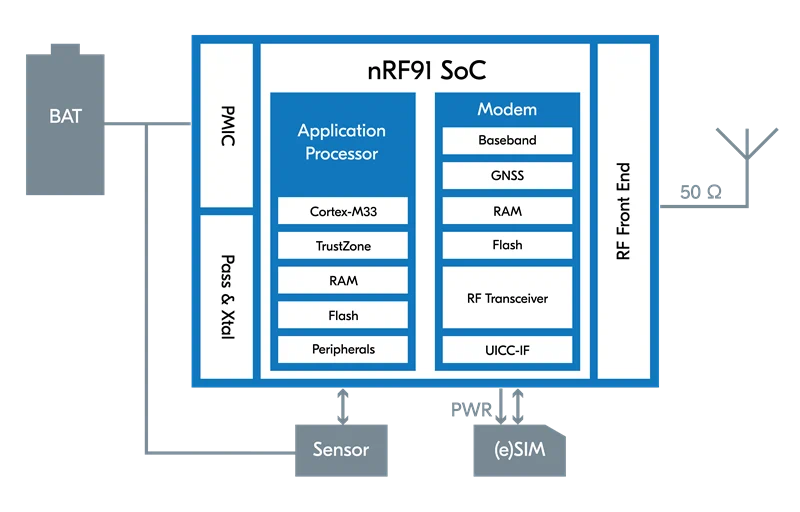
The nRF91 SoC supports implementation of the nuSIM software SIM. Image used courtesy of Nordic Semiconductor
Streamlined Supply Chain and Digital Provisioning
Beyond the hardware improvements, the nuSIM integration streamlines the cellular IoT device supply chain through a fully digital provisioning workflow. Instead of managing unique physical SIMs that must be pre-installed or provisioned per carrier, the manufacturer manages the secure download of a SIM profile directly onto the module during the factory assembly phase.
After the application firmware containing the nuSIM is loaded onto the nRF91 module, a specialized software utility is used to prepare the device to receive its unique profile. The tool then securely connects to a selected Mobile Network Operator (MNO) and downloads the encrypted profile to the secure element within the nRF91 SiP. Deutsche Telekom is the first MNO to provide commercial profiles for this integrated nuSIM solution, establishing an initial platform for developers looking to move to this architecture.
Conclusion and Applications
The integration of the nuSIM standard into Nordic Semiconductor’s nRF91 Series modules represents a technical refinement in cellular IoT design by consolidating connectivity security functions into the SiP’s existing hardware security framework. By utilizing the Arm TrustZone for secure credential storage and eliminating the physical SIM hardware, the solution reduces overall BOM cost, saves board space, and significantly improves the mechanical reliability and power efficiency of the device. This architecture is well-suited for high-reliability, long-term deployment applications. These include smart metering, utility monitoring, remote asset tracking, and industrial sensor networks where device size, ruggedness against harsh environmental factors (corrosion and vibration), and minimal power draw are critical design criteria.


