
PolarBerry – A secure PolarFire SoC (FPGA + RISC-V) Linux-capable SBC and SoM
PolarBerry is a System on Module (SoM) SBC utilizing the Microsemi PolarFire SoC, which integrates a low-power FPGA with a highly-secure, four-application-core, 64-bit RISC-V subsystem that is Linux-capable. Application Flexibility PolarBerry is designed to be application-flexible, while also being quick to use and deploy.
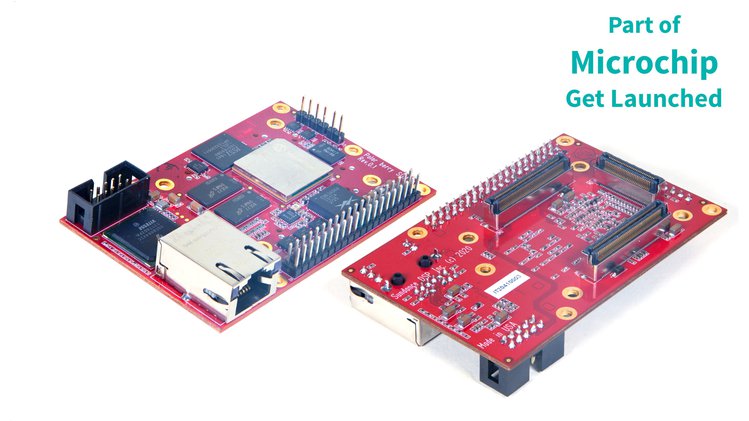
PolarBerry is a System on Module (SoM) SBC utilizing the Microsemi PolarFire SoC, which integrates a low-power FPGA with a highly-secure, four-application-core, 64-bit RISC-V subsystem that is Linux-capable.
Application Flexibility
PolarBerry is designed to be application-flexible, while also being quick to use and deploy. Its combination of features make it perfect for applications that require high-performance but a low power draw, defense-level security, a real-time, deterministic RISC-V processor that’s capable of Linux, a small physical profile, immediate connectivity, or custom extensibility – such as those in the autonomous vehicle or defense industries.
FPGA, RISC-V, and Linux
PolarBerry with its PolarFire SoC provides a system with hardcore, deterministic, coherent RISC-V processing and programmable logic – enabling real-time systems and Linux with unparalleled security features.
SBC and SoM Form-factor
As the board is essentially an SBC in a SoM form-factor, it can be utilized as a standalone module or along with a carrier board like the Sundance DSP SE215 carrier or one of your own designs.
A Raspberry Pi connector, two CAN bus interfaces, and an RJ45 port for Ethernet allows PolarBerry to tap into extensive ecosystems, and its Samtec connectors provide high-speed communication to a carrier board for powerful peripheral customization.
For example, PolarBerry works well with our SE215 PCIe SoM carrier board which provides access to an FMC and additional interfaces like an SFP+ module.
Specifications
- SoC: Microsemi PolarFire FPGA MPFS250T-FCVG484
- 5 x RISC-V cores in a deterministic, coherent cluster
- 1 x RV64IMAC monitor core
- 4 x RV64GC application cores
- 254K x logic elements (4LUT + DFF)
- 784 x math blocks (18 x 18 MACC)
- 16 x SERDES lanes at 12.5 Gbps
- 12 W maximum power consumption
- Built-in oscillator for configuration, etc.
- 5 x RISC-V cores in a deterministic, coherent cluster
- Security:
- DPA-resistant bitstream programming
- DPA-resistant secure boot
- Anti-tamper
- DPA-resistant crypto-coprocessor
- CRI DPA countermeasures pass-through license
- Memory: Micron MT40A1G16WBU-083E:B
- 4 GB of 32-bit wide DDR4 memory
- Storage:
- 128 Mb SPI Serial NOR flash for storing boot image
- 4 Gb eMMC for general use
- Clock Sources:
- 1 x 25 MHz XO with ±10 ppm stability over temperature, as reference
- 4 x Silicon Labs SI5338A programmable clock sources, providing flexible clocking to FPGA and high-speed transceivers
- Transceivers:
- 4 x high-speed, low-power transceivers from 250 Mbps – 12.7 Gbps
- Expansion Interfaces:
- High-speed IO: 3 x high-speed Samtec connectors
- Bank 1 IO from FPGA including ULPI
- JTAG
- SPI interface from FPGA
- 100/1000BASE-T interface
- Raspbery Pi connector: 40-pin (2 x 20) male headers with standard .1″ (2.54 mm) pitch
- 1 x I²C from MSS part
- 1 x UART from MSS part
- 20 x GPIOs from PL part(can be assigned to SPI, UART, CAN or another interface from MSS)
- 6 x GPIOs from MSS part
- All RPI signals are 3.3 V logic
- CAN: 6-pin (1 x 6) male headers with standard .1″ (2.54 mm) pitch
- 2 x CAN 2.0 PHY
- Ethernet: RJ45 connector
- 100/1000BASE-T
- High-speed IO: 3 x high-speed Samtec connectors
- Power: Intel EN63A0QA
- Operates on 5 or 3.3 V input
- Maximum power consumption of module is 16 W
- Dimensions: 55 x 85 mm
- Temperature range: -20°C to +65°C
The project will soon lauch on CrowdSupply.com, get more details here: https://www.crowdsupply.com/sundance-dsp/polarberry


