
Qualcomm Introduces Satellite Support for Snapdragon Wearable Platforms
Qualcomm Technologies has integrated NB-NTN satellite support into its Snapdragon W5+ Gen 2 and W5 Gen 2 wearable platforms, enabling users to send and receive emergency messages in remote locations.
Qualcomm Technologies has updated the wearable technology market with the introduction of the Snapdragon W5+ Gen 2 and W5 Gen 2 wearable platforms. The new platforms feature NB-NTN emergency satellite messaging and enhanced GPS accuracy for users in remote locations.
The W5+ Gen 2 and W5 Gen 2 are also designed to introduce greater flexibility in managing power budgets and enable the creation of smaller, more power-efficient devices with longer battery life. They feature multiple low-power states, such as ‘Deep Sleep’ and ‘Hibernate,’ to maximize operational time.
Qualcomm has designed its Snapdragon W5+ Gen 2 and W5 Gen 2 wearable platforms to support NB-NTN satellite messaging and GPS location accuracy. Image used courtesy of Qualcomm Technologies
Snapdragon W5+ Gen 2 and W5 Gen 2
Qualcomm’s new Snapdragon W5+ Gen 2 and W5 Gen 2 wearable platforms are built on an efficient 4 nm process, which is the foundation of their improved performance and power management. The architecture is centered around a Qualcomm Hexagon V66K processor, and the W5+ Gen 2 features a dedicated, always-on, low-power co-processor. This dual-processor design allows the co-processor to handle sensor-related tasks, offloading work from the main CPU.
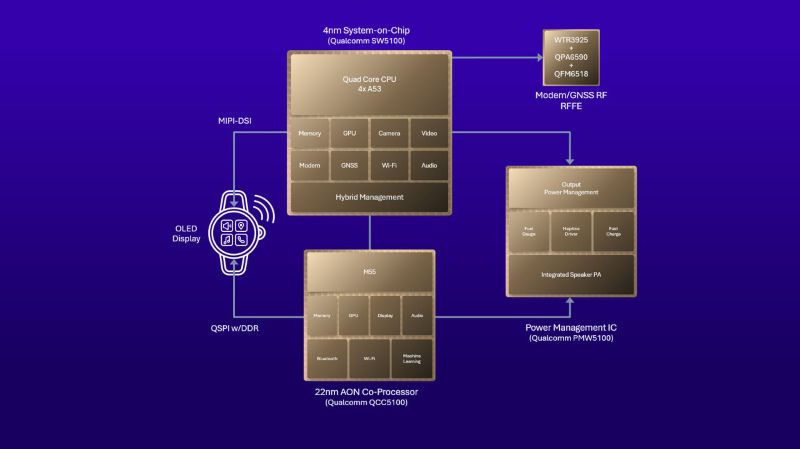
The Snapdragon W5+ Gen 2 platform has a low-power co-processor for enhanced sensor support. Image used courtesy of Qualcomm Technologies
Satellite Connectivity and Location Services
A key feature of Qualcomm’s new Snapdragon W5+ Gen 2 and W5 Gen 2 is the integration of Narrowband Non-Terrestrial Network (NB-NTN) satellite connectivity. This technology enables two-way emergency messaging directly from a wearable, even in areas without cellular or Wi-Fi coverage. This integrated functionality addresses a critical safety and communication need for users in remote locations.
The Snapdragon platforms also feature Location Machine Learning 3.0, which, according to Qualcomm, improves GPS accuracy by up to 50% in challenging environments like urban canyons. This is accomplished by combining signals from multiple satellite systems, including GPS, Beidou, Galileo, and GLONASS, with machine learning algorithms.
Additionally, an optimized RF Front End (RFFE) not only aids in location accuracy but also reduces its physical size by approximately 20%, contributing to a more compact overall design.

The Snapdragon wearable platforms feature an optimized RF front end, which reduces their footprint and power usage. Image used courtesy of Qualcomm Technologies
Advancing Wearable Design
The technical specifications and features of the new Snapdragon wearable platforms aim to influence the design of future wearable devices. The inclusion of NB-NTN support and improved location services provides a foundation for creating wearable technology with enhanced safety and reliability features.
The Snapdragon platforms are also optimized for the latest version of Wear OS, and include a range of connectivity options and 4.5 GB of eMMC storage. The focus on a highly efficient and integrated architecture gives engineers the tools to develop devices that are both more capable and more compact, supporting the continued evolution of the wearable technology market.


