
Extreme Temperature Probe Tips Measure Direct Current in Harsh Environments
Tektronix has added extreme temperature probe tips to its IsoVu isolated current probe platform, enabling direct current measurements across a wide temperature range from -40°C to 125°C.
Tektronix has expanded its IsoVu isolated current probe lineup with extreme temperature probe tips for current measurements in thermally demanding test environments. The addition addresses a common workaround in power-electronics validation: engineers testing under thermal-cycling conditions have often had to infer current from voltage measurements. This method can introduce additional noise and reduce accuracy, particularly when working with fast-switching wide bandgap devices.
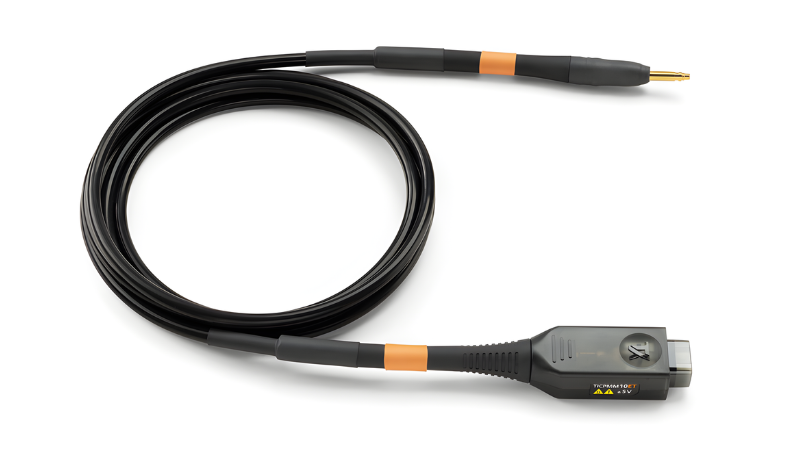
Tektronix has expanded its IsoVu isolated current probe platform with extreme temperature probe tips. Image used courtesy of Tektronix
Extreme Temperature Probe Tips
The new extreme temperature (ET) probe tips extend Tektronix’s IsoVu isolated current probe platform’s measurement capability to a continuous operating range of -40°C to 125°C, making them suitable for use inside environmental chambers during thermal cycling and reliability testing. A six-foot cable connects the tip, positioned inside the chamber, to the device under test, the probe body, and the oscilloscope, all located outside. Tektronix specifies that the working zone within the chamber should begin at least 330.2 mm from the probe head to prevent environmental chamber access-port leakage from affecting the probe.
The tips use MMCX connectors and are compatible with the existing IsoVu probe bodies (TICP025, TICP050, and TICP100), which offer bandwidths of 250 MHz, 500 MHz, and 1 GHz, respectively. The ET tips themselves support bandwidth up to 700 MHz, as shown in the frequency response data from the datasheet.
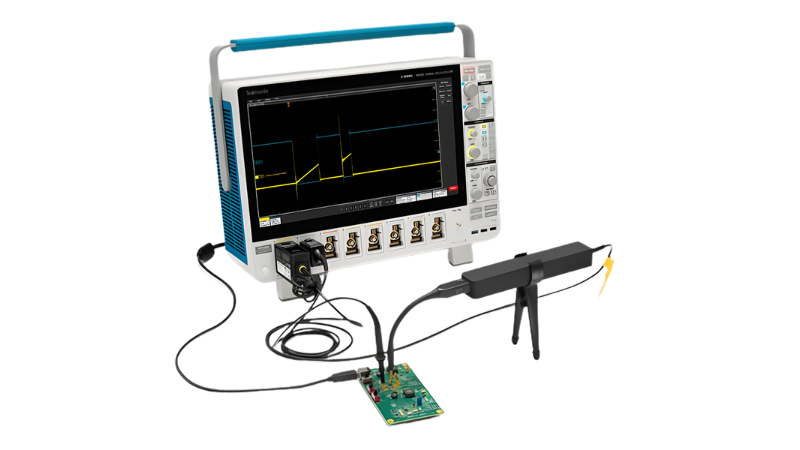
The IsoVu isolated current probes are available in three bandwidths: 250 MHz, 500 MHz, and 1 GHz. Image used courtesy of Tektronix
Attenuation Options and Galvanic Isolation
The ET probe tips are available in three attenuation configurations: 1X (TICPMM1ET), 10X (TICPMM10ET), and 100X (TICPMM100ET), corresponding to differential input voltage ranges of ±0.5 V, ±5 V, and ±50 V, respectively. This flexibility allows the same probe body to cover a wide range of current magnitudes depending on the shunt resistance in use.
Like the standard IsoVu tips, the ET variants measure current indirectly by sensing the voltage drop across a precision shunt resistor. The IsoVu architecture uses complete galvanic isolation between the probe tip and the oscilloscope, eliminating ground loops and delivering CMRR figures that, for the ET tips, remain above 80 dB across much of the operating frequency range before rolling off at higher frequencies.
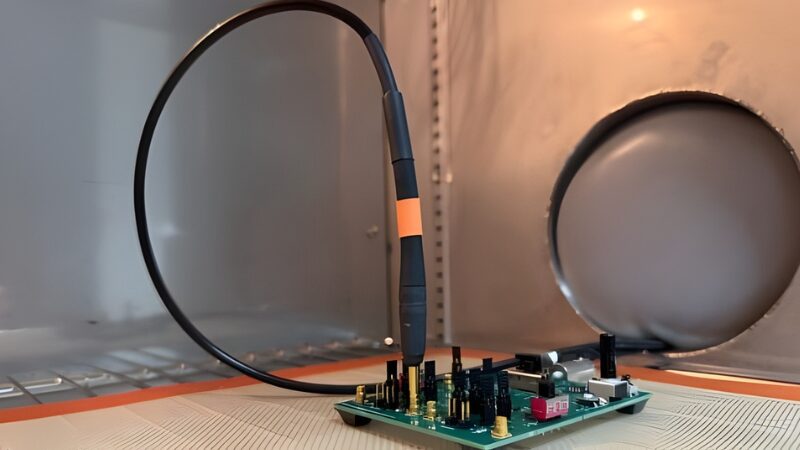
The ET probe tips perform direct current measurements in extreme environments, including EV power systems and high-temperature industrial applications. Image used courtesy of Tektronix
Extreme Temperature Environments
The primary use cases called out by Tektronix include EV power systems, aerospace and defense electronics, satellite systems, and industrial applications where devices must be characterized across their full operating temperature range. In these contexts, capturing switching transients and dynamic current behavior at temperature, rather than extrapolating from room-temperature data, can be significant for both design validation and reliability testing.
The platform’s low-noise architecture also lends itself to low-current measurements, where the probe is paired with a higher-value shunt to reduce the noise floor in amperes. With a 1 Ω shunt at a 20 MHz bandwidth, the datasheet lists a noise floor of 21 µA RMS, which is relevant for standby current monitoring in battery-powered systems undergoing temperature testing.
High-Temperature Measurement Solutions
The ET probe tips are compatible with the 4, 5, and 6 series MSO oscilloscopes via the existing IsoVu probe bodies. The TekVPI interface allows probe configuration directly from the oscilloscope front panel. Standard accessories ship with each probe; the ET tips are listed as optional recommended accessories with part numbers TICPMM1ET, TICPMM10ET, and TICPMM100ET.


