
Rohm Safeguards High-Resolution Cameras With Schottky Barrier Diode
The new RBE01VYM6AFH Schottky barrier diode combines ultra-low forward voltage and low reverse leakage current to protect high-resolution image sensors in harsh industrial and automotive applications.
The increasing precision required in advanced driver-assistance systems (ADAS) cameras and other high-resolution imaging devices introduces unique circuit protection challenges. Specifically, image sensors, particularly under bright light exposure when the main system power is off, are susceptible to damage from induced photovoltaic voltage. Protecting against this requires a robust, low-clamping mechanism.
Rohm Semiconductor has developed the new RBE01VYM6AFH Schottky barrier diode (SBD) to address this constraint by employing a redesigned, proprietary device structure.
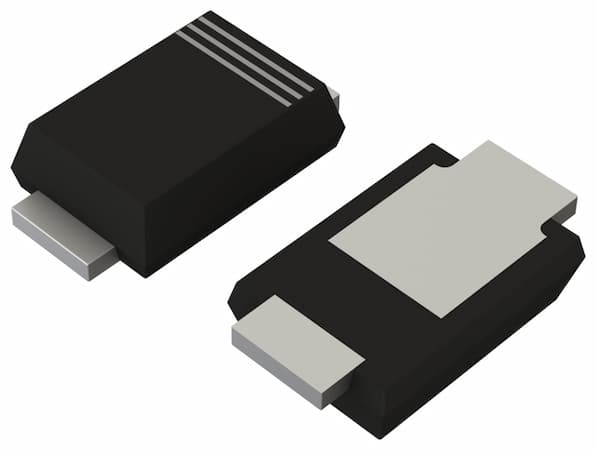
Rohm’s RBE01VYM6AFH SBD is housed in a 2.5 mm x 1.4 mm x 0.6 mm flat-lead SOD-323HE package. Image used courtesy of Rohm Semiconductor
Schottky Barrier Diodes (SBDs)
Engineers traditionally rely on SBDs for their fast switching characteristics and low forward voltage (VF), which makes them suitable for clamping and reverse protection. However, the core design constraint in SBDs involves a reciprocal relationship between VF and reverse leakage current (IR). Designing for an extremely low VF to ensure effective clamping typically results in a high IR.
In high-temperature environments, such as those found in automotive compartments, an elevated IR is a significant liability. The resulting leakage current generates heat, which further increases the IR in a positive feedback loop, leading to the risk of thermal runaway and device failure. To ensure long-term reliability and stability, particularly in AEC-Q101 qualified components, a solution must simultaneously achieve low VF for protection and tightly controlled low IR to mitigate thermal risk during normal operation.
The RBE01VYM6AFH SBD
Rohm’s new RBE01VYM6AFH SBD centers on adapting the low-VF characteristics typically found in larger rectification SBDs and applying them effectively in a small-signal protection context while drastically suppressing the resulting IR. This proprietary architecture modulates the Schottky junction properties to minimize the inherent trade-off.
The result is a device engineered for high-reliability protection applications. Under typical operating conditions (Tj =25°C), the diode exhibits a maximum VF of just 200 mV at an operating current of IF =7.5 μA. Critically, the maximum reverse current (IR) is limited to 30 μA at a reverse voltage (VR) of 3 V.
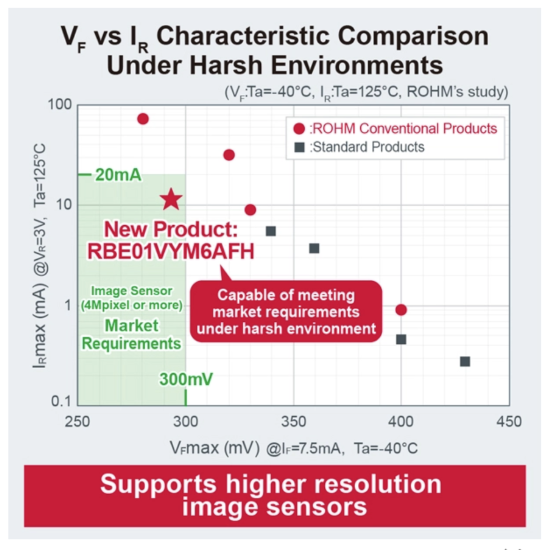
The RBE01VYM6AFH SBD is built for use in harsh automotive and industrial applications. Image used courtesy of Rohm Semiconductor
Performance in Harsh Conditions
For automotive and industrial applications where temperature swings are common, the diode’s performance across the operating temperature range is paramount. The RBE01VYM6AFH maintains a VF of less than 300 mV even at temperatures as low as Ta=−40°C.
More importantly for thermal stability, the device demonstrates suppressed leakage current performance at the maximum junction temperature of 125°C. By achieving a highly-controlled IR at elevated temperatures, the diode significantly reduces the probability of thermal runaway, thereby supporting long-term reliability in high-heat modules. The device is rated for a maximum repetitive peak reverse voltage (VRM) of 6 V and a continuous average rectified current (IO) of 0.1 A at TC=120°C.
The component is offered in a compact flat-lead SOD-323HE package, measuring 2.5 mm × 1.4 mm with a height of 0.6 mm. This size optimization is essential for modern, space-constrained electronic control units and sensor modules. Furthermore, the RBE01VYM6AFH is qualified to AEC-Q101 standards, confirming its suitability for high-reliability automotive electronic systems.
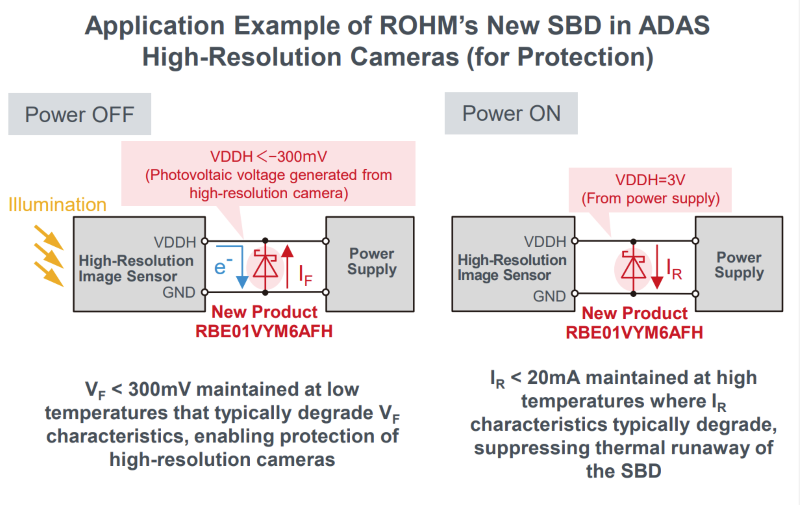
Application of Rohm’s RBE01VYM6AFH SBD in ADAS cameras. Image used courtesy of Rohm Semiconductor
High-Resolution Camera Protection
The RBE01VYM6AFH successfully integrates an ultra-low VF (200 mV) for effective clamping with a low, controlled IR for thermal stability, overcoming a fundamental material science and architectural challenge in diode design. This combination provides a high-reliability protection mechanism necessary for modern high-resolution image sensing applications. Primary uses include protecting image sensor inputs within ADAS cameras, as well as safeguarding circuits in high-performance security cameras, smart intercoms, and various high-reliability home IoT devices that require stable operation across a wide thermal range.


