
Vishay Expands Resettable Overcurrent Protection With Slim PTCs
New surface-mount polymer thermistors offer small footprints down to 0603, low resistance, and fast trip times for power delivery and battery systems.
Circuit protection remains a fundamental design consideration as electronic devices shrink and power densities rise. Managing transient overcurrent events without permanently disrupting circuit operation is essential for system reliability. Vishay Intertechnology recently addressed this challenge by introducing six new surface-mount polymer positive temperature coefficient (PTC) thermistor series. Under the Vishay BCcomponents brand, these components deliver resettable overcurrent protection for low-voltage applications while minimizing board space and circuit losses.
Scalable Footprints and Electrical Profiles
The expanded portfolio comprises the PPTC0603E3, PPTC0805E3, PPTC1206E3, PPTC1210E3, PPTC1812E3, and PPTC2920E3 series. Footprints range from the compact 0603 up to the 2920 case size, with heights from 0.3 mm to 2 mm. This slim design facilitates integration into highly dense or low-profile assemblies. Electrical characteristics scale across the product family to accommodate diverse demands; holding currents span from 0.02 A up to 5.0 A, while maximum voltage ratings reach up to 90 VDC. For instance, the PPTC0603E3 series provides a holding current between 0.02 A and 0.5 A with voltage ratings spanning from 6 VDC to 60 VDC.
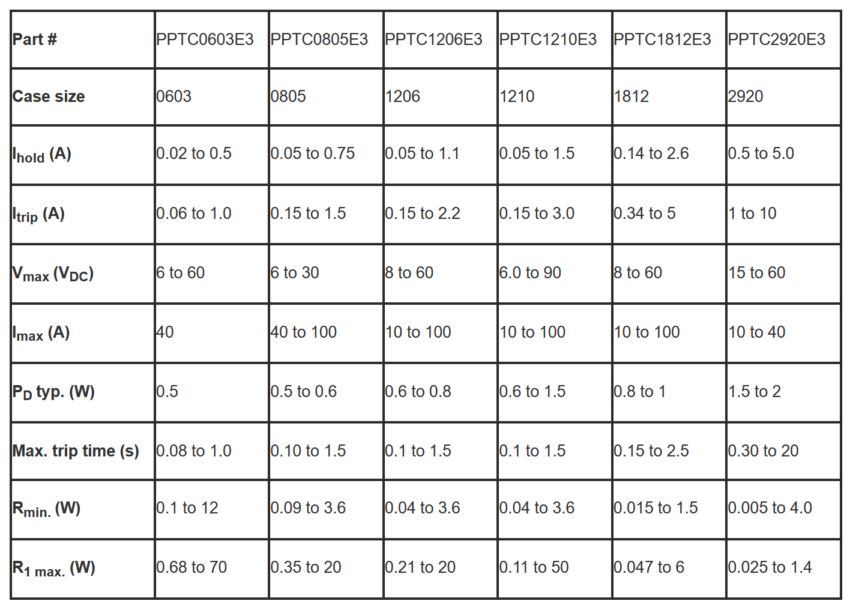
Electrical specifications and case sizes for the expanded Vishay overcurrent protection portfolio, detailing holding current and trip-time boundaries. Table used courtesy of Vishay
Performance Metrics and Thermal Robustness
Efficiency is a critical benchmark for these protective components. The thermistors feature low initial resistance, down to 5 mω for high-current options, minimizing unwanted inline voltage drops. During a fault, the devices respond rapidly, exhibiting trip times as low as 50 ms to isolate downstream circuitry. Operating across a temperature range of -40 °C to +85 °C, their maximum surface temperature in a tripped state can reach 125 °C. The series is compatible with lead-free reflow soldering up to 260 °C, RoHS-compliant, and halogen-free. Designers can also access SPICE and 3D models for circuit simulation and layout verification.
It is interesting to see how these compact polymer thermistors combine highly scalable footprints with low internal resistance to tackle contemporary overcurrent protection challenges. These passive components appear to be practical solutions for safeguarding USB-C ports, power-over-Ethernet setups, and PC motherboards. They also look well-suited for battery protection in mobile devices, home automation sensors, and consumer systems where reliable, space-efficient, and resettable current limiting is needed to maximize system uptime.


