Wireless-Tag ESP32P4C61-TINY AIoT Development Board Supports Camera and Display
Built around ESP32-P4 and ESP32-C61 SoCs, this AIoT development board supports Wi-Fi 6, Bluetooth 5, MIPI camera/display interfaces, and microSD storage.
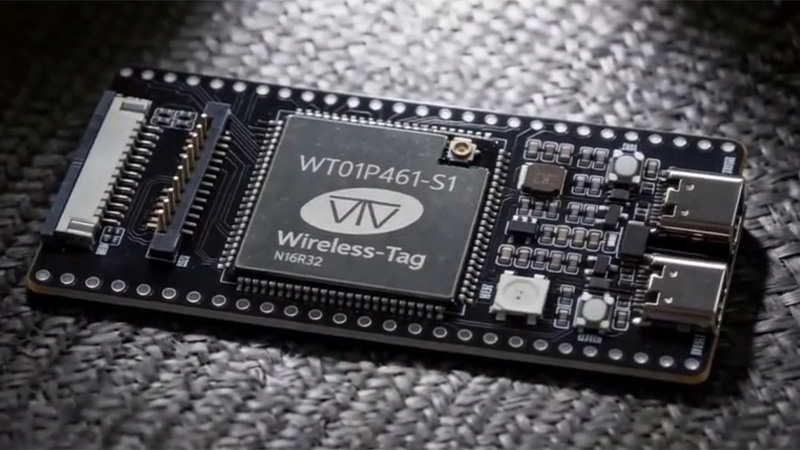
ESP32P4C61-TINY AIoT development board
ESP has launched the ESP32P4C61-TINY, a compact open-source AIoT development board based on the company’s WT01P461-S1 wireless module. The board combines the ESP32-P4 application processor with the ESP32-C6 wireless SoC, creating a platform designed for edge AI, smart devices, and connected embedded systems.
Unlike many ESP32-based solutions that integrate wireless connectivity into a single chip, this AIoT development board uses the ESP32-P4 for application processing and an ESP32-C61 SoC for Wi-Fi 6 and Bluetooth 5 connectivity. The design allows developers to take advantage of the ESP32-P4’s higher processing capabilities while offloading wireless communication tasks to a dedicated controller.
The board also includes MIPI CSI and MIPI DSI interfaces, enabling direct support for cameras and displays. Combined with onboard PSRAM, a microSD card slot, and exposed GPIO headers, the platform targets computer vision, AI-assisted interfaces, industrial control, and other edge computing workloads.
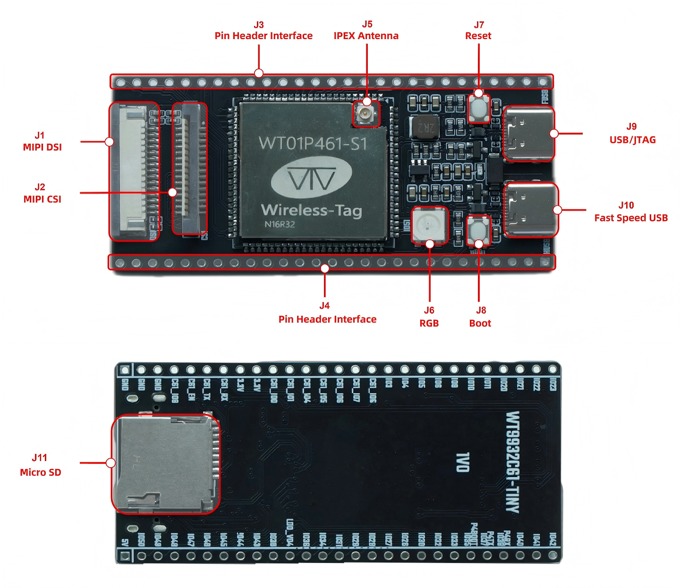
ESP32P4C61-TINY Hardware Specifications
ESP32P4C61-TINY Features:
- Wireless Module: Wireless-Tag WT01P461-S1 (25 x 25 mm)
- Main Processor: ESP32-P4 dual-core RISC-V MCU running at 360/400 MHz with AI instruction extensions and single-precision FPU
- Low-Power Core: Single RISC-V LP MCU operating at up to 40 MHz
- Graphics: 2D Pixel Processing Accelerator (PPA)
- Video: Hardware H.264 and JPEG codec support
- Memory:
- 768KB HP L2MEM
- 32KB LP SRAM
- 8KB TCM
- 16MB or 32MB PSRAM
- Storage:
- 16MB NOR Flash
- 128KB HP ROM
- 16KB LP ROM
- Wireless Connectivity:
- 2.4GHz Wi-Fi 6
- Bluetooth 5
- Powered by ESP32-C61
- IPEX antenna connector
- Storage Expansion: MicroSD card slot
- Display Interface: MIPI DSI connector (supports included 2.8-inch 640×480 display)
- Camera Interface: MIPI CSI connector (supports included camera module)
- USB:
- USB Type-C for USB/JTAG debugging
- USB Type-C Fast Speed USB port
- Expansion:
- 2× 27-pin headers
- 36 GPIOs from ESP32-P4
- 10 GPIOs from ESP32-C61
- Other Features: RGB LED, Boot button, Reset button
- Power Supply: 5V/2A through USB Type-C
- Dimensions: 69 x 33 mm
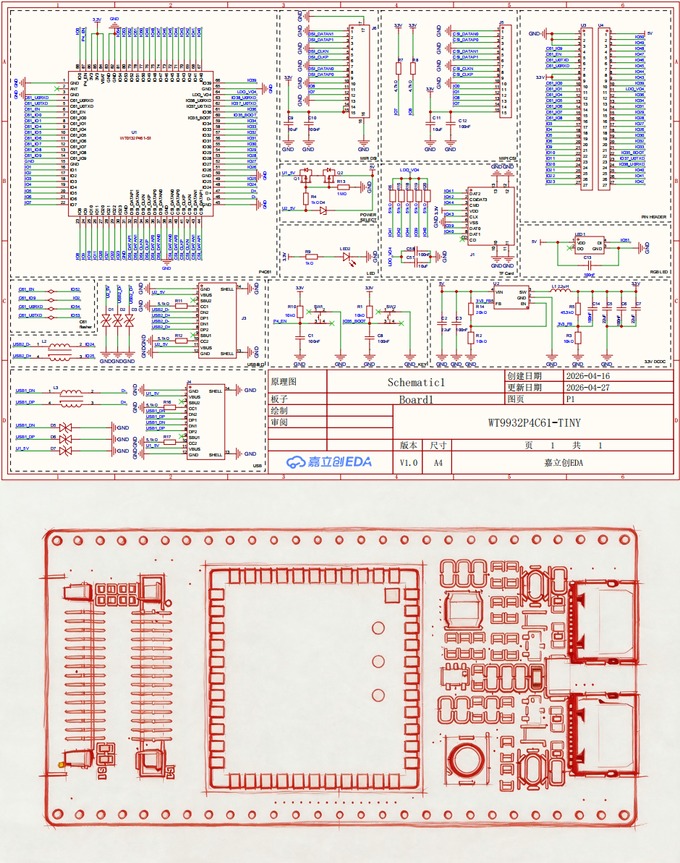
Product Schematic and Board Diagram
Wireless-Tag describes the ESP32P4C61-TINY as a fully open-source platform, although the company has not yet released complete documentation or source files. At the time of writing, the Kickstarter page only provides a limited hardware overview and a low-resolution schematic. The board will likely rely on Espressif’s ESP-IDF development framework, with additional hardware resources expected to appear on the company’s GitHub repository and documentation portal after the crowdfunding campaign concludes.
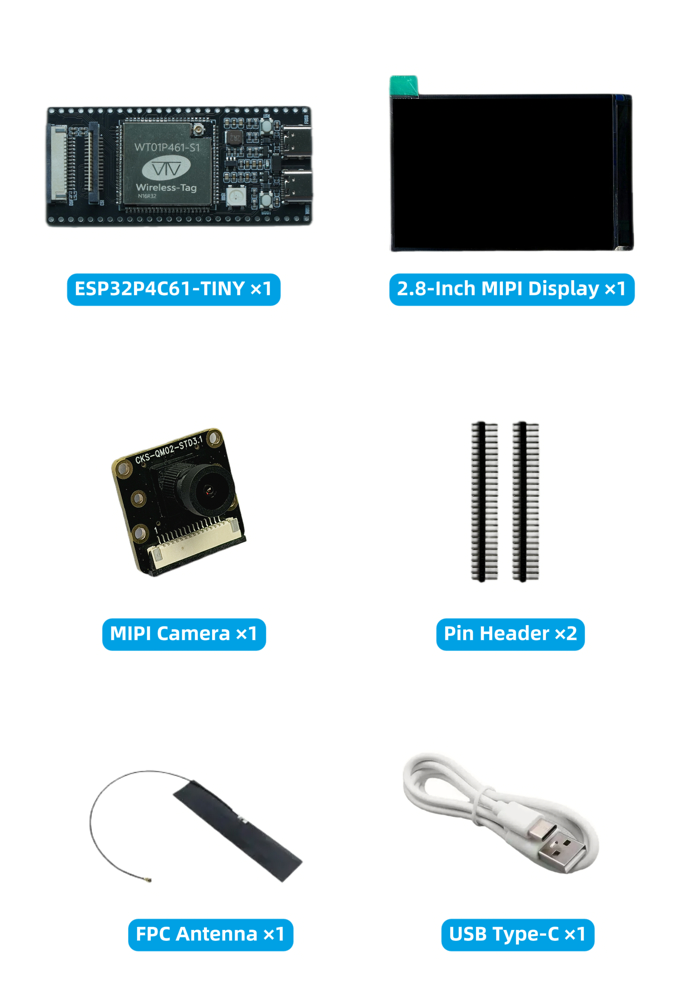
ESP32P4C61-TINY Package Content
The ESP32P4C61-TINY AIoT development board is currently available through a Kickstarter crowdfunding campaign. The “Super Early Bird” package starts at approximately $40, representing a 51% discount from the stated $81.50 MSRP. The kit includes the development board, a 2.8-inch MIPI display, a MIPI camera module, an antenna, header pins, and a USB Type-C cable. Additional reward tiers include an “Early Bird” option priced at around $66 and a two-kit “Double Discount” package for approximately $76. Wireless-Tag expects shipments to begin in July 2026, while shipping charges and taxes apply separately.
Images used courtesy of kickstarter and wireless-tag.