
Ambiq Announces Ultra-Low-Power SoCs for High Performance in Edge Designs
The Apollo510 Lite series of ultra-low-power SoCs is designed for energy efficiency, wireless connectivity, and fast performance in edge devices, including wearables, smart home systems, and IoT sensors.
Ambiq has introduced the Apollo510 Lite System-on-Chip (SoC) series, expanding its portfolio of ultra-low-power devices targeting edge AI applications such as wearables, industrial IoT, and smart home systems. The series is built on the company’s Subthreshold Power Optimized Technology (SPOT) platform, which is engineered to minimize power consumption in the subthreshold operating region.
According to Ambiq, the new SoC series delivers a performance increase of up to 16 times faster and up to 30 times better AI energy efficiency when compared to M4 or M33 solutions.
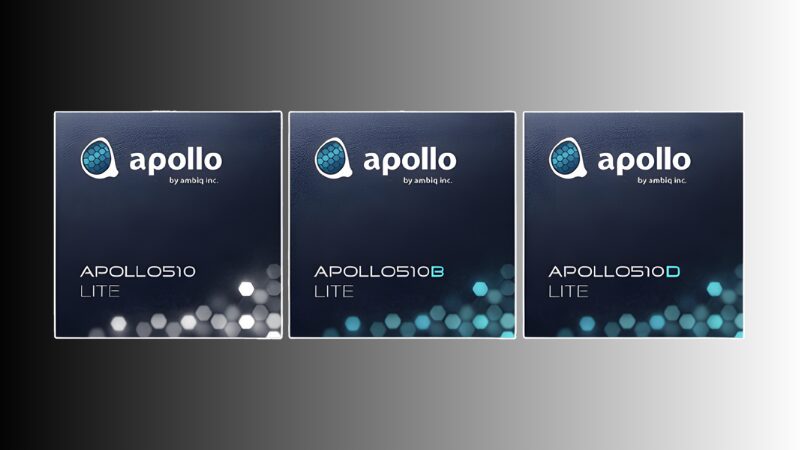
The Apollo510 Lite series is built to deliver high performance and efficiency in edge designs, including wearables, smart homes, and IoT sensors. Image used courtesy of Ambiq
Apollo510 Lite SoC Series
The Apollo510 Lite SoC series employs a heterogeneous dual-core architecture intended to separate high-demand application processing from specialized networking and sensor fusion tasks.
The primary application processor is an Arm Cortex-M55 core, clocked at up to 250 MHz. This core incorporates Ambiq’s turboSPOT technology and Helium vector processing technology, which provides specialized acceleration for efficient AI workloads.
Alongside the M55, a dedicated 48/96 MHz Arm Cortex-M4F coprocessor is included. This secondary core is utilized for optimized wireless communication and sensor fusion.

The Apollo510 Lite series includes three models: the Apollo510 Lite, Apollo510B Lite, and Apollo510D Lite. Image used courtesy of Ambiq
Memory Subsystem and Caching
For memory, the SoC series integrates 2 MB of system RAM and 2 MB of embedded non-volatile memory for code and data storage. To support the 250 MHz M55 core, the architecture includes dedicated instruction and data caching with a 32 kB I-cache and 32 kB D-cache.
The design also features 256 kB of instruction/data tightly coupled memory, along with a memory protection unit, facilitating faster execution of critical routines. External memory interfacing is supported by flexible serial peripherals, with potential transfer rates up to 250 MT/s depending on the package configuration.
Connectivity and Peripherals
The Apollo510 Lite Series is available in three primary variants to address diverse connectivity requirements. The Apollo510 Lite lacks an integrated radio, while the Apollo510B Lite includes a Bluetooth LE 5.4 radio, supporting features such as direction finding and periodic advertising with response (PAwR). The radio subsystem offers a transmit power of up to +14 dBm and receives sensitivity ranging from -95 dBm (2 Mbps) to -104 dBm (125 kbps).
The Apollo510D Lite includes the above features and additional connectivity with an integrated dual-mode Bluetooth radio, including support for Bluetooth Classic Audio in addition to LE features.
Peripheral support is extensive, providing 12-bit ADC functionality with 11 selectable input channels and a sampling rate up to 1.7 MS/s. Audio processing hardware includes one PDM stereo digital microphone interface for always-on voice applications and one full-duplex multichannel I²S port. Other integrated interfaces include a USB 2.0 FS/HS device controller, SDIO/eMMC, UART, and up to 120 GPIO pins.
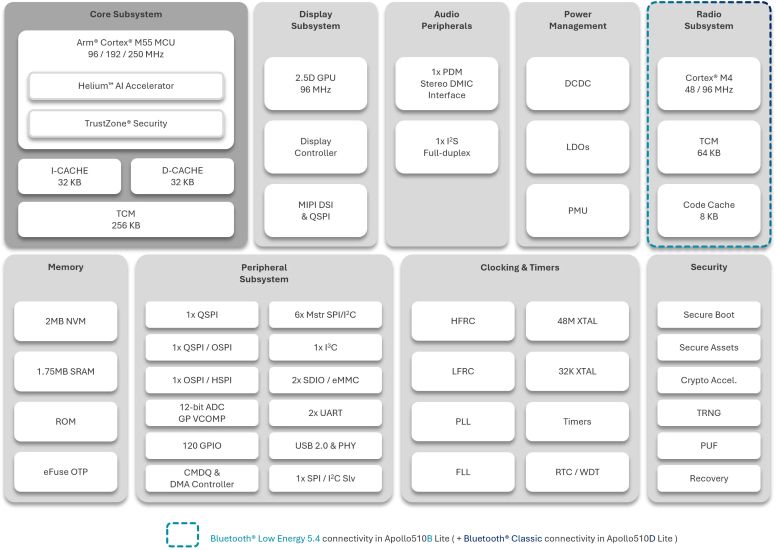
Apollo510 Lite SoC series block diagram. Image used courtesy of Ambiq
Security and Graphics Subsystems
Security is managed via the secureSPOT 3.0 subsystem, which implements Arm TrustZone technology. Additional security features include a secure boot process, OTP key storage, PUF-based identity/sign/verify capabilities, and secure OTA update support.
For display applications, the graphiqSPOT 2.0 features a 2D/2.5D GPU with vector graphics acceleration and anti-aliasing hardware. The display subsystem supports resolutions up to 480 x 480 at 60 FPS. The device operates within a voltage range of 1.71 V to 2.2 V and utilizes a SIMO Buck Converter for power management. Packaging options include a 5.3 x 5.3 mm BGA with 120 GPIO and a smaller 4.0 x 4.0mm CSP with 68 GPIO, catering to space-constrained designs.
Advancing AI Compute at the Edge
The Apollo510 Lite series focuses on delivering enhanced AI performance and memory capacity within a strict ultra-low-power envelope through the use of the Arm Cortex-M55 core and Ambiq’s SPOT technology. This combination of low-power operation, dual-core processing, robust BLE 5.4 connectivity, and integrated security is specifically designed for applications requiring high-density local computation and extended battery life, such as smartwatches, patient health monitors, hearing assist devices, and industrial condition monitoring at the edge.


