
AMD Launches Ryzen AI Embedded P100 and X100 With Up to 50 TOPS AI Power
AMD is bringing its "Ryzen AI" branding to the embedded sector, with Zen 5 CPUs, RDNA 3.5 graphics, and an XDNA 2 NPU for Edge AI applications.
AMD Ryzen AI Embedded Series of SoC
At CES 2026, AMD has introduced the Ryzen AI Embedded P100 and X100 series, two new ranges of x86 processors designed for the automotive, healthcare, and robotics applications at the Edge. At the time of writing, we only have the specification avilabe for the P100 series, and the X100 series is expected to sample in the first half of 2026.
We saw AMD introduce its Ryzen Embedded series in 2018 with the Ryzen Embedded V1000 family. After that, many different upgrades were introduced; more recently, they have released the Ryzen Embedded 8000 series, featuring up to 8 CPU cores, 16 threads, and an integrated NPU with up to 6 TOPS of AI processing power. But compared to those, the Ryzen AI Embedded P100 and X100 series features high-performance “Zen 5” CPU cores, RDNA 3.5 graphics, and an XDNA 2 NPU, for low-latency, low-power, and high-performance Edge AI workloads.
At the time of writing, the company has released specifications for only the P100 series, which includes six SKUs. AMD has segmented into three distinct grades to suit different engineering requirements: Commercial, Industrial (i), and Automotive (a).
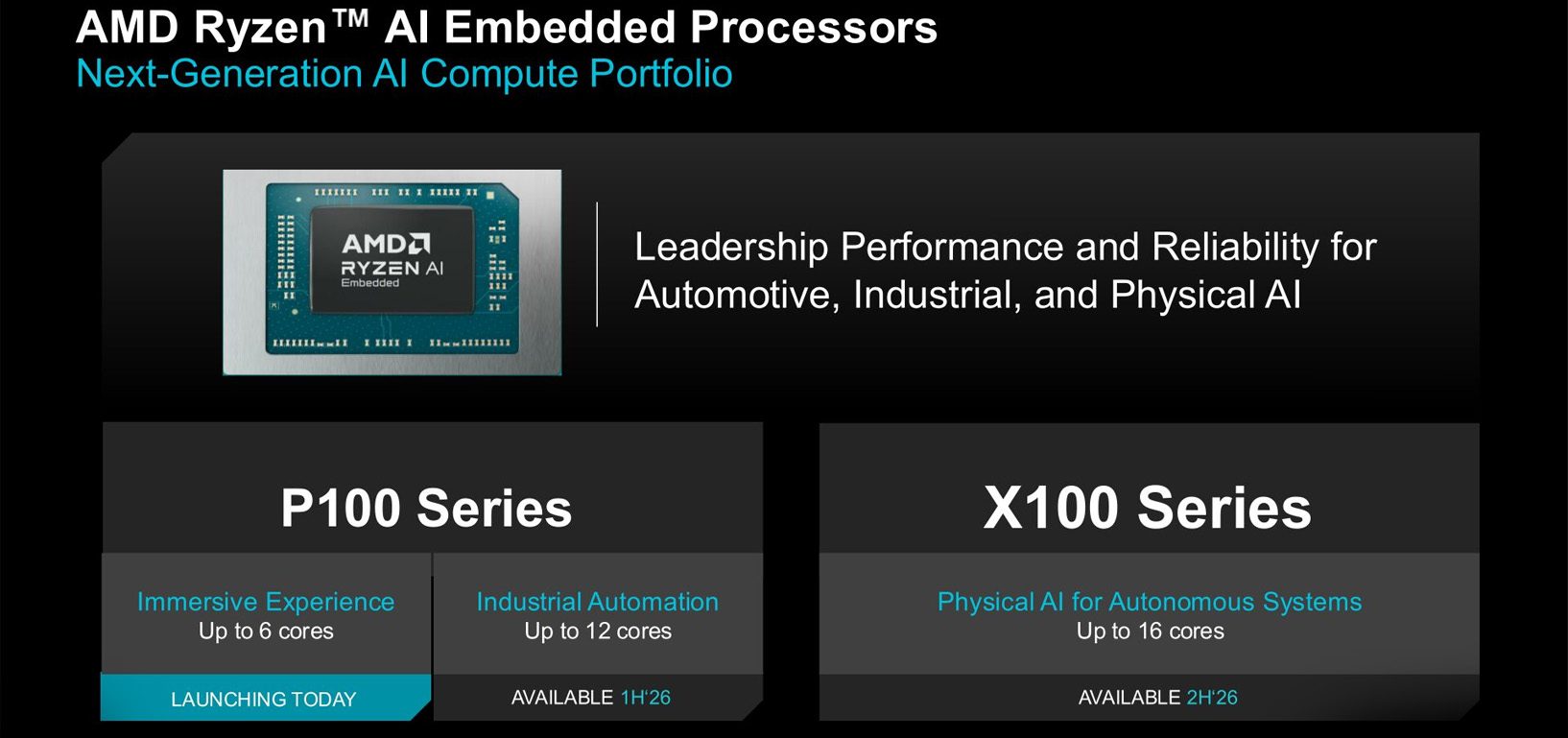
AMD Ryzen AI Embedded P100 and X100 Series Portfolio
Ryzen AI Embedded P100 Specifications:
- Processore: Ryzen AI Embedded P100
- CPU:
- Up to 6× “Zen 5” CPU cores
- 4 cores (P121 [Commercial], P121i [Industrial], P122a [Automotive])
- 6 cores (P132 [Commercial], P132i [Industrial], P132a [Automotive])
- Max frequency:
- Up to 4.4 GHz (P121 [Commercial], P121i [Industrial])
- Up to 4.5 GHz (P132 [Commercial], P132i [Industrial])
- Up to 3.65 GHz (P122a / P132a [Automotive])
- 8 MB shared L3 cache (all variants)
- Up to 6× “Zen 5” CPU cores
- GPU:
- Integrated RDNA GPU
- Work Group Processors:
- 1 WGP (P121 [Commercial], P121i [Industrial])
- 2 WGP (P132 [Commercial], P132i [Industrial], P122a / P132a [Automotive])
- GPU max frequency:
- Up to 2.7–2.8 GHz (Commercial / Industrial)
- Up to 2.0–2.4 GHz (Automotive)
- Display support:
- Up to 4× 4K@120 Hz or 2× 8K@120 Hz (all variants)
- AI Accelerator:
- Integrated NPU
- 30 TOPS (P121 [Commercial], P121i [Industrial], P122a [Automotive])
- 50 TOPS (P132 [Commercial], P132i [Industrial], P132a [Automotive])
- CPU:
- Memory: DDR5-5600 ECC memory supported for both Commercial and Industrial SoCs
- LPDDR5X ECC:
- Up to 8000 MT/s (P132 [Commercial], P132i [Industrial])
- Up to 7500 MT/s (P121 [Commercial], P121i [Industrial])
- 7500 MT/s with RAS (P122a / P132a [Automotive])
- LPDDR5X ECC:
- Networking: 2× 10GbE with TSN (all variants)
- USB:
- 2× USB4 (Commercial / Automotive)
- All Varients:
- 1× USB 3.2
- 1× USB 3.1
- 3× USB 2.0
- 1× USB 2.0 (Secure BIOS)
- Power:
- Nominal TDP:
- 28 W (Commercial / Industrial / P122a [Automotive])
- 45 W (P132a [Automotive])
- Configurable TDP range:
- 15–54 W (Commercial / Industrial)
- 15–30 W (P122a [Automotive])
- 25–45 W (P132a [Automotive])
- Operating Temperature
- 0°C to 105°C (Commercial)
- –40°C to 105°C (Industrial / Automotive)
- Package: 25 mm × 40 mm BGA package
- Product longevity: 2.5 years standard | Up to 10 years extended
- Nominal TDP:
The detailed specification is shown above, but to make things even simpler, you can check the table below:
| Model | Grade | Cores (Zen 5) | NPU (TOPS) | TDP Range | Junction Temp |
|---|---|---|---|---|---|
| P121 | Commercial | 4 | 30 | 15-54 W | 0°C to 105°C |
| P132 | Commercial | 6 | 50 | 15-54 W | 0°C to 105°C |
| P121i | Industrial | 4 | 30 | 15-54 W | -40°C to 105°C |
| P132i | Industrial | 6 | 50 | 15-54 W | -40°C to 105°C |
| P122a | Automotive | 4 | 30 | 15-30 W | Auto Grade |
| P132a | Automotive | 6 | 50 | 25-45 W | Auto Grade |
AMD mentions up to a 2.2× boost in single- and multi-thread performance over the previous generation, with the P132a delivering up to 84% higher single-thread and 125% higher multi-thread performance compared to the previous generation Ryzen Embedded V2A46 on the SPECrate®2017_int_base benchmark.
On the graphics side, the RDNA 3.5 GPU offers an estimated 35% faster 3D rendering (GFXBench Vulkan) and supports up to four 4K or two 8K displays at 120 fps, while the XDNA 2 NPU delivers up to 50 TOPS of AI power with up to 3× higher AI inference performance for AI workloads such as vision transformers, compact LLMs, and CNNs.
On the software side, the P100 series has support for Yocto Linux, Ubuntu, Windows, and Android. AMD’s Ryzen AI Software also makes it easier to deploy AI models, which makes it easy to move pre-trained models from PyTorch or TensorFlow onto the XDNA 2 NPU. Additionally, they have support for Xen virtualization, which allows a real-time OS like FreeRTOS to run alongside a with Windows or Android, where the FreeRTOS manages real-time control, and the Windows runs other non critical application.

AMD Ryzen AI Embedded P100 Series Applications
The P100 series of processors is already sampling with early customers, with mass production expected in Q2 2026. The company also mentions that there will be more powerful 8- to 12-core P100 models designed for industrial automation that will sample in Q1 2026, and as mentioned at the beguinng the top-of-the-line X100 series is expected to begin sampling in H1 2026 (likely Q2 2026). More information is available on the product page and the press release page.
Images used courtesy of AMD


