
Digital Matter’s Energy Saving Stack Enhances Battery-Powered Asset Tracking
The new Energy Saving Stack doubles the life of compatible battery-powered asset tracking devices, providing users with greater energy efficiency and an improved return on investment.
Digital Matter has launched Energy Saving Stack (ESS), a software enhancement to the company’s Device Manager ecosystem. ESS is designed to double battery life and increase location updates by 100% in compatible battery-powered asset tracking devices without requiring any hardware changes. This upgrade aims to address a critical challenge in IoT deployments: maximizing energy efficiency to extend device life and data granularity.
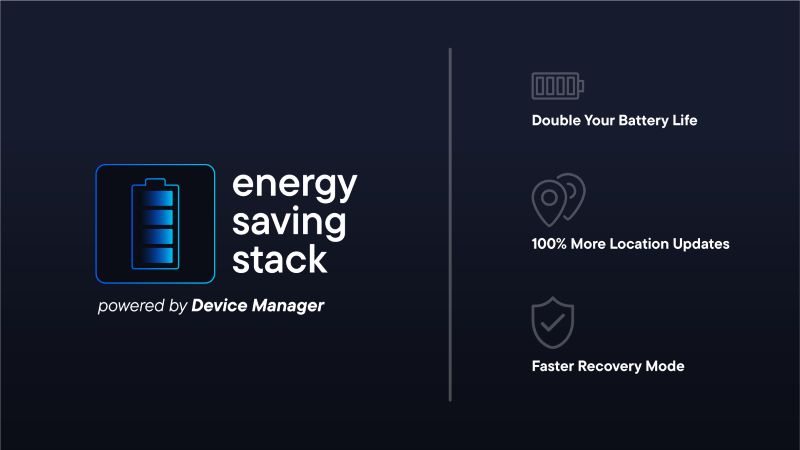
ESS doubles battery life for Digital Matter’s asset tracking devices that use Device Manager. Image used courtesy of Digital Matter
Energy Saving Stack (ESS)
The core of the ESS technology lies in leveraging advanced enhancements within 5G cellular network standards. Specifically, ESS utilizes two key 3rd Generation Partnership Project (3GPP) features on compatible networks to achieve energy savings by minimizing the time the modem is active. These features include Power Saving Mode, introduced in 3GPP Release 12, and Release Assistance Indication, featured in 3GPP Releases 13 and 14.
In addition to leveraging these standards, ESS enhances transmission efficiency by maximizing the packet size on networks. Digital Matter also notes that because network implementations of these standards can vary, ESS incorporates safeguards to ensure devices still realize incremental gains even on sub-optimally configured networks.
Device Manager enables users to monitor and control connected Digital Matter devices over the cloud. Video used courtesy of Digital Matter
Streamlined Communication
ESS efficiency gains are further realized by streamlining communication during check-ins and location updates. This streamlining is a two-part process that focuses on reducing communication overhead.
Firstly, ESS simplifies the communication between the device and the server by reducing the total number of packets sent. Secondly, the Device Server is now capable of prioritizing communications. This optimization allows the device to go off-air more quickly instead of waiting for confirmation that downstream systems have received the payload.
This simplified, lower-overhead process helps conserve energy while maintaining data reliability. It also enables more frequent asynchronous check-ins, which improves the responsiveness of the Recovery Mode feature, allowing devices to reconnect and update location after unexpected activity.

ESS is ready for use on Barra Edge devices, with support for additional Digital Matter devices on the way. Image used courtesy of Digital Matter
Advancing IoT Asset Tracking
The ESS can provide up to 2X battery life or 100% more location updates. Customers also have the flexibility to prioritize one benefit over the other.
This enhancement is currently activated through the Device Manager platform. Initially, ESS is supported on Barra Edge devices and is planned for rollout to Digital Matter’s Edge, Fusion, and Core device ranges.
By significantly extending device life and increasing data granularity, ESS enables longer deployment cycles and minimized maintenance for battery-powered asset tracking solutions. This technical advancement is critical for applications that rely on long-term, reliable asset visibility, such as supply chain optimization, fleet and equipment tracking, and various remote monitoring tasks. The reduced energy consumption also lowers the total cost of ownership and environmental impact of large-scale deployments.


