
E-peas Introduces Dual-Source Energy Harvesting PMIC for Smart Power Management
The new AEM13921 is a dual-input energy harvesting power management IC featuring independent boost converters with over 90% efficiency, ultra-low cold start, and adaptive power management.
The design of perpetually powered IoT devices often requires leveraging multiple ambient energy sources, a requirement that traditional single-input power management ICs (PMICs) complicate. E-Peas’ new AEM13921 is a specialized PMIC engineered for dual-source energy harvesting, integrating two independent boost inputs to extract power simultaneously from disparate sources like photovoltaic cells, thermal electric generators (TEGs), and RF harvesters.
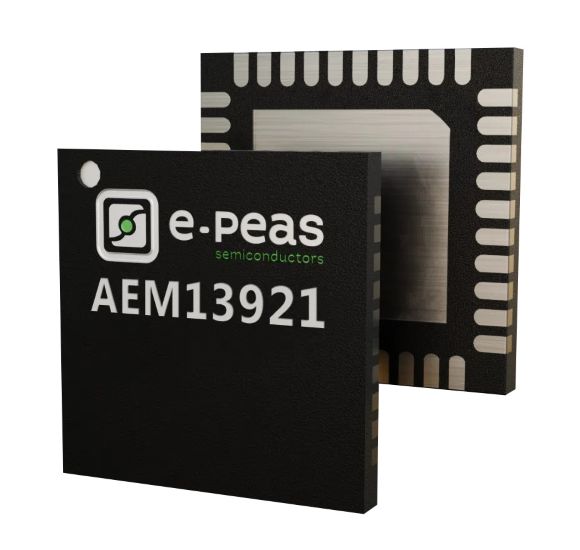
E-peas’ AEM13921 PMIC features simultaneous dual-source energy harvesting. Image used courtesy of E-peas
Dual-Source Energy Harvesting
The AEM13921 PMIC utilizes two discrete boost converters, each optimized for ultra-low-power operation, capable of cold starting from a minimal input of 1.5 µW at 275 mV. Following a cold start, the boost converters can operate down to 120 mV input, supporting sources with low output voltages. Each of the two boost inputs is rated to handle up to 135 mA of input current.
A critical design feature of the AEM13921 is the independent configurability of the energy extraction mechanism for each source. Both boost stages can be configured for either maximum power point tracking (MPPT) or constant voltage mode. This flexibility enables users to tailor the PMIC operation to the dynamic characteristics of combined harvesters, such as pairing a regulated constant-voltage TEG with a variable light-intensity PV cell requiring MPPT.
Power Regulation and Storage Element Management
The AEM13921 integrates a high-efficiency buck converter to regulate the voltage supplied to the application load. This output is user-selectable within a range of 0.6 V to 3.3 V and can deliver up to 100 mA. This wide voltage range accommodates common low-power microcontrollers and transceivers. The buck regulator itself also operates with an efficiency exceeding 90%.
The AEM13921’s storage element interface is designed for versatility, supporting various rechargeable chemistries, including Li-ion, LiPo, Li-ceramic pouch cells, and supercapacitors, with a voltage range of 2.4 V to 4.59 V. Comprehensive management features include configurable overcharge, overdischarge, and charge-ready thresholds, ensuring safe operation and maximizing the lifespan of the storage element.

Block diagram of the AEM13921 PMIC. Image used courtesy of E-peas
Additionally, a thermal monitoring function is included that provides protection against over- and under-temperature conditions during charge and discharge cycles. For deployment scenarios, a shipping mode feature disables both charge and discharge paths to preserve residual energy during transport.
For systems that may experience extended periods without ambient energy, the PMIC includes an auxiliary 5 V charging input. This port allows for supplemental charging from an external source, with a configurable current limit up to 135 mA.
Advanced Monitoring and Configuration
System configuration and real-time monitoring are handled through a dedicated I²C interface, which supports the Fast Mode Plus specification. While basic operation settings can be controlled via GPIO pins, the I²C interface provides access to all internal registers, enabling dynamic adjustment of operational parameters like MPPT ratios and protection thresholds.
A key feature of the AEM13921 is the integrated average power monitoring system, which measures the actual energy flow throughout the system’s power path, tracking the energy transferred from each source to the storage element, the energy drained from the storage element to the load, and the duration of 5 V charging cycles. This telemetry is crucial for developers designing adaptive firmware that optimizes operation based on available energy, contributing to truly autonomous system behavior.
An additional safety measure, the ST_LOAD pin, provides a proactive alert mechanism for low-energy conditions, allowing the application circuit to perform a controlled shutdown before the storage element reaches its critical overdischarge threshold.
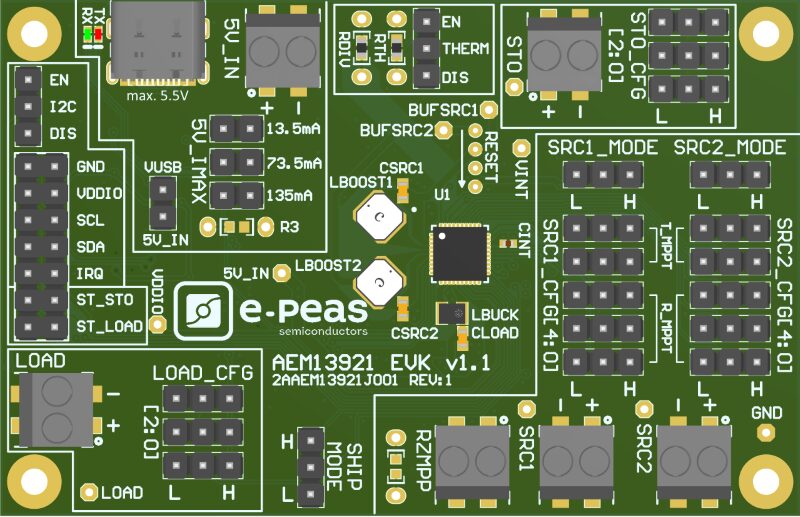
The AEM13921 evaluation board for testing and configuration. Image used courtesy of E-peas
Enhancing Energy Management
The AEM13921 provides a robust, highly integrated platform for multi-source energy harvesting. Its combination of dual independent boost inputs, high conversion efficiency, sophisticated storage protection, and the average power monitoring system positions it as an effective solution for minimizing battery maintenance in constrained, low-power systems.
Suitable applications include Industrial IoT sensor nodes, smart retail electronic shelf labels that combine PV and RF harvesting, smart building sensors (temperature, humidity, CO2) utilizing light and thermal gradients, and compact remote controls relying on pulsed sources and ambient light.


