
Rohm Launches LDO Regulator Series With Ultra-Stable Control Technology
The BD9xxN5 LDO regulators feature an output current of 500 mA and a low current consumption of 25 μA, supporting 12 V / 24 V power supplies in automotive, industrial, and consumer applications.
Rohm Semiconductor has announced the BD9xxN5 series, a family of 500 mA LDO regulators that incorporate the company’s Nano Cap technology, enabling stable operation with output capacitors as small as 230 nF. The 18-device lineup targets 12 V and 24 V primary power supply applications in automotive, industrial, and communications infrastructure equipment.
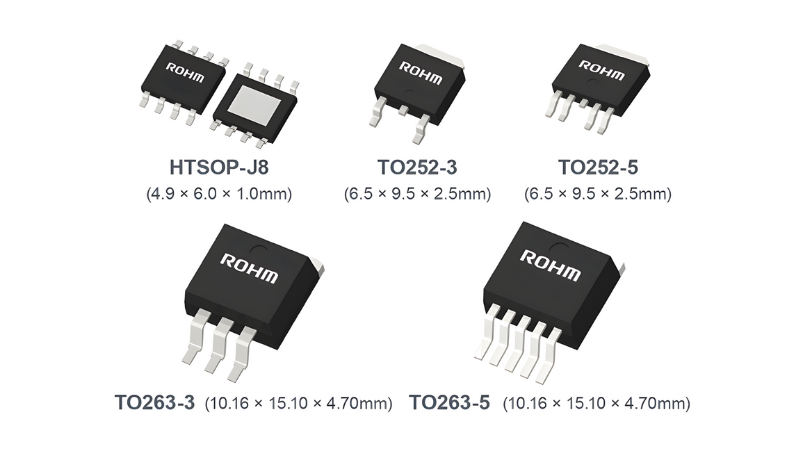
BD9xxN5 series of LDO regulator ICs with an output current capability of 500 mA. Image used courtesy of Rohm Semiconductor
BD9xxN5 Series of LDO Regulators
The BD9xxN5 series builds on Rohm’s earlier BD9xxN1 series, which demonstrated stable operation with 100 nF output capacitors at 150 mA output current. The new devices extend this output current capability to 500 mA while maintaining the minimum output capacitance specification of 230 nF, typical. This represents a significant departure from traditional LDO designs that typically require several microfarads of output capacitance for stability.
Rohm’s new series achieves an output-voltage ripple of approximately 250 mV during load transients from 1 mA to 500 mA within 1 μs, even with the minimum specified output capacitance of 470 nF. This performance enables designers to use ultra-small MLCCs in the 0603M package size (0.6 mm × 0.3 mm) while maintaining regulation during fast load changes.
According to Rohm’s datasheet specifications, the regulators maintain stability across an output capacitance range from 0.23 μF to 470 μF with ESR values up to 400 mΩ. The devices support ceramic capacitors as well as electrolytic and tantalum types, though Rohm recommends paralleling a minimum of 0.23 μF ceramic capacitor when using higher-ESR electrolytic or tantalum capacitors exceeding 400 mΩ.
The BD9xxN5 series features Rohm’s “Nano Cap” ultra-stable control technology. Video used courtesy of Rohm Semiconductor
Electrical Performance and Protection
The BD9xxN5 series operates from input voltages of 3 V to 42 V, with a minimum startup threshold of 3 V. Output voltage options include fixed 3.3 V and 5.0 V versions, plus an adjustable variant that supports 1 V to 18 V outputs via external resistive dividers. All versions maintain ±2% output voltage accuracy across the full operating range.
Quiescent current measures 25 μA typical at junction temperatures up to 125°C, increasing to 50 μA maximum at 150°C. Dropout voltage specifications vary with load current. The devices integrate multiple protection features. Overcurrent protection limits the output current to 1000 mA typical (501 mA minimum, 1300 mA maximum) during short-circuit conditions. Thermal shutdown activates at 175°C, with a typical 15°C hysteresis. Under-voltage lockout prevents operation when input voltage falls below 2.4 V typical during power-down sequences.
Ripple rejection reaches 60 dB typical at 1kHz with a 10 mA load current. Line regulation maintains output voltage within 0.1% typical (0.3% maximum) for input voltage changes from VOUT+1.5 V to 42 V. Load regulation holds the output voltage to 0.1% typical (0.5% maximum) across the full 0 mA to 500 mA output current range.
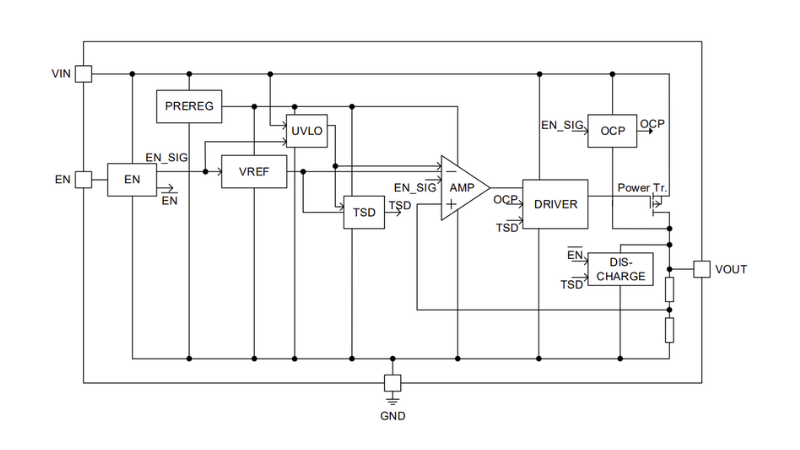
Block diagram of output voltage fixed type models with output shutdown function (BD9xxN5WEFJ-C, BD9xxN5WFP-C, and BD9xxN5WFP2-C models). Image used courtesy of Rohm Semiconductor
Low Current Consumption for Power Supplies
Rohm offers the BD9xxN5 series in five package options: HTSOP-J8, TO252-3, TO252-5, TO263-3, and TO263-5. All packages feature exposed thermal pads for improved heat dissipation.
The product family includes models with and without enable control functionality. Enable-equipped variants (designated with “W” in the part number) accept logic-level control signals. These versions also incorporate output discharge functionality, using an internal 6.5 kΩ typical resistance to discharge the output capacitor when disabled. Models without enable control (standard designation) operate whenever the input voltage exceeds the UVLO threshold.
The series received AEC-Q100 Grade 1 qualification, supporting automotive applications including powertrain fuel injection systems, tire pressure monitoring, body control modules, instrument clusters, and head-up displays. Industrial applications encompass PLCs, RTUs, industrial gateways, and sensor power supplies requiring high-precision analog rails. Communication infrastructure applications include control boards for HVAC systems, thermostats, and security equipment.


