
Infineon Expands Xensiv Family of Coreless Magnetic Current Sensors
The new TLE4971/TLI4971 sensors are housed in a 300-mil package and offer a 0.7% total error for highly accurate, bidirectional AC/DC measurement in industrial and automotive applications.
Precision current measurement in high-voltage power electronics is a persistent challenge for designers, particularly as designs increasingly adopt silicon carbide (SiC) and gallium nitride (GaN) devices. The inherent speed and power density of wide bandgap (WBG) technology demand faster, more accurate, and more robust sensing solutions.
Addressing this need, Infineon Technologies has expanded the Xensiv family of magnetic current sensors with the new TLE4971 (automotive) and TLI4971 (industrial), designed to minimize overall system error and simplify isolation requirements.
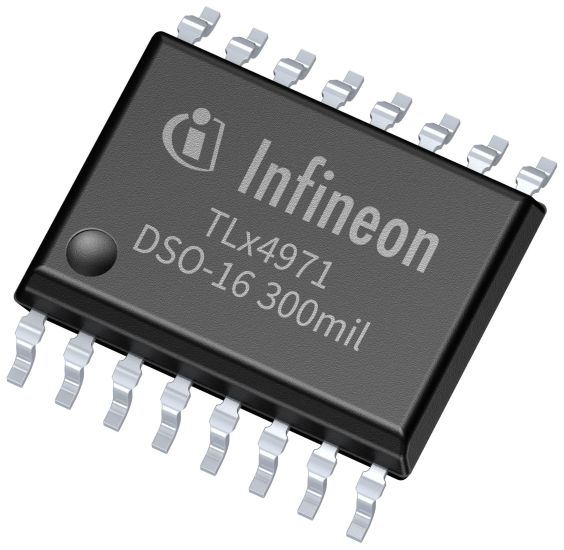
Infineon’s TLE4971/TLI4971 sensors come housed in a 300-mil package. Image used courtesy of Infineon Technologies
Differential Signal Sensing
The primary technical contribution of the Xensiv TLE4971/TLI4971 sensors lies in their magnetic sensing architecture. Unlike traditional core-based magnetic sensors, which often suffer from hysteresis and magnetic saturation effects, the new devices utilize a differential sensing principle.
This coreless approach employs two Hall-effect sensors placed on either side of the integrated current rail. The magnetic field produced by the current flowing through the rail is sampled by both sensors, with the differential output then translated into an accurate current reading. Critically, this differential methodology effectively eliminates the influence of external stray magnetic fields, removing the need for external magnetic shielding, which typically adds complexity and size to a design.
Achieving high accuracy across operating conditions is enabled by proprietary on-chip compensation techniques. The devices feature advanced temperature and stress compensation algorithms that maintain performance stability over the full operating range, resulting in a low total error of only 0.7% over the entire temperature range and product lifetime.
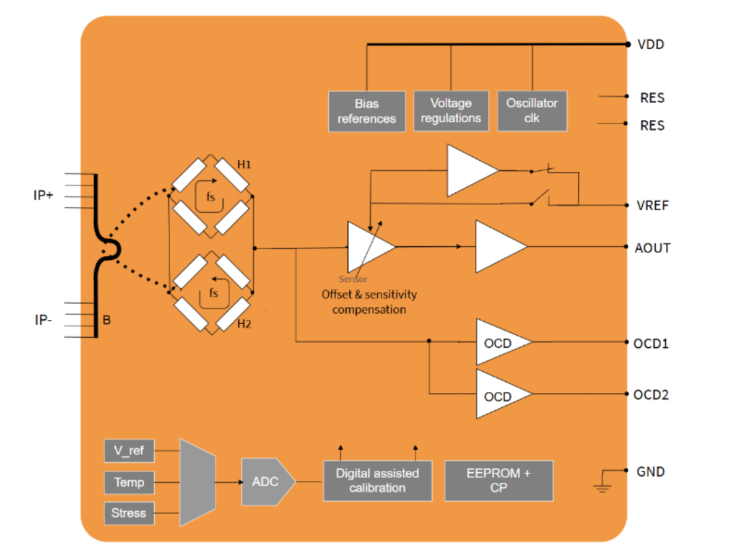
Block diagram of the TLE4971/TLI4971 coreless magnetic current sensors. Image used courtesy of Infineon Technologies
Accurate Current Measurement
Targeted at high-efficiency power conversion, the sensors integrate the current-carrying rail within the package itself. This rail exhibits a typical insertion resistance of 550 µΩ. This low resistance is paramount for minimizing power dissipation within the sensor module, particularly when handling peak currents.
The TLE4971/TLI4971 sensors are available in six pre-programmed, fixed current ranges, spanning from 16 A, 20 A, 30 A, 35 A, 40 A, up to a maximum of 50 A. This range flexibility enables designers to select the most appropriate device for diverse applications, from high-current motor controls to smaller auxiliary power supplies. The sensors are designed to support bidirectional measurement of AC and DC and provide the measurement output via an analog interface, simplifying integration with standard microcontroller analog-to-digital converters.
Robust Isolation and WBG Compatibility
In high-voltage environments, such as those found in electric vehicles and photovoltaic systems, safety isolation is a non-negotiable requirement. The TLE4971/TLI4971 is housed in an industry-standard 300-mil DSO-16 package. This package was specifically optimized to maintain both basic and reinforced isolation standards. It features a robust creepage and clearance distance of 8 mm, suitable for systems operating at high-bus voltages.
Furthermore, the need for rapid circuit protection in WBG-based power stages is addressed by the sensor’s built-in protection features. The devices integrate two fast overcurrent detection (OCD) outputs. The high switching speeds of SiC and GaN MOSFETs demand extremely quick fault detection to prevent catastrophic failure, and the fast OCD outputs are designed to meet this requirement. An integrated EEPROM allows developers the ability to adjust the OCD limits and deglitch filters, tuning the protection response to the specific application’s transients and noise characteristics.
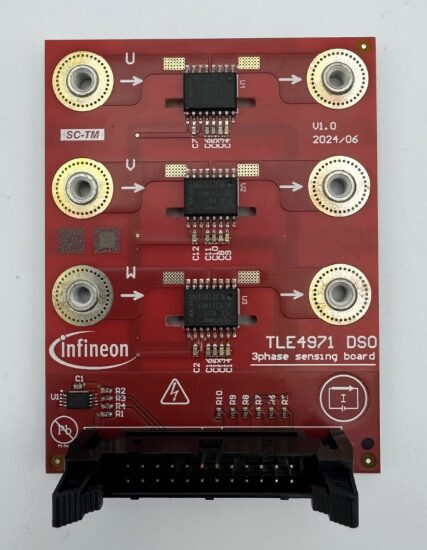
Infineon offers a three-phase 50 A peak evaluation board for the TLE4971/TLI4971 sensors to speed up development. Image used courtesy of Infineon Technologies
Advancing Power Electronics
Infineon’s release of the Xensiv TLE4971 and TLI4971 sensors marks a measured step forward in current sensing, offering a highly integrated, coreless solution that delivers sub-1% total error performance. By utilizing differential sensing and proprietary compensation, these devices aim to resolve long-standing issues related to magnetic interference and thermal drift that plague conventional architectures. The technical focus on low insertion loss (550 µΩ) and robust high-voltage isolation (8 mm creepage) makes them particularly relevant for modern high-power, high-efficiency systems.
The TLE4971 variant is engineered for demanding automotive applications such as high-voltage auxiliary drives and on-board chargers in electric vehicles. The TLI4971 targets high-power industrial infrastructure, including DC fast charging stations, battery energy storage systems, industrial servo drives, and photovoltaic inverters, providing the necessary precision and protection for next-generation power conversion stages employing SiC and GaN devices.


