
Introducing the i.MX 952 Applications Processor for Safety-Critical Displays
NXP Semiconductors’ AI-powered i.MX 952 is designed for vision processing and includes support for local dimming in harsh lighting, improving readability and safety in automotive and industrial displays.
The ongoing convergence of safety-critical operation, high-resolution visual processing, and AI at the edge is driving the need for highly integrated System-on-Chips (SoCs). Traditional architectures often rely on separate components for application processing, functional safety monitoring, and AI acceleration, complicating design efforts and increasing latency.
NXP Semiconductors has introduced the i.MX 952 applications processor, designed to address these system-level constraints by consolidating these functions onto a single die. The device is specifically positioned for automotive and industrial applications, including human-machine interface systems, in-cabin sensing, and industrial AI surveillance platforms.
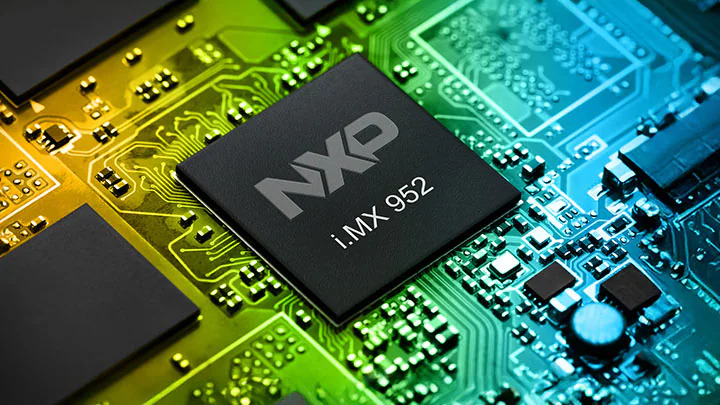
NXP Semiconductors’ i.MX 952 applications processor is built for automotive, industrial, and commercial applications. Image used courtesy of NXP Semiconductors
The i.MX 952 Applications Processor
The i.MX 952 applications processor employs a sophisticated heterogeneous architecture built around two distinct processing domains to ensure a balance of high-performance throughput and determinism for safety functions. The multi-core application domain features up to four Arm Cortex-A55 cores, providing the computational power necessary for running complex operating systems, graphics rendering for HMI, and high-level application software.
The i.MX 952’s independent safety domain consists of dedicated Arm Cortex-M7 and Arm Cortex-M33 CPUs. This architectural separation is fundamental to achieving functional safety compliance. The M-series cores can run real-time operating systems to handle monitoring, diagnostics, and critical I/O, independent of the higher-level A-core applications. This design is engineered to enable platforms compliant with ISO 26262 ASIL B for automotive use cases and SIL2/SIL3 compliance for industrial safety-critical environments, such as monitoring industrial plant equipment.
AI Acceleration and Sensor Fusion
The core of the i.MX 952’s intelligence capabilities is the integrated eIQ Neutron neural processing unit (NPU). This NPU accelerates machine learning inference operations, enabling real-time analysis of sensor data without overwhelming the main Cortex-A55 cores.
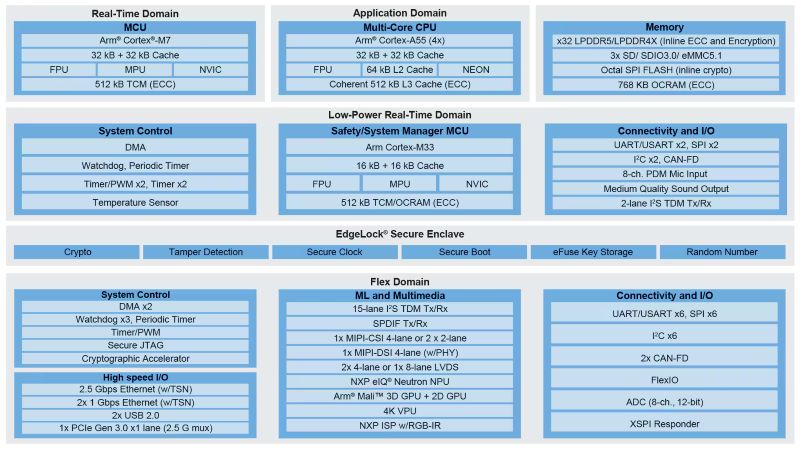
Block diagram of the i.MX 952 applications processor. Image used courtesy of NXP Semiconductors
This processing capability is tightly coupled with the chip’s extensive sensor interface support. The i.MX 952 features an integrated image signal processor (ISP) capable of handling image data rates up to 500 Mpixel/s. The ISP supports advanced sensing modalities, including RGB-IR sensors, which are increasingly utilized in in-cabin sensing for simultaneously capturing visible light and infrared data necessary for effective driver monitoring and child presence detection.
The processor’s design emphasizes sensor fusion, intelligently combining data from multiple input sources, such as cameras, ultra-wideband, and ultrasonic sensors, to create a more reliable and contextual understanding of the environment. NXP facilitates this through its eIQ AI software development environment.
Local Dimming and Advanced Security
According to NXP, the i.MX 952 is the world’s first automotive and industrial processor to integrate dedicated support for local dimming. This feature allows fine-grained control over the backlight zones of LCD panels and head-up displays. From a design perspective, local dimming significantly improves contrast ratios, enhances outdoor visibility by dynamically adjusting brightness, and provides substantial energy savings by selectively illuminating only the necessary parts of the screen.
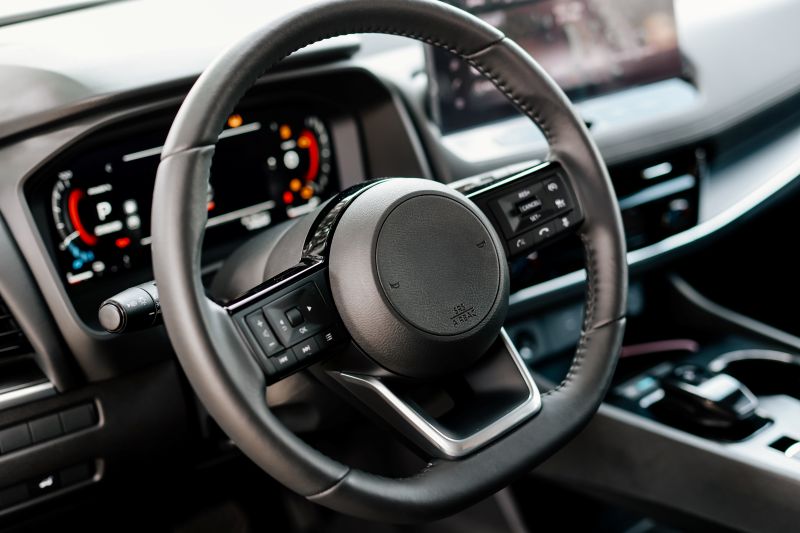
The i.MX 952 enhances the readability of LED-backlit in-cabin displays via local dimming, improving driver safety. Image used courtesy of Adobe Stock
The device’s security integration is handled by the EdgeLock Secure Enclave (Advanced Profile). This hardware root-of-trust simplifies implementation of critical security functions, including secure boot, device attestation, and secure over-the-air updates. The enclave is designed with support for post-quantum cryptography alongside classic cryptography, positioning the processor to meet anticipated security standards like ISO 21434 and the European Cyber Resilience Act.
Finally, the i.MX 952 is pin-to-pin compatible with NXP’s broader i.MX 95 family, allowing developers to scale their hardware platforms and software investment across different performance and cost tiers within a unified design footprint. NXP also highlights seamless integration with its existing portfolio, including the PF09 safety power management IC, UWB solutions like the Trimension NCJ29D6, and Wi-Fi 6/6E solutions.
AI-Driven Vision Solutions
The i.MX 952 is a technically comprehensive processor that unifies high-performance application cores, safety-critical microcontrollers, and a dedicated NPU into a single, scalable device. Its architectural division into application and safety domains is a key design choice for meeting stringent safety standards like ASIL B and SIL3.
By integrating specialized hardware like the 500 Mpixel/s ISP, sensor fusion capabilities, PQC-enabled security, and local dimming display control, the chip reduces system complexity and bill of materials. This integration makes the i.MX 952 a strong contender for demanding embedded applications, including next-generation automotive central computing platforms, advanced HMI clusters, in-cabin monitoring systems, and high-reliability industrial vision inspection systems.


