
Kioxia Samples UFS 5.0 NAND With 10.8GB/s for Flagships
Featuring 8th-gen BiCS FLASH and a custom controller, Kioxia’s UFS 5.0 delivers up to 10.8GB/s, targeting AI-driven smartphones with 512GB and 1TB options.

Kioxia BiCS Flash
Samples of Kioxia’s UFS 5.0 embedded flash memory, intended for upcoming flagship smartphones and next-generation mobile devices, are currently commencing to be prepared for shipment. Net-generation smartphones and other mobile devices will be powered by UFS 5.0 flash storage, which has a read/write speed of about 10.8 GB/s. JEDEC is currently working on a new embedded flash storage standard called UFS 5.0 to satisfy the performance needs of next-generation mobile devices, like expensive smartphones with on-device AI capabilities. It makes use of UniPro version 3.0 for the protocol and MIPI M-PHY version 6.0 for the physical layer. With two lanes, UFS 5.0 can achieve about 10.8GB/s of effective read/write performance; M-PHY version 6.0 introduces the new HS-GEAR6 mode, which hypothetically bolsters an interface speed of up to 46.6Gbps per lane.
The advanced 3D flash memory and power-efficient technology discovered within Kioxia Corporation’s early UFS 5.0 samples speed up mobile AI and device performance. In addition to KIOXIA’s revolutionary 8th-generation BiCS FLASH 3D flash memory, which uses CBA (CMOS directly Bonded to Array) technology to further enhance power efficiency, performance, and density, these samples incorporate a custom in-house controller for UFS 5.0. These samples are all about adaptability and adequate suitability for an assortment of devices and applications, with capacities of 512GB and 1 TB and a compact footprint of 7.5 x 13mm. Despite the fact that controller behavior, NAND parallelism, thermals, and power management will continue to influence actual devices, the new interface ceiling demonstrates the general direction for the future of high-end mobile storage.
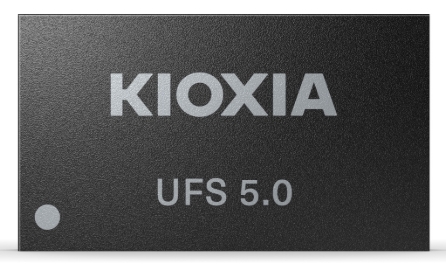
Kioxia UFS 5.0 NAND
Storage is becoming a more noticeable aspect of system performance as phone manufacturers push harder for on-device AI. Larger datasets are pushed through the phone by local AI features, which can reveal impediments that were more straightforward to conceal in previous generations. These features range from offline model execution to real-time assistants and photo and video enhancement. According to Kioxia Corporation, a two-lane UFS 5.0 link can achieve an effective read throughput of about 10.8 GB/s under the standard’s assumptions. Typical UFS designs use two lanes. On February 24, shipments of 512 GB evaluation samples started, and starting in March, shipments of 1 TB samples are planned. Additional information can be found on the official news page.
Images used courtesy of Kioxia.


