Littelfuse’s Omnipolar TMR Switches Target Compact, Battery-Powered Electronics
The new LF21173TMR and LF21177TMR switches feature a low 160 nA power consumption and a wide 1.8 V to 5.5 V operating range in a compact LGA4 package.
Littelfuse has introduced two omnipolar magnetic switches built around tunneling magnetoresistance technology. The LF21173TMR and LF21177TMR integrate TMR sensing elements with CMOS circuitry to deliver magnetic field detection at supply currents an order of magnitude lower than typical Hall-effect devices. Both components operate across a 1.8 V to 5.5 V supply range and come packaged in a four-pin land grid array suitable for space-constrained PCB layouts.
TMR Technology Fundamentals
Traditional Hall-effect sensors generate a voltage proportional to magnetic flux density through the Hall effect. TMR devices take a different approach by measuring changes in resistance in a magnetic tunnel junction. When a magnetic field alters the relative orientation of ferromagnetic layers separated by a thin insulating barrier, the quantum-mechanical tunneling probability changes, leading to a measurable shift in resistance. This physical mechanism produces stronger signal levels at lower operating currents than Hall-effect devices, resulting in reduced power consumption in battery-operated systems.
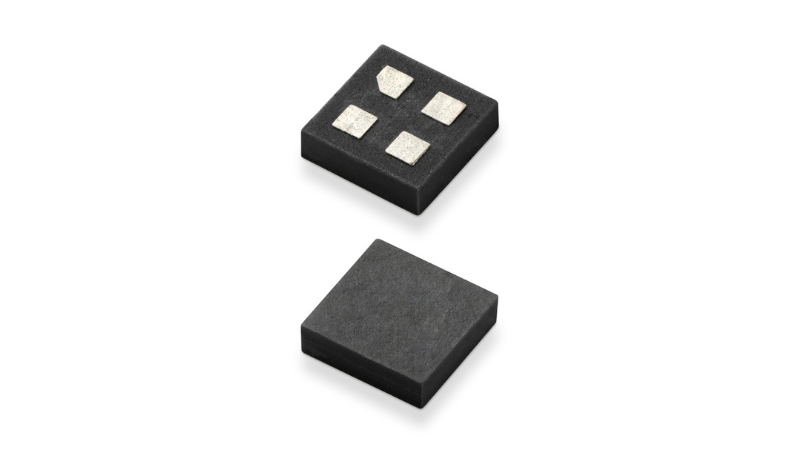
Littelfuse’s omnipolar magnetic switches, the LF21173TMR and LF21177TMR, are housed in a compact LGA4 package. Image used courtesy of Littelfuse
The technology also offers improved temperature stability. While Hall-effect sensors can experience drift across their operating range, TMR sensors maintain more consistent magnetic thresholds over temperature, reducing the need for software compensation or calibration routines in the end application.
Omnipolar TMR Switches
The LF21173TMR features a nominal operating threshold of 9 gauss and a release point of 6 gauss, providing approximately 3 gauss of hysteresis. The LF21177TMR offers a higher threshold at 30 gauss operate and 21 gauss release, giving designers the flexibility to match sensor characteristics to magnet strength and air-gap requirements. Both devices draw a typical supply current of 160 nA and respond to magnetic fields along the X-axis in omnipolar mode, meaning either magnetic pole triggers the output state change.
The push-pull CMOS output swings rail-to-rail and can source or sink current directly to drive downstream logic without external pull-up resistors. The maximum frequency response reaches 50 kHz, which is adequate for position sensing and speed detection in mechanical systems. Operating temperature spans -40°C to 85°C, covering industrial and automotive ambient conditions.
Each device integrates a voltage generator, comparator circuit, digital control logic, and threshold trimming circuitry within the compact LGA4 package, making these switches particularly suitable for applications where board space and profile height are constrained.
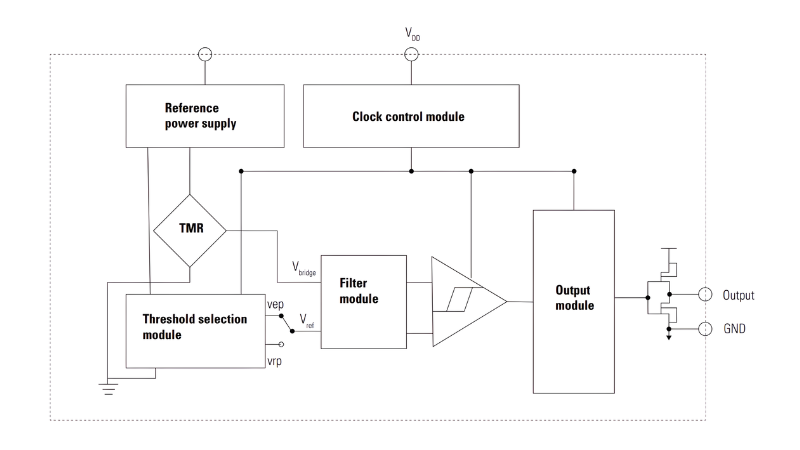
Block diagram of the LF2117XTMR switches. Image used courtesy of Littelfuse
Efficient Battery-Powered Designs
The combination of sub-microampere supply current and flexible voltage operation positions Littelfuse’s new omnipolar magnetic switches for battery-powered sensing applications. Smart utility meters can leverage the low sleep current to extend battery life while maintaining continuous magnetic tamper detection. Electronic door locks can benefit from the wide voltage range, which accommodates battery discharge curves without requiring boost converters. Medical devices such as glucose monitors and insulin delivery systems can benefit from the compact package and power efficiency.
The devices are now being sampled through Littelfuse distribution channels in tape-and-reel quantities of 3,000 units. The LF21173TMR and LF21177TMR expand Littelfuse’s magnetic sensor portfolio by bringing TMR technology to applications that require a combination of high sensitivity, minimal power draw, and compact packaging, which Hall-effect solutions have traditionally struggled to address in battery-operated and space-constrained designs.