
Dracula Technologies Announces Enhanced Light Energy Harvesting OPV
At CES 2026, Dracula Technologies unveiled the next generation of its LAYER OPV module, targeting battery-free IoT devices in indoor ambient lighting conditions.
Dracula Technologies announced LAYER V2.0 at CES 2026, the next generation of its organic photovoltaic (OPV) energy-harvesting technology for battery-free devices in IoT applications. According to the company, the update delivers a 30% performance increase over the previous generation through materials improvements and manufacturing process refinements.
LAYER V2.0 OPV Technology
The performance improvement in Dracula Technologies’ LAYER V2.0 technology stems from a redesigned OPV ink formulation that combines increased light absorption with higher conversion efficiency. The company developed this proprietary ink to optimize performance under indoor lighting conditions, particularly LED sources typically found in commercial and industrial environments.
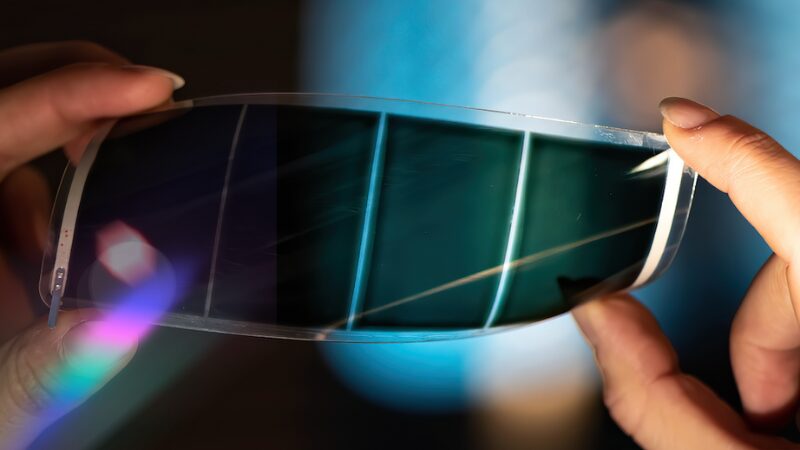
Dracula Technologies’ LAYER harvests energy from both artificial and natural light sources. Image used courtesy of Dracula Technologies
LAYER’s update translates to two implementation options for system designers: higher power output from modules of equivalent size or reduced module surface area for the same power level. The smaller footprint option decreases both material costs and the physical space required for integration into IoT devices. The technology generates power from ambient light starting at 50 lux, making it functional in low-light environments such as warehouses or storage facilities where conventional photovoltaics would be ineffective.
LAYER modules use a bulk heterojunction architecture with an inverted device structure. The active layer consists of a blend containing electron-donating and electron-withdrawing organic materials that form multiple junctions throughout the film. When photons are absorbed, they create excitons that diffuse to donor-acceptor interfaces where charge separation occurs. The separated charges are then transported through the blend to the collection electrodes.
Design and Manufacturing Updates
LAYER’s V2.0 generation introduces changes to both the module construction and production process. The company replaced copper bus bars with screen-printed silver bus bars, reducing inactive areas within the module while creating a more uniform visual appearance. Screen printing for this component layer enables rapid tooling changes between designs, while maintaining the manufacturing flexibility provided by inkjet printing for the other functional layers.
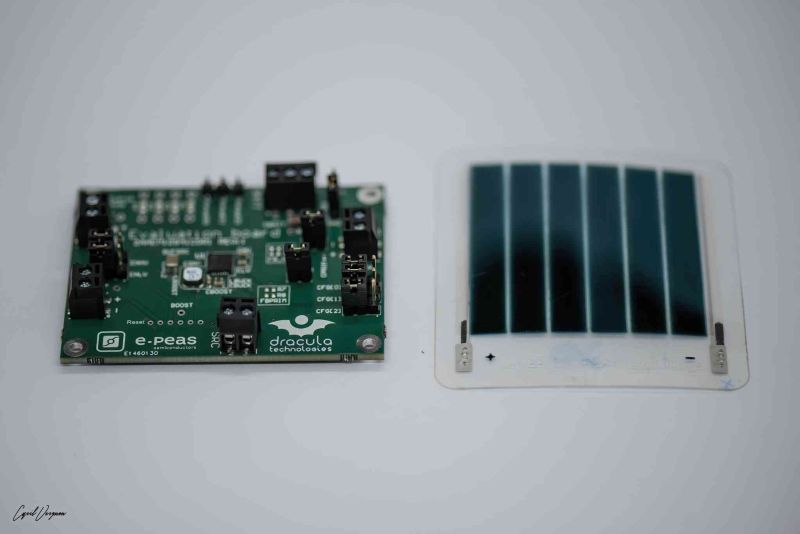
Dracula Technologies’ evaluation kit with a PMIC and OPV module. Image used courtesy of Dracula Technologies
A new top-coating layer offers both aesthetic options for OEM product integration and improved mechanical durability. This coating increases scratch resistance in applications where devices experience physical contact or impacts during normal operation. The coating can be customized for different visual finishes, allowing manufacturers to integrate the modules less conspicuously into their products.
Light Energy Harvesting OPV
OPV technology exhibits a strong spectral response in the 350-750 nm range, matching the emission spectra of fluorescent and LED lighting. This makes organic photovoltaics particularly suited for indoor applications where more than 90 percent of the available light falls within this wavelength range. In contrast, silicon-based photovoltaics are optimized for the broader solar spectrum, including infrared wavelengths, making them less efficient for indoor light harvesting on a power-per-area basis.
Dracula Technologies’ modules operate by converting light photons into electrical current through the photovoltaic effect. Light absorption creates electron-hole pairs bound by Coulombic attraction, called excitons. These excitons diffuse through the organic material until they reach a donor-acceptor interface, where the energy offset between the materials provides the driving force for charge separation. The separated charges must then transport through percolation pathways to the electrodes while avoiding recombination. The nanoscale morphology of the donor-acceptor blend directly affects both exciton dissociation efficiency and charge transport properties.
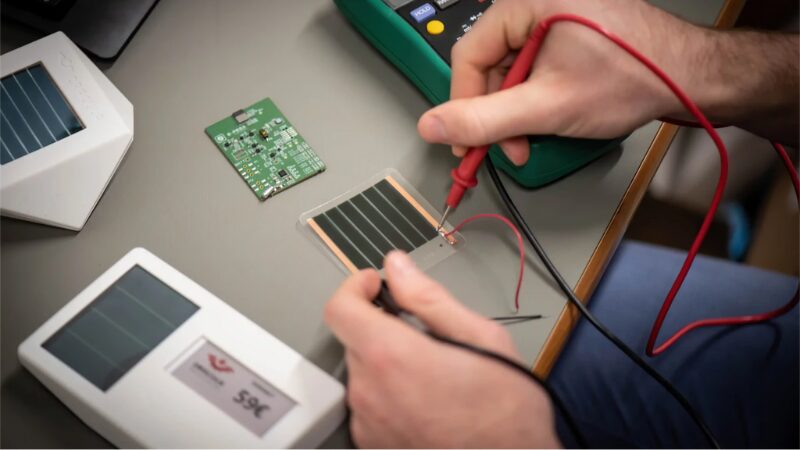
LAYER V2.0 targets battery-free IoT applications in industrial, consumer, and retail markets. Image used courtesy of Dracula Technologies
Battery-Free IoT Applications
LAYER V2.0 targets applications where the combination of low average power consumption and adequate ambient light makes battery elimination feasible. Asset-tracking devices in warehouses can operate continuously without battery replacement by harvesting energy from overhead lighting. Smart building sensors for occupancy detection, temperature monitoring, and air quality measurement represent another application category, particularly in commercial buildings with consistent artificial lighting.
Retail environments deploy electronic shelf labels and inventory-tracking tags that can operate maintenance-free with light-harvesting power. Consumer applications include smart home sensors, wireless switches, and remote controls that eliminate the need for battery replacements. Industrial IoT implementations benefit from facilities monitoring applications, where replacing batteries in thousands of distributed sensors incurs significant labor costs.


