
Luxonis OAK 4 AI Vision Camera Brings 52 TOPS Edge AI Performance
The OAK 4 series integrates on-device AI, depth sensing, and rugged IP67 hardware, enabling real-time computer vision without cloud or external host systems.

OAK 4 AI vision camera
The Luxonis OAK 4 AI vision camera is a self-contained, industrial-grade edge device designed for high-performance computer vision and spatial AI without relying on external hosts or cloud computing. Built for rugged environments, OAK 4 combines advanced sensing, on-device AI inference, and flexible connectivity in a single unit. Powered by state-of-the-art Qualcomm platforms, the OAK 4 series delivers up to 52 TOPS of AI performance, enabling real-time neural network inference with low latency and high efficiency directly at the edge.
The OAK 4 family includes the OAK 4 S, OAK 4 D, OAK 4 D Pro, and OAK 4 CS AI vision camera models. The OAK 4 CS is based on the Qualcomm DragonWing QCS8550 and Luxonis’ RVC4 vision compute platform with a 6-core Armv8 CPU, supporting swappable lenses and optional 5MP global shutter cameras for machine vision. All models feature 8GB RAM, 128GB storage, and a 48MP rolling shutter RGB sensor, while the OAK 4 D and D Pro add dual OV9282 depth sensors, with the Pro version including a laser dot projector. Each device comes in an IP67-rated enclosure with USB or PoE power and M8 I/O, making the OAK 4 series suitable for industrial, robotics, and embedded AI vision applications.
Previously, we covered the CamThink NeoEyes NE301 AI vision camera powered by the STMicroelectronics STM32N6 Arm Cortex-M55 MCU, along with the Seeed Studio Modbus RS485 Vision AI Camera and the Intel RealSense D421 depth camera. Feel free to check them out if you’re interested in similar products.
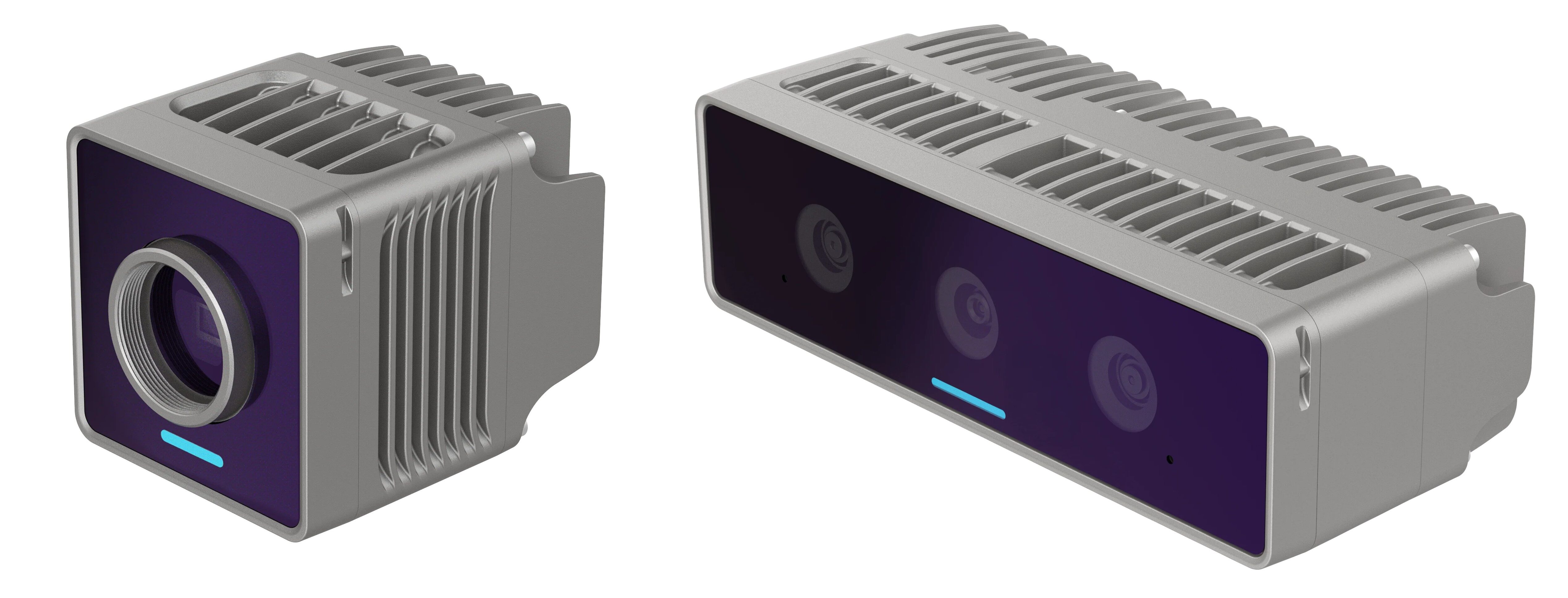
OAK-4CS and OAK-4D6
Luxonis OAK 4 specifications:
- SoC: Qualcomm DragonWing QCS8550
- CPU: 1x GoldPlus core @ 3.2 GHz + 4x Gold cores @ 2.8 GHz + 3x Silver cores @ 2.0 GHz
- GPU: Adreno 740 GPU with support for Ray tracing, OpenGL ES 3.2, Vulkan 1.2, OpenCL 3.0 full profile, Adreno NN direct
- Compute DSP: V73 AI-optimized tensor processor, six threads scalar DSP
- Sensor DSP: Qualcomm Sensing Hub 3.0
- On-board Robotics Vision Core 4 (RVC4) having 6-core ARM CPU (QC 8-series)
- AI: Dual eNPU V3, 4x HVX, HMX, 48 INT8, 12 FP16 TOPs; 4 FP16 TOPS GPU; Combined 52 TOPS
- VPU:
- Video decode up to 4K240/8K60; AV1 decoder
- Video encode up to 4K120/8K30
- Package: 15.6 x 14 mm
- Process Node: 4 nm
- System Memory: 8GB LPDDR5/5x @ 4200 MHz
- Storage: 128GB flash
- Camera:
- 48MP IMX586 RGB Sensor with rolling shutter; three options
- Auto focus: DFOV / HFOV / VFOV – 82.4° / 67.3° / 53°
- Fixed focus: DFOV / HFOV / VFOV – 78° / 66° / 52
- Wide angle: DFOV / HFOV / VFOV – 120° / 95° / 72°
- OR 5MP Global Shutter RGB sensor with global shutter (OG05B10) (option for OAK 4 CS only)
- Depth sensing:
- OV9282 depth sensor (OAK 4 D and OAK 4 D Pro)
- DFOV / HFOV / VFOV – 84.5° / 77° / 52.7°
- Global shutter, Fixed focus
- Depth Range: 70cm to 12m
- Himax Dot projector/infrared illuminator (OAK 4 D Pro only)
- OV9282 depth sensor (OAK 4 D and OAK 4 D Pro)
- 48MP IMX586 RGB Sensor with rolling shutter; three options
- Connectivity: 2.5Gbps Gigabit Ethernet M12 port PoE | 802.3at, Class 3 PoE compliance with 2.5GBASE-T speeds
- USB: USB 3.2 Gen2 (10 Gpbs) Type-C port with screws
- Sensors: 9-axis IMU, 3-microphone array
- Expansion: M8 I/O port
- Misc:
- Reset button, IR LED, Status RGB LED
- 50 or 75mm VESA mount and tripod support
- Power Supply:
- 5V via USB-C port
- Power Consumption – 1.5W to 25W
- Housing:
- Industrial-grade aluminum with Front Gorilla Glass
- Water resistance enclosure with IP65 rating (with lens attached), up to IP67 when paired with Lens Hood
- Dimensions and Weight:
- OAK 4 D and OAK 4 D Pro: 144.78 x 67.34 x 42.5 mm | 674 grams
- OAK 4 S : 71 x 58 x 58 mm | 325 grams
- Temperature Range: -20°C to +50°C
- IP Rating: IP67

OAK-4CS ,OAK-4D6 and OAK-4S AI Vision Camera Specifications
Luxonis OS, a Linux-based operating system based on kernel 5.15, powers the OAK 4 CS AI vision camera. It allows users to run custom CV functions in addition to supporting computer vision functions like edge detection, feature tracking, warp (undistortion), resize, and crop via the “ImageManip” node. While 2D and 3D tracking depends on the “ObjectTracker” node, stereo depth perception is implemented with filtering, post-processing, RGB-depth alignment, and high configurability. Popular AI and computer vision libraries and frameworks, including PyTorch, DepthAi, RTABMap, OpenCV, OpenVINO, and Open3D, are supported by the camera. Additionally, the company offers the Luxonis Hub cloud device-management software for monitoring, updates, deployment, and enhancement. On the documentation website, users can find instructions on how to begin using the cameras.

OAK-4CS internal hardware
The Luxonis store offers all three versions. The starting prices for the OAK 4 S, OAK 4 D, and OAK 4 D Pro are $749, $849, and $949, respectively. Although it isn’t listed on the store, the OAK 4 CS with a swappable lens will retail for $899 in Q1 2026. The Sony IMX586 rolling-shutter and Omnivision OG05B10 global-shutter versions of the OAK 4 CS are priced at $899 and $999, respectively, under an “early access” program. General availability is scheduled for early 2026. The press release and the product page contains more information.
Images used courtesy of luxonis.


