
SK Hynix’s Latest Automotive DRAM Attains ISO 26262 ASIL-D Certification
The LPDDR5X automotive DRAM has achieved the highest safety integrity level for automotive systems, meeting stringent functional-safety requirements for autonomous vehicles and ADAS.
SK Hynix has secured ASIL-D certification from TÜV SÜD for its LPDDR5X automotive DRAM, achieving the highest safety integrity level defined by ISO 26262 for automotive functional safety. The certification validates both the memory chip’s design implementation and the company’s development processes across the complete product lifecycle, from initial specification through mass production.
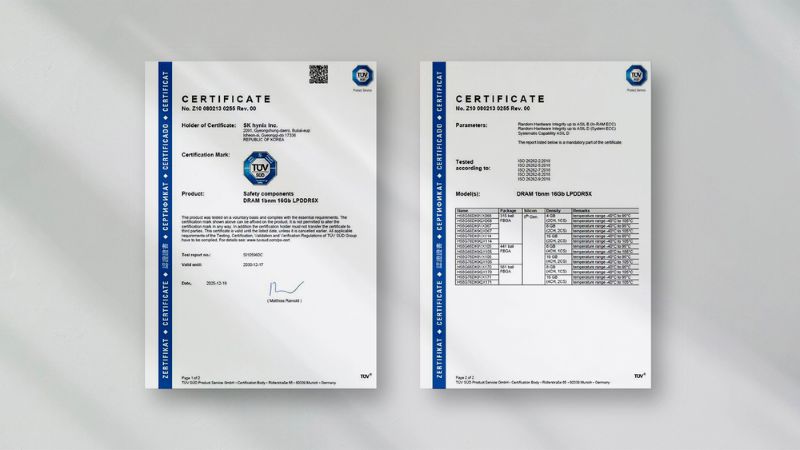
SK Hynix’s LPDDR5X automotive DRAMs have achieved ISO 26262 ASIL-D certification. Image used courtesy of SK Hynix
What Is Automotive Safety Integrity Level D (ASIL-D)?
ASIL-D represents the most stringent classification within the automotive safety integrity framework, typically required for systems where failures could directly impact human safety. The grading system evaluates three risk factors: severity of potential harm, likelihood of exposure, and controllability of the resulting hazard. While conventional automotive displays may require ASIL-B certification, autonomous driving control systems must meet ASIL-D due to their safety-critical nature.
The certification process examined SK Hynix’s safety architecture, error detection mechanisms, development methodologies, and quality management systems. TÜV SÜD’s evaluation encompassed not only the LPDDR5X chip itself but also the frameworks supporting its development and manufacture. This comprehensive assessment ensures that functional safety considerations were integrated throughout the engineering process rather than added as an afterthought.
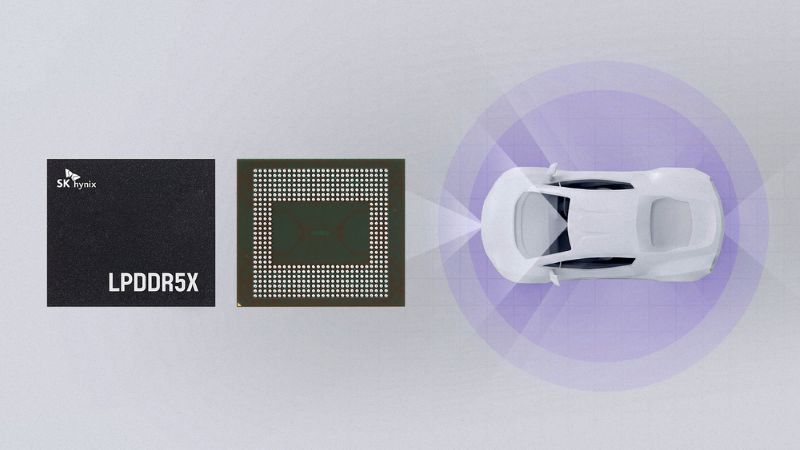
With ASIL-D certification, the LPDDR5X targets modern automotive applications such as autonomous driving control systems. Image used courtesy of SK Hynix
Technical Implementation of Safety Mechanisms
Meeting ASIL-D requirements required specific design choices that addressed both systematic failures and random faults. Systematic failures arise from issues in development, design, or verification processes. Random faults occur during normal operation due to component degradation over time, even when the latest manufacturing technologies are properly applied.
To manage systematic failures, SK Hynix established a functional safety management (FSM) system that documents and tracks all stages from customer requirements through design verification and production control. This framework standardizes decision-making processes and ensures appropriate verification methodologies are applied based on the target ASIL level.
To mitigate random faults, the LPDDR5X design incorporates several hardware-level safety features. Error correction code circuitry provides data integrity protection by detecting and correcting bit errors during memory operations. A dual-fuse mechanism provides redundancy to handle manufacturing defects. The chip also implements fault notification capabilities that diagnose error severity and communicate status to the host system.
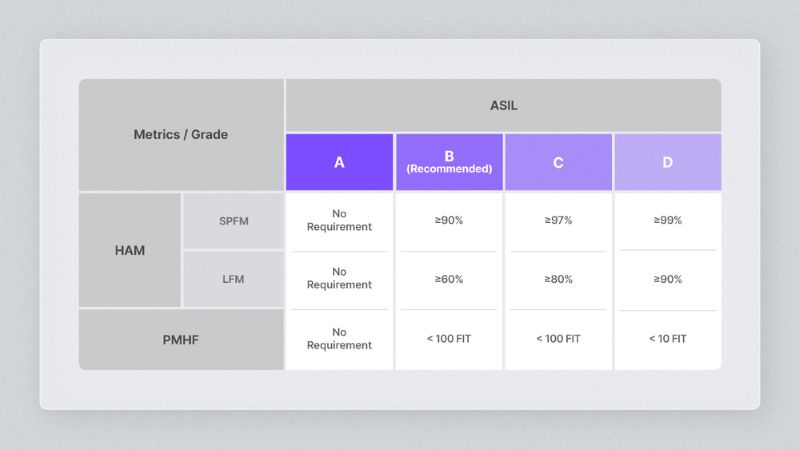
A look at ASIL safety metrics, including single-point fault metric (SPFM), latent fault metric (LFM), and probabilistic metric for hardware failures (PMHF). Image used courtesy of SK Hynix
These mechanisms must satisfy quantitative metrics defined in the ASIL-D specification. The single-point fault metric must exceed 99%, meaning the design must handle single-point failures without causing system-level hazards in at least 99% of cases. The latent fault metric requires greater than 90% coverage, ensuring that dormant faults are detected before they combine with other failures to create dangerous conditions. The probabilistic metric for hardware failures must remain below 10 FIT, where 1 FIT represents 1 failure in 1 billion device hours.
Next-Generation Automotive Systems
The achievement positions SK Hynix’s LPDDR5X for use in next-generation ADAS implementations, autonomous-driving computers, and in-vehicle infotainment systems that require certified functional safety. As automotive manufacturers select memory components for safety-critical applications, ISO 26262 compliance has transitioned from a competitive advantage to a baseline requirement for supplier consideration.
The certification’s scope extends beyond the chip’s technical specifications to encompass the manufacturing and quality control processes that produce it. This systems-level approach ensures consistency between development samples and production units, a critical consideration for automotive applications where components may remain in service for 15 years or longer.
SK Hynix’s LPDDR5X now provides automakers with a certified memory solution meeting the functional safety requirements of modern automotive electronics architectures.


