
Texas Instruments Expands Family of Logic Gates for 2 V to 6 V Operation
Texas Instruments has grown its digital logic family with SN74AC132 quadruple two-Input NAND gates, featuring both standard and AEC-Q100 automotive-qualified versions to support a wide range of designs.
In a move to support the increasing demand for high-speed, high-performance digital circuits, Texas Instruments has introduced a new family of digital logic gates under the SN74AC series. This launch aims to provide engineers with modern, reliable building blocks for a wide array of applications, from industrial systems to consumer electronics and automotive designs. The family includes both standard and AEC-Q100 qualified automotive-grade versions.
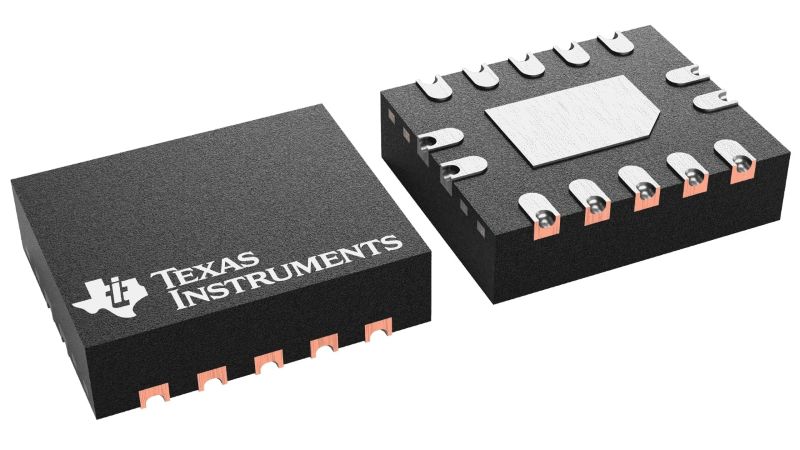
Texas Instruments’ SN74AC132 14-pin BQA smaller, leadless package. Image used courtesy of Texas Instruments
Digital Logic Gates
Digital logic gates are the foundational components of virtually every electronic device. While many designers now rely on FPGAs or microcontrollers for complex logic, discrete gates remain essential for simple functions, signal conditioning, and glue logic. They are particularly valuable for designers who need fast, predictable performance without the overhead of programmable logic. The new SN74AC family is positioned to fill this role by offering a robust combination of speed and low power consumption.
Four-Channel Two-Input NAND Gates
The new SN74AC132 and SN74AC132-Q1 NAND gates operate over a wide supply voltage range from 2 V to 6 V. This wide operating range provides design flexibility and simplifies integration into systems that may have varying voltage domains, including those using legacy 5 V logic. Despite the wide voltage tolerance, the devices are engineered for high-speed operation, with maximum 7.5 ns typical propagation delays (tpd) at a 5 V supply voltage. This speed is critical for time-sensitive applications where signal latency must be minimized.
The SN74AC family is built using Texas Instruments’ Advanced High-Speed CMOS (AHC), which enables it to achieve high drive strength while maintaining a low quiescent supply current. The outputs are rated to source and sink up to ±24 mA, providing ample drive capability for controlling subsequent logic stages or driving transmission lines with up to a 50 Ω impedance. The low quiescent current, typically in the single-digit microampere range, is a significant advantage in power-sensitive and battery-powered applications where standby current draw must be minimized.

A simple SN74AC132 NAND gate schematic. Image used courtesy of Texas Instruments
Regular and Automotive-Grade Versions
A notable aspect of this launch is the availability of both standard and automotive-grade versions. The automotive parts, denoted with a -Q1 suffix, are AEC-Q100 qualified. This qualification confirms the components’ reliability for use in demanding automotive environments. They are rated for a device temperature grade 1, operating from -40 °C to 125 °C, and meet the stringent ESD standards required for in-vehicle systems.
The inclusion of an automotive-grade option streamlines the design and qualification process for engineers in the transportation sector. It ensures that designers can use the same logic family for both their primary designs and their automotive variants, reducing the need for requalification and accelerating time to market.
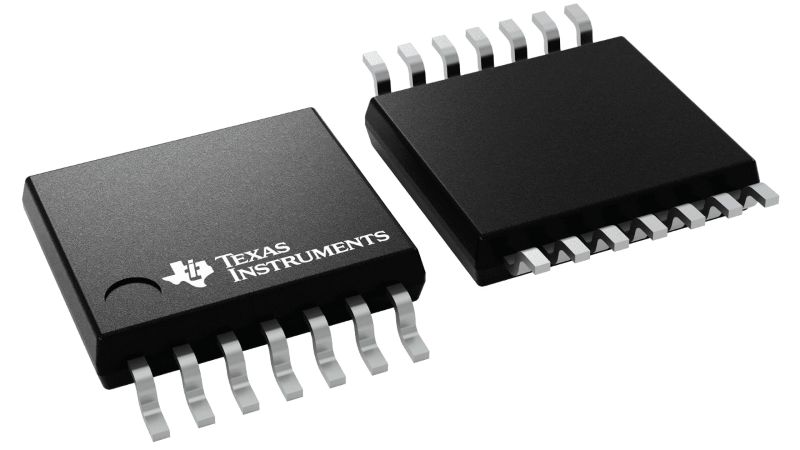
Texas Instruments’ SN74AC132 14-pin PW larger, leaded package. Image used courtesy of Texas Instruments
2 V to 6 V Operation
With the expansion of the SN74AC series, Texas Instruments provides a clear and reliable path for engineers seeking foundational logic components that meet the demands of modern applications. By combining high-speed performance, a wide operating voltage range, and a broad selection of standard and automotive-grade devices, the family offers a versatile toolset for solving today’s digital design challenges.


