
Würth Elektronik’s WE-FNCS Targets Low-Frequency EMI Shielding
Würth Elektronik expands its EMC lineup with thin, flexible nanocrystalline sheets that suppress magnetic interference from 10 Hz to 120 MHz.
Achieving EMC compliance in the low-frequency range has long meant turning to mu-metal, a material that works well but comes with real trade-offs in cost, weight, and machinability. Würth Elektronik’s newly released WE-FNCS (Flexible Nanocrystalline Sheets) offer a lighter, more practical alternative, targeting EMI attenuation across a frequency range of roughly 10 Hz to 120 MHz.
Nanocrystalline Construction and Magnetic Performance
WE-FNCS sheets derive their performance from a nanocrystalline grain structure, which delivers exceptionally high magnetic permeability alongside strong flux saturation. Standard catalog variants are available with complex permeability values of 1,000, 2,000, and 10,000 at 128 kHz, with sheet dimensions up to 120 mm × 65 mm and thicknesses ranging from 0.06 mm to 0.13 mm. Roll-format variants extend to 15,000 mm in length, making the material well-suited for production environments. The maximum configurable thickness reaches 0.3 mm when up to 12 nanocrystalline layers are stacked, and each additional layer scales the absorption performance proportionally. An operating temperature range of −40°C to 85°C keeps the sheets viable across most industrial and consumer deployment scenarios.
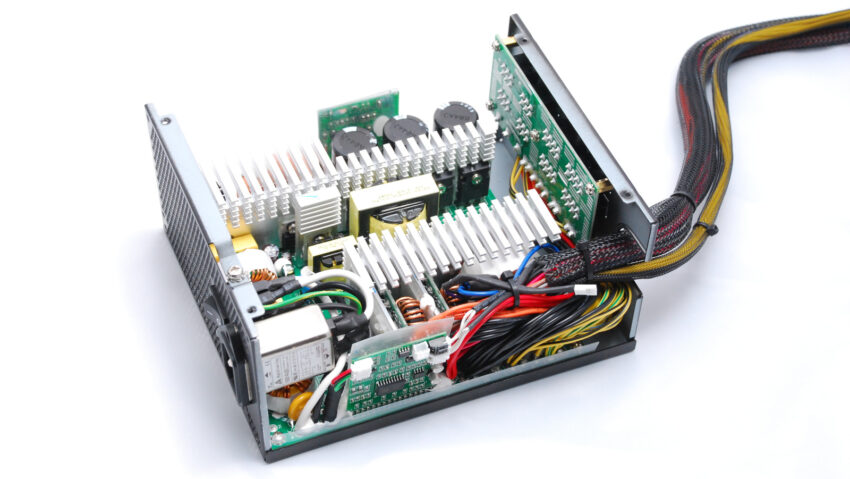
The switching components inside a PC power supply are common sources of low-frequency EMI, exactly the kind of interference WE-FNCS sheets are designed to suppress. Image used courtesy of Adobe Stock
A black PET cover layer handles electrical insulation on the upper surface, while an acrylic adhesive layer on the underside simplifies placement during assembly or field installation. Both faces are shipped protected by a removable foil. Beyond acting as a shielding barrier, WE-FNCS sheets can also improve wireless power transfer efficiency by channeling magnetic flux and reducing stray-field losses, a useful secondary function for charging applications. Würth Elektronik supports custom formats and layer configurations upon request, and provides technical integration assistance.
Target Applications
For engineers who spend time wrestling with low-frequency emissions from power transformers, CMCs, DC/DC converters, inverters, or switched-mode power supplies, or shielding sensitive components like Hall effect sensors from ambient magnetic interference, WE-FNCS presents a compelling option. The same applies to medical equipment such as MRI systems, where the management of low-frequency magnetic fields is a well-known design constraint. The flexibility, adhesive backing, and configurable permeability make these sheets relatively straightforward to slot into both new designs and retrofit applications, which should appeal to anyone looking to close an EMC gap without a major redesign.


