
A Look at the AP7369Q: Diodes’ Latest AEC-Q100 Qualified LDO Regulator
The AP7369Q is an automotive-compliant, low-dropout (LDO) regulator with a 3 V to 45 V input voltage range that provides a 150 mA output, low quiescent current, high PSRR, and integrated protection.
Diodes Incorporated has announced the release of the AP7369Q, a new automotive-compliant low-dropout (LDO) linear regulator. This device is designed to provide a stable, regulated voltage in automotive applications, with a focus on systems that require both high input voltage tolerance and low power consumption.

Diodes’ AP7369Q is an LDO regulator suitable for battery-powered systems in automotive applications. Image used courtesy of Diodes Incorporated
AP7369Q Automotive-Compliant LDO Regulator
The AP7369Q LDO regulator features a wide input voltage range of 3 V to 45 V. This large operational window makes the device versatile for use in automotive systems, which are subject to significant voltage fluctuations, such as during cold-crank conditions or load dumps. The LDO can deliver a maximum output current of 150 mA, which is suitable for powering microcontrollers, sensors, and other low-power components.
A key performance metric for the AP7369Q is its low quiescent current, rated at 2.1 µA (typical). This characteristic is crucial for “always-on” systems in vehicles, as it minimizes power draw from the battery when the vehicle is off, thereby helping to extend battery life.
The regulator is available in fixed output voltage options of 2.5 V, 3.3 V, and 5.0 V, with an output voltage accuracy of ±2%. The low dropout voltage is another critical feature, specified at 35 mV typical at 10 mA and 350 mV typical at 100 mA. This enables the regulator to maintain a stable output even when the input voltage drops close to the desired output voltage, a common scenario in battery-powered or automotive systems.
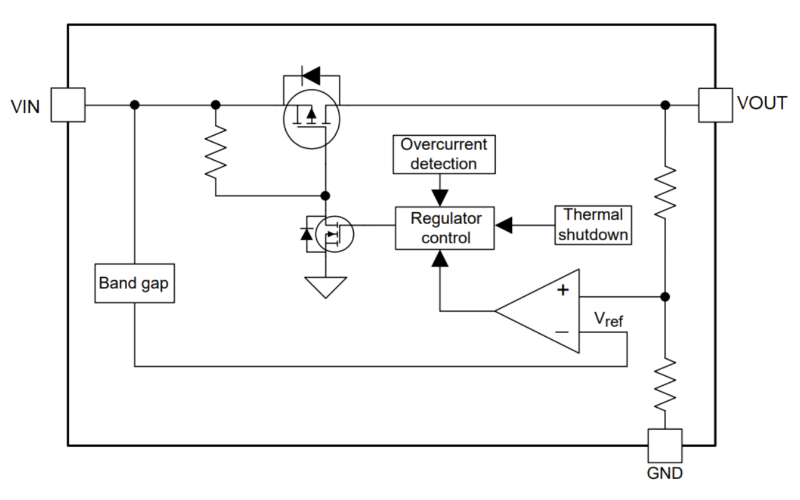
Functional block diagram for the AP7369Q LDO regulator. Image used courtesy of Diodes Incorporated
Noise Rejection and Transient Response
The AP7369Q features a high power supply rejection ratio (PSRR) of 85 dB at 1 kHz. In a system where the input power rail may be noisy due to sources like a DC-DC converter or the vehicle’s alternator, a high PSRR is essential for ensuring a clean, stable output voltage. The device also offers excellent line and load regulation, maintaining a stable output despite changes in input voltage or output current.
In addition to its steady-state performance, the LDO is designed with a very fast response to line and load transients, preventing voltage overshoot during startup and short-circuit recovery. This transient response performance is vital for protecting sensitive downstream circuitry from sudden changes in the power supply.
Integrated Protection and Compliance
For robust and reliable operation, the AP7369Q incorporates several integrated protection features. These include short-circuit protection and a thermal shutdown function. The thermal shutdown activates when the junction temperature reaches 175 °C, preventing permanent damage to the device. These features are standard requirements for power management ICs in demanding environments.
The AP7369Q is AEC-Q100 qualified, PPAP capable, and manufactured in facilities that meet IATF 16949 certification. These certifications confirm its suitability for use in automotive applications, where reliability and traceability are paramount. The device is available in a compact SOT25 package and the larger SOT223 package, offering flexibility for thermal dissipation and board layout.
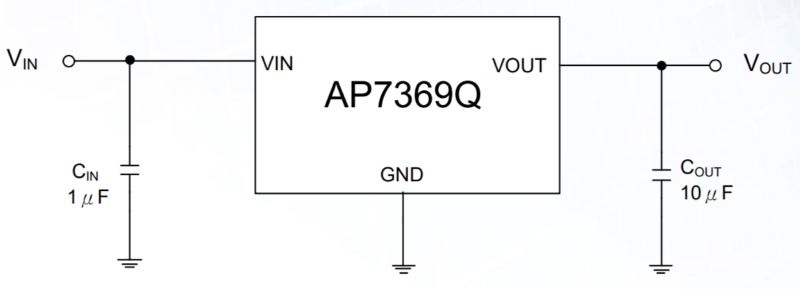
Typical applications circuit for the AP7369Q LDO regulator. Image used courtesy of Diodes Incorporated
Powering Automotive Applications
Diodes’ AP7369Q is a robust LDO regulator designed to meet the rigorous demands of automotive systems. Its wide 45 V input range, low quiescent current, high PSRR, and integrated protection make it a dependable component for power regulation. The device is well-suited for a variety of automotive applications, including powering microcontrollers and CAN/LIN transceivers in vehicle control modules, head units and infotainment systems, and battery management systems in EVs and HEVs.


