
CES 2026: Broadcom Brings Edge AI to Wi-Fi 8 with New BCM4918 APU
The newly announced Wi-Fi 8 SoC integrates a proprietary Neural Engine and 10G PHYs to offload AI inference from the main CPU in next-gen residential access points.
Broadcom has announced the BCM4918, a new quad-core Armv8 Accelerated Processing Unit (APU) built specifically for Wi-Fi 8 (IEEE 802.11bn) access points. Unlike earlier residential gateway SoCs that were designed for raw packet throughput, the BCM4918 is designed for smarter edge processing by integrating a dedicated AI/ML engine directly into the silicon.
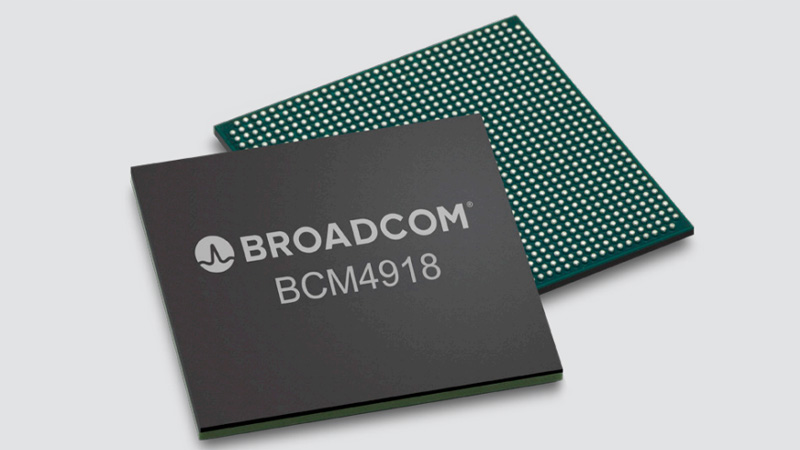
Broadcom BCM4918 Wi-Fi 8 APU. Images used courtesy of Broadcom
The “AI-Ready” Architecture
At its core, the BCM4918 features a quad-core Armv8-compatible CPU, but the most interesting addition is the Broadcom Neural Engine (BNE). In traditional access point designs, tasks like traffic analysis, security checks, and network optimization are handled by the main CPU. This can introduce latency when the processor is already busy pushing multi-gigabit data.
With the BNE, Broadcom moves these AI and machine-learning inference tasks into dedicated hardware. This allows the access point to run AI workloads locally, including tasks like detecting unusual network behavior or dynamically adjusting QoS without relying on the cloud or slowing down the main processor, effectively turning the router into a small edge computing device.
Packet Processing and I/O
Beyond the AI engine, the BCM4918 use Broadcom’s “Runner” packet-offload architecture. It is built around a dual-issue Runner network processor (DI-XRDP) that takes care of both wired and wireless data traffic.
The SoC is designed to keep packet handling away from the main CPU entirely. According to Broadcom, the engine enables “complete CPU bypass of all networking traffic”. By offloading routing and forwarding tasks to the DI-XRDP and dedicated networking blocks, the Arm cores are freed up to run higher-level software, such as system services or containerized applications, while ensuring ultra-low latency for network traffic.
Key Technical Specifications:
- CPU: Quad-core ARMv8-compatible processor.
- AI Acceleration: Integrated Broadcom Neural Engine (BNE).
- Memory: Support for advanced memory interfaces (DDR) and Flash memory.
- Networking Offload: Dual Issue Runner Network Processor (DI-XRDP) for wired/wireless data path offload.
- Ethernet Interfaces:
- Integrated Multi-Gig Ethernet PHYs.
- USXGMII port for 10Gbps connectivity.
- Expansion & I/O:
- Quad PCIe Gen3 controllers (configured as x1 lanes for radio integration).
- Dual USB ports (supporting USB 3.2/2.0).
- Package: 19 mm x 19 mm FCBGA.
Integration and Connectivity
The BCM4918 is designed as the central processing hub for a Wi-Fi 8 access point, interfacing with Broadcom’s accompanying radio chips via PCIe. The block diagram highlights a specific split for these radios:
- BCM6718: A 4×4 radio dedicated to the 6.0 GHz band.
- BCM6719: A 4+4 radio handling the 5.0 GHz and 2.4 GHz bands.
To simplify hardware design, Broadcom has integrated significant connectivity directly into the die. The block diagram shows multiple integrated Multi-Gig PHYs alongside the USXGMII interface, enabling direct connections to 2.5GbE or 10GbE LAN/WAN ports without relying on extensive external PHY components. The chip also includes support for RGB LEDs and standard peripherals.
On the security side, the BCM4918 adds a Secure Boot ROM, OTP (One-Time Programmable) memory, and a dedicated cryptographic engine to accelerate security protocols and strengthen platform protection.
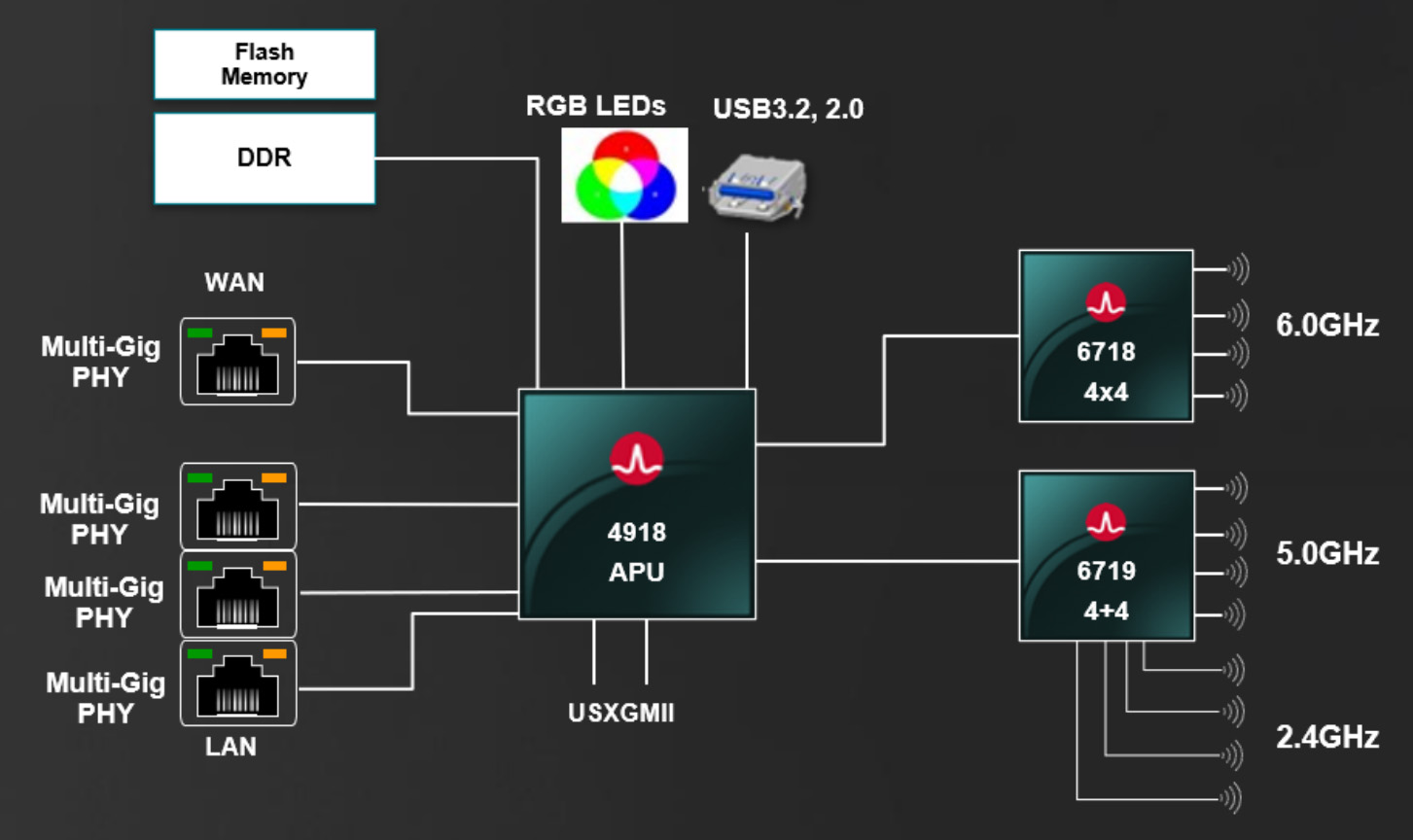
Typical tri-band Wi-Fi 8 access point block diagram with BCM4918 SoC, 6GHz BCM6718, and 2.4GHz+5GHz BCM6719. Images used courtesy of Broadcom
The Shift to Wi-Fi 8
While Wi-Fi 7 (802.11be) is only now becoming mainstream, the industry is already looking ahead to Wi-Fi 8 (802.11bn). Instead of chasing higher peak speeds, Wi-Fi 8 puts more emphasis on reliability and very low latency. The launch of the BCM4918 shows that chipmakers see on-device AI as a key part of achieving these goals, using machine learning to anticipate interference and adjust network behavior in real time.
Broadcom rates the BCM4918 for an operating temperature range of 0°C to 70°C, which aligns with typical requirements for commercial and residential networking hardware. The press release didn’t mention a mass production timeline. More details may be found on the product page.


