
MediaTek Genio 520 designed for GenAI applications
MediaTek Genio 520 is a high-performance IoT SoC designed to support edge artificial intelligence and generative AI applications.
MediaTek Genio 520 IoT system-on-chip
At Embedded World 2025, MediaTek unveiled the Genio 520, a high-performance and energy-efficient IoT system-on-chip designed to support edge artificial intelligence and generative AI applications. The company highlights that the Genio 520 is designed for a wide range of intelligent and interactive IoT use cases, including smart home systems, interactive retail kiosks, point-of-sale systems, human-machine interfaces, and factory automation.
Given the increasing demand for generative AI, the Genio 520 SoC enables on-device local inference with 10 TOPS, achieving lower latency. This makes it an ideal choice for scenarios where reliance on the cloud is impractical. MediaTek’s unified hardware and software ecosystem will enhance the application landscape, allowing for maximizing reuse across product lines, from the Genio 520 to the more advanced Genio 720, therefore accelerating development cycles.
In comparison, the Genio 520 provides better performance relative to the Genio 510. It features an upgraded GPU, moving from a hexa-core to an octa-core configuration with a higher clock rate. MediaTek claims that this upgrade results in more than a 10 percent improvement in both single- and multi-core performance. The module also includes support for Wi-Fi 6 (1×1) and Wi-Fi 6E (2×2) options, which improves the bill of materials.
Specifications of Genio 520 SoC
- CPU: 2x Arm Cortex-A78 at 2.2 GHz and 6x Arm Cortex-A55 at 2.0 GHz
- GPU: Arm Mali-G57 MC2 at 880 MHz supporting OpenGL ES 3.2, Vulkan 1.1, OpenCL 2.2
- NPU: 8th generation NPU delivering 9 TOPS
- Image signal processor: 1x ISP and single camera at 16 MP at 30fps
- Wireless connectivity: WiFi-6 1×1/Bluetooth 5.3 and WiFi-6E 2×2/Bluetooth 5.3
- Memory: x32 LP4X-4266 up to 8 GB and x32 LP5(X)-6400 up to 16 GB
- Storage: eMMC 5.1, UFS 3.1, 2x SD 3.0, SPI-NOR
- I/O: 2x USB 2.0 (Host), 1x USB 2.0 (Host/Device), 1x USB 3.2 Gen1 (Host/Device, shared with DP), 1x USB 3.2 Gen1 (Host), 1x GbE MAC (TSN), 1x PCIe 2.0, 4x UART, 9x I2C, 6x SPI Master, 3x PWM
- Display controller: Dual display with max. 2.5K60+2.5K60, single display with max UW5K60 or 4K60
- Video interface: 2x MIPI-CSI (4L)
- Decode: H.264/H.265/VP9 (4K60) and MPEG4/VP8 (FHD60)
- Encode: H.264/H.265 (4K30)
- Audio interface: 2x I2S/TDM input, 2x I2S/TDM output, 2x PDM input, 1x PCM input/output
- Operating temperature: Consumer 20°C to 95°C and Industrial -40°C to 105°C
- Dimensions: 13.8 x 11.8 x 0.9 mm, 0.4 mm ball pitch
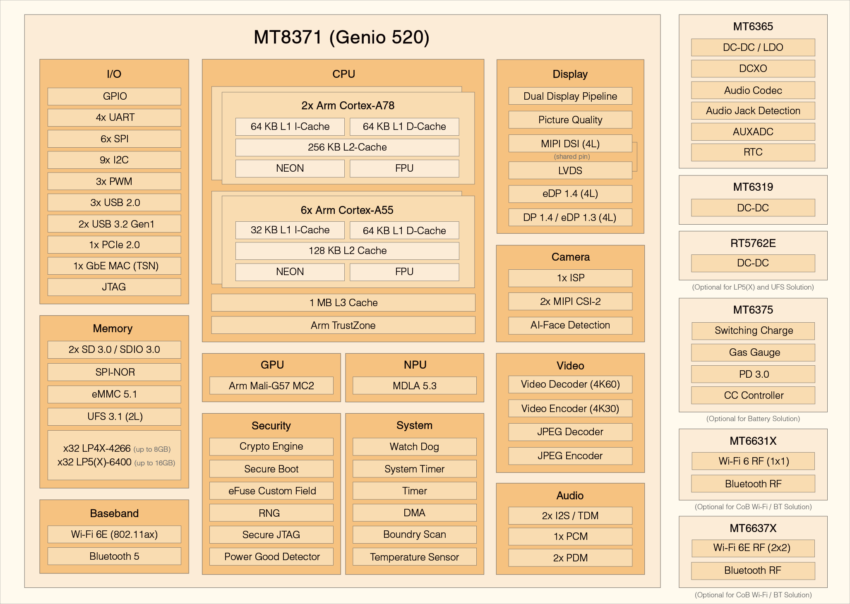
MediaTek Genio 520 Block Diagram
In terms of software support, the MediaTek Genio 520 will officially accommodate Android, Yocto Linux, and Ubuntu. The system can also be integrated with the Nvidia TAO Toolkit and supports common large language models (LLMs) for generative AI deployment. It will also provide support for Open Standard Module reference designs, ensuring pin-to-pin compatibility, particularly between the Genio 520 and Genio 720 for easy scaling.
It’s important to note that not all operating systems will enable the full capabilities of the SoC. Each operating system and its respective release version offer varying levels of hardware feature enablement. For more details, developers should refer to the release notes for Android and Yocto provided by MediaTek.
All images courtesy of MediaTek


