
CES 2026: Qualcomm Debuts Next-Gen Dragonwing Q-Series Processors
The new Dragonwing Q-8750 and Q-7790 processors feature on-device AI, enhanced multimedia capabilities, and high-performance processing to advance consumer and industrial edge devices.
Qualcomm Technologies featured two new processors in its Dragonwing lineup at CES 2026, expanding its industrial and embedded IoT portfolio with the Q-7790 and Q-8750. These Dragonwing Q-series processors target edge AI deployments where local processing reduces latency and eliminates cloud dependencies for time-sensitive applications.
Qualcomm introduced its new Qualcomm Dragonwing Q-series processors at CES 2026. Image used courtesy of Qualcomm Technologies
Q-8750: High-Performance Edge Computing
The Dragonwing Q-8750 processor represents Qualcomm’s most capable IoT processor to date. Built around an octa-core Oryon CPU running up to 4.32 GHz, the chip pairs this with an Adreno 8-series GPU clocked at 1.1 GHz. The processor delivers 77 TOPS of dense AI performance via its Hexagon V79 tensor processor, supporting INT4/8/16 and FP16 precision operations.
The Q-8750’s AI engine enables on-device inference for large language models with up to 11 billion parameters, enabling systems to run complex neural networks locally. For video-intensive applications, the processor handles 8K video encoding at 30 fps and decoding at 60 fps. Video decode performance scales to 4K at 240 fps when lower resolutions are required.
The camera subsystem supports up to 12 physical cameras through triple 48 MP image signal processors. Memory support extends to 24 GB via four 16-bit LPDDR5X channels running at 4800 MHz. The processor targets applications in autonomous drones, multi-angle vision systems, and media hubs that require simultaneous processing of multiple high-resolution video streams.
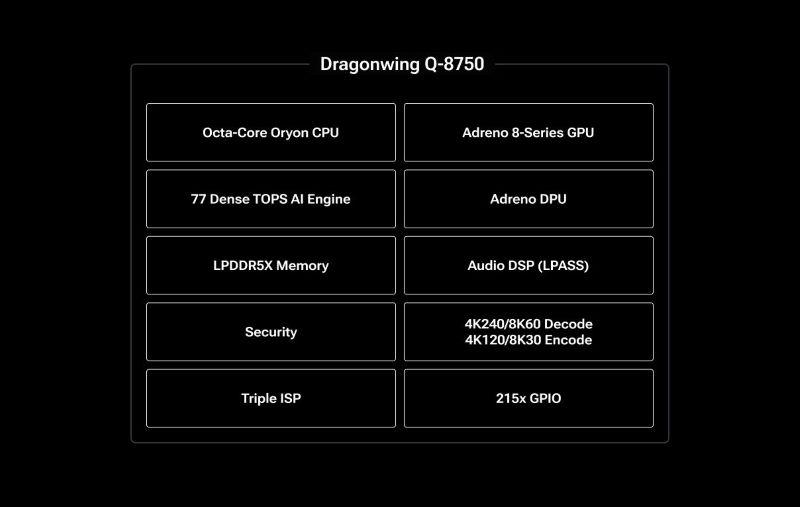
Block diagram of the Dragonwing Q-8750 processor. Image used courtesy of Qualcomm Technologies
Q-7790: Mainstream AIoT Performance
Positioned for cost-sensitive and power-constrained designs, the Dragonwing Q-7790 processor delivers 24 TOPS of on-device AI performance. The processor handles dual 4K60 display outputs, 4K120 video decoding with hardware AV1 support, and 4K60 encoding. Available in two SKUs, CQ7790M and CQ7790S, the processors support up to 16 GB of memory via dual 16-bit channels.
Security features include a Total Management Engine, Secure Boot, and Qualcomm Trusted Execution Environment. The Q-7790 targets smart cameras, AI-enabled televisions, video collaboration systems, and industrial vision applications where moderate AI acceleration and 4K video capability meet requirements without the multi-camera support of the Q-8750.
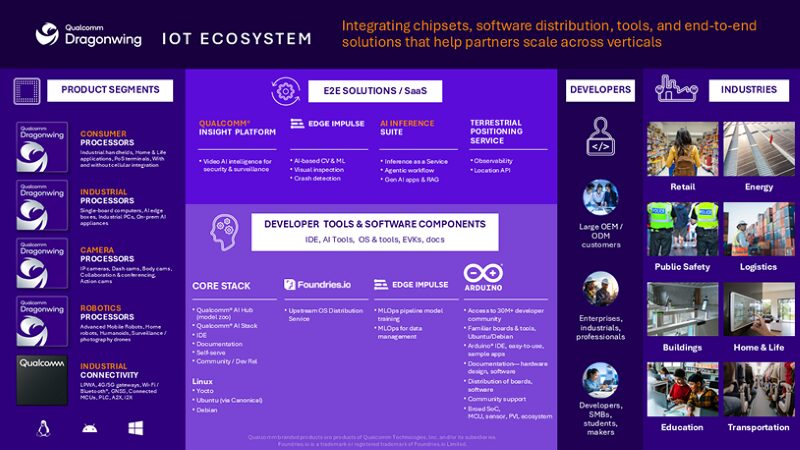
Qualcomm’s Q-series processors benefit from the company’s unified IoT ecosystem. Image used courtesy of Qualcomm Technologies
Software and Connectivity
Both processors support Android 15 and Linux. Qualcomm provides OTA-ready software packages for field updates. Connectivity options depend on companion chips, with Wi-Fi 7 and Bluetooth available through separate modules. The processors include extensive peripheral support with dedicated buses for I3C, I2C, SPI, and UART interfaces.
The announcement aligns with Qualcomm’s broader industrial and embedded IoT strategy, which now incorporates technologies from recent acquisitions, including Arduino, Edge Impulse, Augentix, Focus.AI, and Foundries.io. These additions provide development tools, edge AI deployment frameworks, and secure IoT device management platforms.
Next-Generation Edge Applications
Qualcomm’s Dragonwing Q-series processors address edge computing requirements where centralized cloud processing introduces unacceptable latency or bandwidth constraints. The Q-8750’s multi-camera architecture suits autonomous drones requiring real-time obstacle detection and navigation, surveillance systems processing multiple video feeds with on-device analytics, and industrial inspection stations analyzing parts from multiple angles simultaneously.
The Q-7790 targets single-camera smart security systems with local AI processing, retail analytics displays combining video and customer interaction data, and video conferencing endpoints with background processing and noise cancellation. Both processors enable applications to execute neural network inference locally, reducing operational costs associated with cloud compute while maintaining data privacy for sensitive deployments.


