
CES 2026: Snapdragon X2 Plus 3nm SoCs Targets Copilot+ PCs With 80 TOPS AI and Multi-Day Battery
The new platform brings the 3rd Gen Oryon CPU and an 80 TOPS NPU to the mainstream laptop market, promising multi-day battery life and advanced AI capabilities.
At CES 2026, Qualcomm Technologies announced the Snapdragon X2 Plus. Positioned as a “bold leap forward” for modern professionals and aspiring creators, the new SoC is designed to power the next generation of sleek, ultra-portable Windows 11 Copilot+ PCs.
The X2 Plus integrates Qualcomm’s 3rd Generation Oryon CPU and a powerful Hexagon NPU, targeting devices expected to hit shelves in the first half of 2026. Most likely at the time of writing, those are in their final production step.
Qualcomm’s Snapdragon X2 Plus platform targets ultra-portable Windows 11 Copilot+ PCs, combining a 3rd Gen Oryon CPU with on-device AI acceleration and high efficiency. Images used courtesy of Qualcomm
The 3rd Gen Oryon CPU
The core part of the Snapdragon X2 Plus is the 3rd Generation Qualcomm Oryon CPU. Qualcomm has optimized this architecture for efficiency and multitasking, claiming a significant performance jump over previous generations. The platform is available in two distinct configurations to suit different OEM designs and performance needs:
- 10-Core Variant (X2P-64-100): Features 6 Prime cores and 4 Performance cores, clocking up to 4.0 GHz multi-thread and 4.04 GHz single-core boost. It includes a substantial 34 MB total cache.
- 6-Core Variant (X2P-42-100): A more streamlined option with 6 Prime cores (no Performance cores), also reaching 4.0 GHz multi-thread speeds with 22 MB total cache.
While CPU clocks remain similar across variants, the graphics subsystem sees a major differentiation. The 10-core model’s GPU operates at 1.7 GHz, whereas the 6-core version is significantly slower at 0.9 GHz. Built on a 3nm process node, the X2 Plus is engineered for “intelligent power management,” delivering what Qualcomm describes as “multi-day battery life” that remains consistent whether plugged in or running on battery.
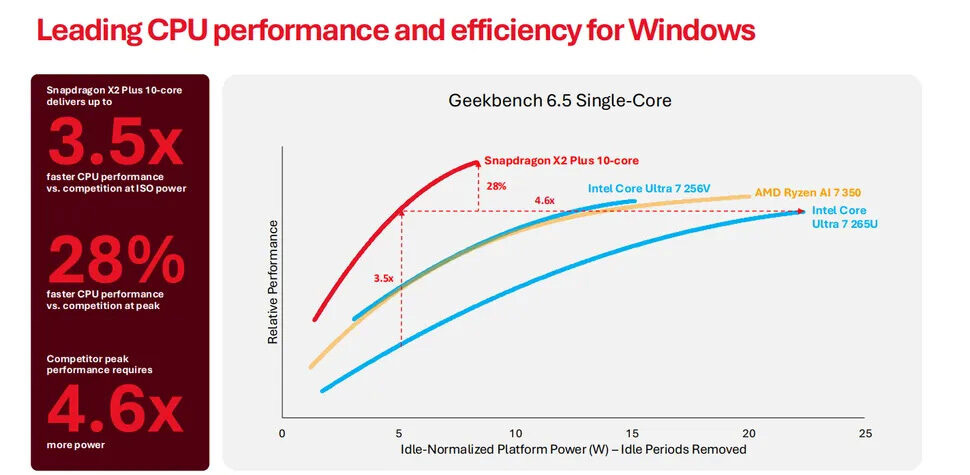
Qualcomm claims the Snapdragon X2 Plus (10-core) delivers up to 28% higher single-core Geekbench 6.5 performance and up to 3.5× better performance per watt than Intel Core Ultra 7 processors. Images used courtesy of Qualcomm
80 TOPS AI Performance with Hexagon NPU
The most substantial upgrade in the X2 Plus is the NPU capacity. While the previous generation offered 45 TOPS, just enough to meet Microsoft’s baseline Copilot+ requirements, the new X2 Plus jumps to 80 TOPS, matching the premium X2 Elite series.
This means that local AI workloads like live captions, image generation, and agentic AI tasks should run just as fast on an entry-level X2 Plus laptop as they do on a top-tier X2 Elite system. This “lightning-fast AI acceleration” enables the NPU to handle complex background tasks efficiently, keeping the CPU and GPU free for other workflows.
This “lightning-fast AI acceleration” is designed to handle on-device tasks like Photo and video editing, Multimodal content generation, Autonomous AI agents, Live translation, and advanced audio/video effects for streaming. The NPU works in the background to enable effortless multitasking and “agentic” AI experiences, a key requirement for the growing ecosystem of Windows 11 Copilot+ applications.
Connectivity and Graphics
The platform supports Wi-Fi 7 (802.11be) with High Band Simultaneous (HBS) multi-link operation to reduce latency, along with the Snapdragon X75 5G Modem-RF System for always-connected PCs, offering peak download speeds of up to 10 Gbps.
Graphics are handled by the Qualcomm Adreno GPU, which can drive up to three external displays at 4K 144 Hz (or 5K 60 Hz) and includes dedicated media engines supporting 8K video decode at 60 FPS (AV1, HEVC, AVC) and 8K encode at 30 FPS, targeting high-resolution video and content creation workloads.
Technical Specifications
For developers and engineers interested in the platform’s technical details, the following section outlines the key specifications and capabilities of the Snapdragon X2 Plus
- Process Node: 3nm
- CPU: 3rd Gen Qualcomm Oryon (10-core or 6-core options)
- Max Frequency: 4.0 GHz (Multi-core) / 4.04 GHz (Single-core Boost)
- NPU: Qualcomm Hexagon™ NPU (80 TOPS)
- Memory: LPDDR5X, up to 9523 MT/s, 128-bit, Max 128 GB
- Storage: NVMe, UFS 4.0, SD v4.0
- Display: Adreno DPU, Max On-Device: 4K @ 144Hz
- Video:
- Decode: 8K @ 60 FPS (AV1, HEVC, AVC)
- Encode: 8K @ 30 FPS (HEVC, AVC)
- Connectivity: Wi-Fi 7, Bluetooth 5.4, Snapdragon X75 5G Modem (up to 10 Gbps DL)
- Interface: USB4 (40 Gbps), PCIe Gen 5.0 (8 lanes), PCIe Gen 4.0 (4 lanes)
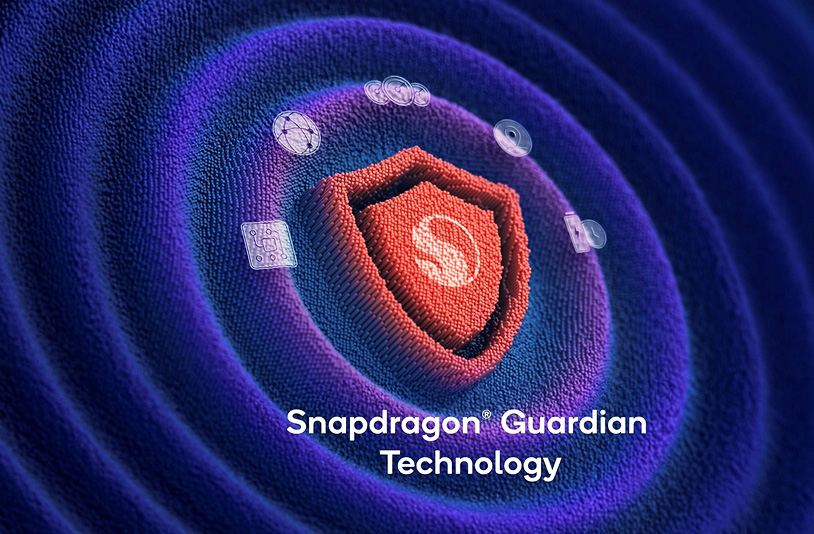
Snapdragon Guardian Technology adds hardware-backed security and out-of-band manageability, enabling remote device control and protection even when the OS is offline. Images used courtesy of Qualcomm
Software Support
For enterprise deployments, the X2 Plus series supports Snapdragon Guardian Technology, which enables out-of-band PC management over Wi-Fi or 5G. This allows IT teams to locate, lock, or wipe devices remotely, even if the operating system is not running. On the software side, Qualcomm is positioning the platform primarily for Windows 11 at launch, while Linux support based on past Snapdragon compute platforms may be available to varying degrees depending on vendor enablement and upstream support.
Availability
The Snapdragon X2 Plus is expected to power devices from leading OEMs starting in the first half of 2026. With its combination of high-performance cores, significant NPU headroom, and low-power architecture, it aims to set a new standard for the “always-connected” laptop market.


