
Clintech Pico Packs 48 GPIOs in Raspberry Pi RP2354B Board
A compact RP2354B-based board with full 48 GPIO breakout, USB-C, dual-core Arm/RISC-V support, and 2MB flash, designed for flexible embedded development.
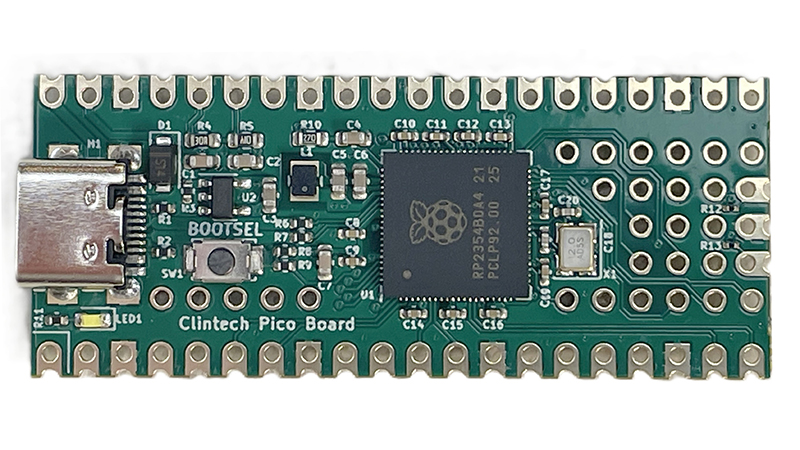
Clintech Pico Raspberry Pi RP2354B board
The Clintech Ltd. Clintech Pico introduces a new option in the growing ecosystem of microcontroller boards based on the Raspberry Pi RP2354B. This Raspberry Pi RP2354B board keeps the familiar Raspberry Pi Pico form factor while exposing the full capabilities of the newer RP2354B chip. Instead of limiting GPIO access like earlier designs, this board focuses on maximum hardware accessibility for developers building embedded systems.
Unlike typical Pico-compatible boards, this Raspberry Pi RP2354B board breaks out all 48 GPIOs directly on the PCB. Clintech achieves this by combining standard edge castellations with additional through-hole pads placed on the board surface. This design removes the usual GPIO limitations and gives engineers full control over peripherals, custom interfaces, and external memory expansion.
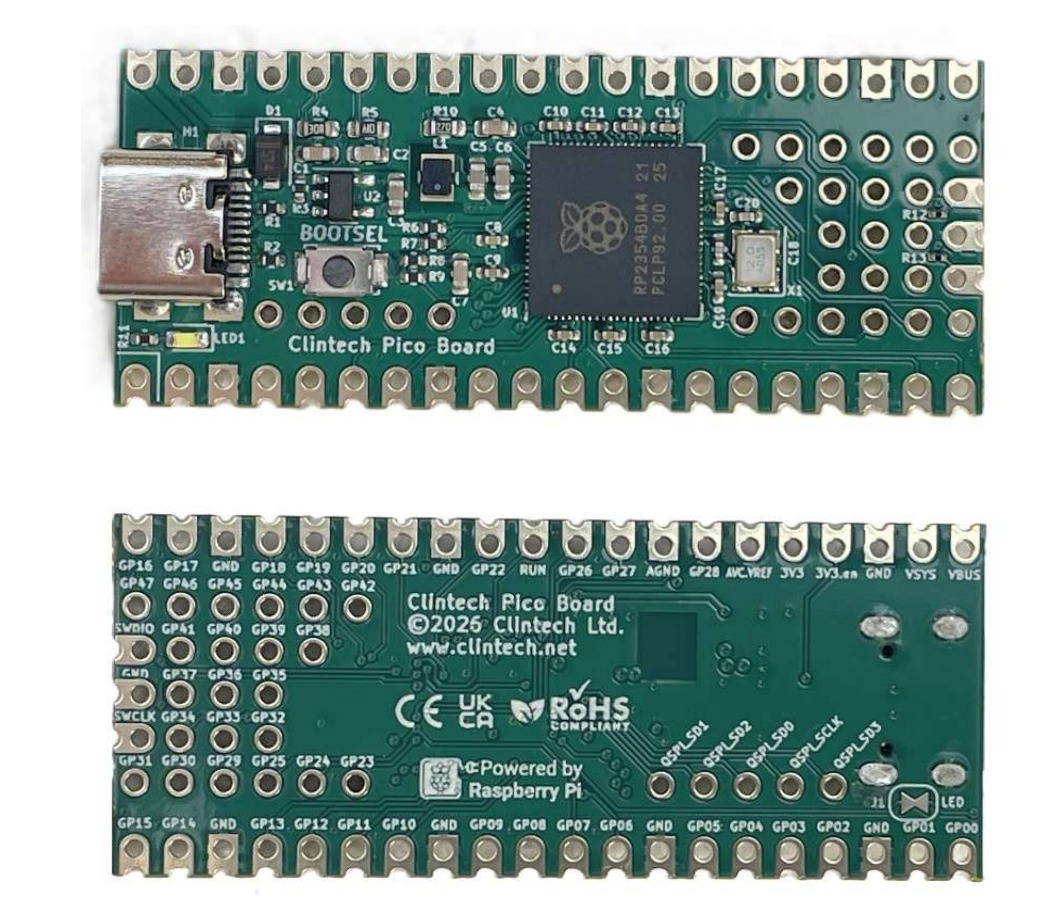
Clintech Pico Board Top and Bottom
Clintech Pico Board Specification:
- SoC: Raspberry Pi RP2354B
- Dual-core Arm Cortex-M33 @ 150 MHz (TrustZone, secure boot)
- Dual-core 32-bit Hazard3 RISC-V @ 150 MHz (RV32IMAC + extensions: Zba, Zbb, Zbs, Zbkb, Zcb, Zcmp, Zicsr)
- Flexible core configuration: 2× Arm, 2× RISC-V, or 1× Arm + 1× RISC-V
- Memory: 520 KB on-chip SRAM
- Storage:
- 2MB in-package (stacked) flash
- Up to 16MB external QSPI flash or PSRAM (via bottom pads)
- GPIO:
- Total 48 GPIOs fully exposed
- Standard GPIOs (0–22, 26–28) via castellated edges
- Additional GPIOs (23–25, 29–47) via onboard through-holes
- Interfaces: UART, SPI, I2C, PWM, ADC
- PIO (Programmable I/O)
- 3× PIO blocks
- 12× state machines
- USB: USB Type-C for power and data
- Debugging: 3-pin SWD interface
- Expansion
- 2× 20-pin headers (GPIO, UART, SPI, I2C, PWM, ADC)
- 27× extra through-holes for full GPIO and QSPI breakout
- Miscellaneous:
- BootSEL button (UF2 flashing mode)
- Onboard LED (GPIO25, with disconnect jumper)
- QSPI interface breakout (SD0–SD3, SCLK)
- Power:
- 5V input via USB-C (VBUS) or VSYS rail
- Onboard 3.3V LDO regulator (up to 500 mA)
- Dimensions: 51 × 21 mm
- Environmental:
- Storage temperature: 15°C to 25°C
- Humidity: 30% to 60%
- Compliance:
- RoHS (Directive 2011/65/EU)
- EMC (Directive 2014/30/EU) compliant
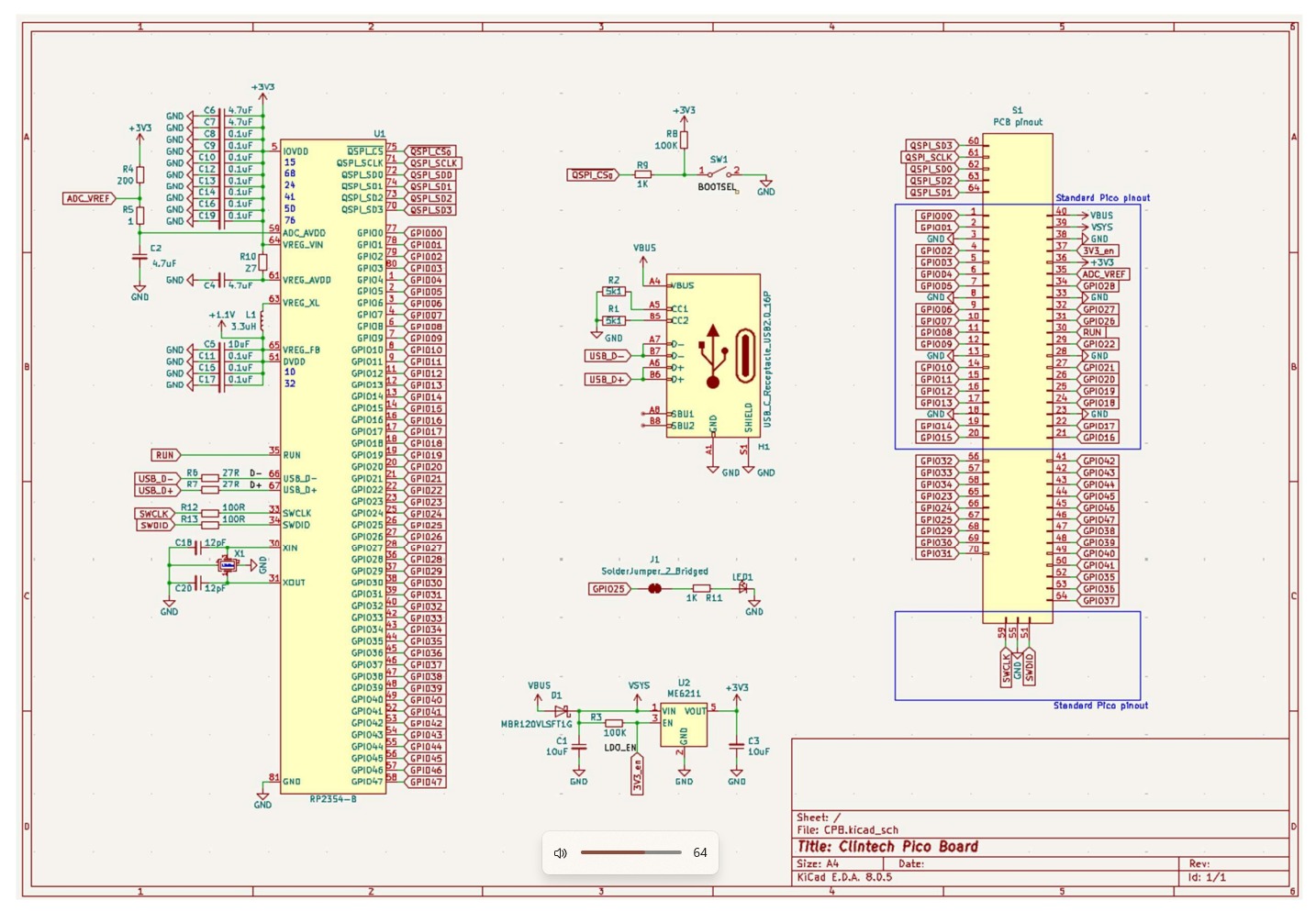
Clintech Pico Board Schematic
This Raspberry Pi RP2354B board runs the standard UF2 bootloader used across Pico devices. You can flash firmware by holding the BOOTSEL button and copying a UF2 file over USB mass storage mode. The board supports both C/C++ SDK and MicroPython, so you can quickly prototype or build production firmware. Developers who already use Raspberry Pi Pico tools will not need to change their workflow.
The Clintech Pico board is available via Tindie for around $20 with worldwide shipping from Bulgaria. Considering it exposes all 48 GPIOs and includes built-in 2MB flash, the pricing sits in a reasonable range for developers who need full hardware access without designing a custom board. You can find more technical details and documentation on Clintech’s official product page.
Images used courtesy of Clintech Ltd


