
EPC’s EPC2370 GaN FET Targets High-Current AI Server Power Rails
An 18 V eGaN transistor promises sub-milliohm conduction losses and dense power delivery for emerging 800 VDC data center architectures.
Efficient Power Conversion (EPC) has moved the EPC2370, an 18 V enhancement-mode gallium nitride (eGaN) FET, into mass production. The device targets the synchronous rectification stage of high-current DC-DC converters, a segment of the power chain under increasing strain as AI accelerator racks demand hundreds of amps at tighter voltage margins without expanding board area or generating excess heat.
The transistor has a 22 V transient voltage rating, which EPC notes provides sufficient headroom to displace silicon MOSFETs rated as high as 25 V in comparable sockets. That margin matters for designers weighing a switch to gallium nitride, since it preserves the reliability cushion engineers expect from an established silicon part while trading up for GaN’s switching and conduction advantages.
Inside the EPC2370
Fabricated on EPC’s seventh-generation GaN platform, the EPC2370 combines a typical on-resistance of 0.28 mΩ with a 101 A continuous current rating and a total gate charge of 26 nC. The resulting resistance-charge figure of merit, a shorthand engineers use to weigh conduction loss against switching loss, positions the part for the high-current, high-frequency duty cycles typical of intermediate bus converters. The die sits in a 3.3 mm by 3.3 mm dual-side-cooled PQFN package with a thermal pad on the underside, allowing heat to escape through both the board and an attached heatsink rather than through a single path.
Fitting Into 800 VDC Racks
AI power architectures are increasingly shifting toward 800 VDC distribution, feeding multi-kilowatt intermediate-bus converters that step the voltage down to 6 V while switching at 1 MHz or higher. EPC positions the EPC2370 as the synchronous rectifier for this stage, whether the front end steps down from 48 V or from 800 V directly. In that role, the company cites peak efficiencies near 98% and full-load efficiencies around 97% in high-density modules, along with reduced converter and magnetic component sizing that lower losses tend to enable. Jason Zhang, EPC’s Vice President of DC-DC Marketing and System Engineering, framed the part as a complement to the company’s recently introduced primary-side switches, the EPC2305, EPC2367, and EPC2361, forming a matched set for 6 V output and high-current rectification.
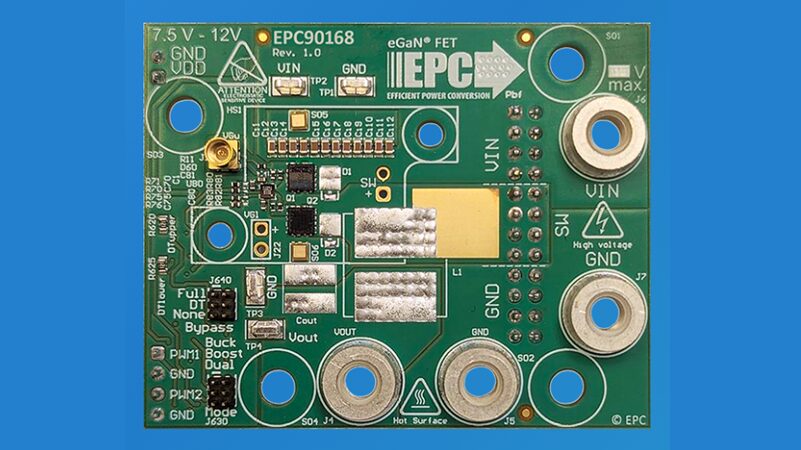
The EPC90168 half-bridge evaluation board pairs two EPC2370 GaN FETs with an onboard gate driver for testing high-current synchronous rectification. Image used courtesy of EPC
Evaluation and Availability
Designers looking to characterize the part can start with the EPC90168 evaluation board, a 2-inch-square half-bridge built around two EPC2370 FETs and featuring multiple probe points for waveform and efficiency measurements. The EPC2370 is now shipping through Digi-Key and Mouser at US$2.52 per 1,000 pieces, while the EPC90168 board lists for $260.
Driven by density pressures in AI server racks and the broader move toward 800 VDC distribution, parts like the EPC2370 fill a specific niche: high-current synchronous rectification, where every fraction of a milliohm and every nanocoulomb of gate charge translates directly into thermal margin. Beyond AI infrastructure, the same characteristics should translate reasonably well to high-performance computing, telecom equipment, and industrial power systems, which share an appetite for compact, high-current conversion.


