
Innodisk Teams Up With Qualcomm, Develops COM-HPC Mini Module
The new EXMP-Q911 COM-HPC Mini module integrates Qualcomm's Dragonwing IQ-9075 processor, delivering 100 TOPS AI performance with wide-temperature operation for industrial edge applications.
Innodisk has introduced the EXMP-Q911, a COM-HPC Mini module that marks the first product in the company’s AI on Dragonwing computing series, developed in collaboration with Qualcomm Technologies. The module addresses the growing demand for high-performance edge AI processing in industrial environments while maintaining thermal and power efficiency.
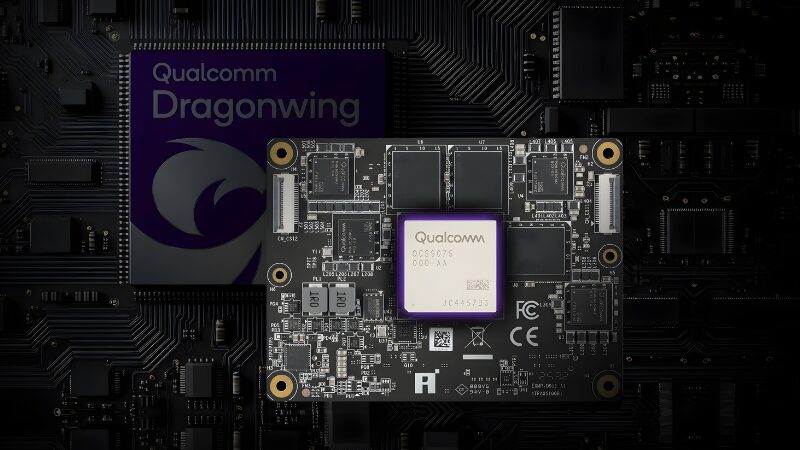
Innodisk has teamed up with Qualcomm Technologies to create the new AI on Dragonwing computing series. Image used courtesy of Innodisk
AI on Dragonwing Computing Series Module
At the core of the EXMP-Q911 COM-HPC Mini module is Qualcomm’s Dragonwing IQ-9075 processor, which features an 8-core Kryo Gen 6 CPU with all cores operating at 2.36 GHz. The processor integrates an Adreno 663 GPU and dual Hexagon tensor processors, providing 100 TOPS of dense AI performance or 200 TOPS in sparse mode. According to Innodisk’s test scenarios, the module can achieve up to 10× higher AI inference FPS compared to similarly configured modules.
The EXMP-Q911 integrates 36 GB of LPDDR5X memory and 128 GB of UFS 3.1 storage directly on board. This eliminates the need for external memory modules and simplifies carrier board design for OEMs. The COM-HPC Mini form factor measures 95 mm × 70 mm and includes standard high-density connectors specified in the PICMG COM-HPC specification, offering improved bandwidth and expandability over the older COM Express Mini standard.
Connectivity and Interface Options
The EXMP-Q911 provides an extensive set of industrial-grade interfaces suitable for machine vision and autonomous systems. Connectivity includes dual PCIe Gen 4 lanes (one ×4 and one ×2), dual 2.5 GbE Ethernet ports with RJ45 connectors, and dual four-lane MIPI CSI-2 interfaces with 22-pin, 0.5 mm pitch connectors mounted directly on the module. Display outputs consist of two DisplayPort 1.2 connections and one eDP interface.
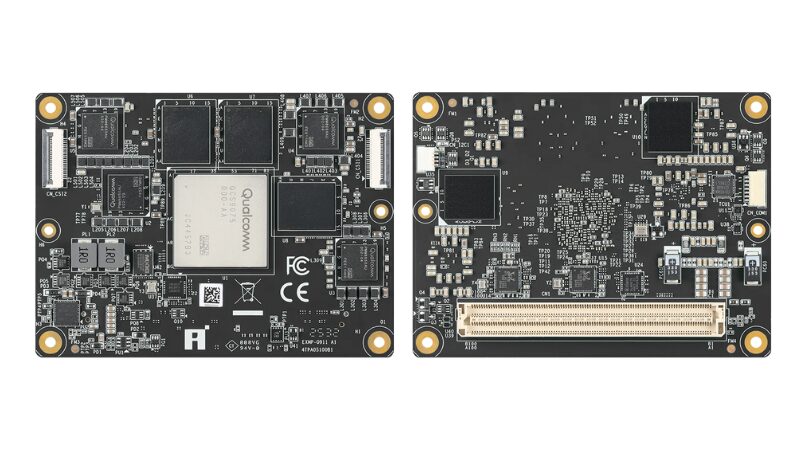
Innodesk’s EXMP-Q911 COM-HPC Mini module, powered by Qualcomm’s Dragonwing IQ-9075 processor. Image used courtesy of Innodisk
Additional I/O includes two USB 3.2 Gen 2×1 ports capable of 10 Gbps operation, four USB 2.0 ports, two UART connections with one supporting CTS/RTS flow control, an on-module RS232/422/485 serial interface, CAN FD support, SPI, and 12 general-purpose I/O pins. The module also integrates TPM 2.0 security and includes an external RTC along with programmable watchdog functionality.
Operating Environment and Longevity
Innodesk has designed the EXMP-Q911 to operate across a wide temperature range, from -40°C to 85°C in ambient conditions, making it suitable for outdoor installations, transportation applications, and industrial facilities without climate control. Power input accepts 8 V to 20 V DC with integrated regulation. The design meets IEC 60068-2-64 random vibration specifications at 3 G across 5-500 Hz and IEC 60068-2-27 shock testing at 30 G with 11ms duration. ESD protection complies with EN61000-4-2 standards for both air discharge at 15 kV and contact discharge at 8 kV.
Qualcomm has committed to supporting the Dragonwing SoC platform through 2038, providing a 13-year availability window from today. This extended lifecycle addresses a common concern in industrial deployments where equipment replacement cycles can span decades.

Users can get started developing with the help of Innodesk’s open-source IQ Studio developer software on GitHub. Image used courtesy of Innodisk
Development Resources and System Integration
For development, Innodisk provides IQ Studio, an open-source portal hosted on GitHub that includes board support packages, reference implementations, and benchmark utilities. The company’s iCAP cloud platform offers remote device management and AI model deployment capabilities for distributed edge installations. For engineers developing custom carrier boards, the module ships with mechanical drawings and interface specifications. Innodisk also offers a reference 3.5-inch carrier board (EXCC-Q911) operating from 9V to 36V DC input, along with validated MIPI and GMSL camera modules and M.2 expansion cards for networking and storage.
The EXMP-Q911 supports both Yocto Linux and Ubuntu, with driver support for its integrated peripherals. The combination of the COM-HPC Mini module approach with Qualcomm’s ARM-based SoC architecture provides an alternative to x86 solutions for applications such as autonomous mobile robots, automated guided vehicles, defect inspection systems, and vision-based sorting equipment, where power efficiency and AI inference throughput are critical. The module is currently available through Innodisk’s distribution channels with a two-year warranty and CE/FCC Class B certification.


