
Littelfuse Rolls Out Energy-Efficient Magnetic Sensing With TMR Switches
The new omnipolar and bipolar switches integrate TMR and CMOS technology, enabling ultra-low current consumption and high magnetic sensitivity for applications ranging from smart meters to wearables.
The demands of high-efficiency, always-on IoT and battery-powered applications continue to drive sensor development toward lower power consumption and increased magnetic sensitivity. Addressing this trajectory, Littelfuse has released two new tunneling magnetoresistance (TMR) magnetic switches, the LF21112TMR and LF11215TMR, engineered specifically for designs where minimizing current draw is critical.
Next-Generation TMR Technology
Littelfuse’s new omnipolar and bipolar switches leverage next-generation TMR technology integrated with an ultra-low-power CMOS design. This combination presents a significant performance advantage over traditional Hall-effect sensors. TMR elements generally offer higher magnetic sensitivity and substantially reduced power consumption compared to Hall elements, making them a more viable solution for devices that must maintain an active sensing state over an extended battery life.
The portfolio is segmented into two types, each optimized for different sensing requirements.
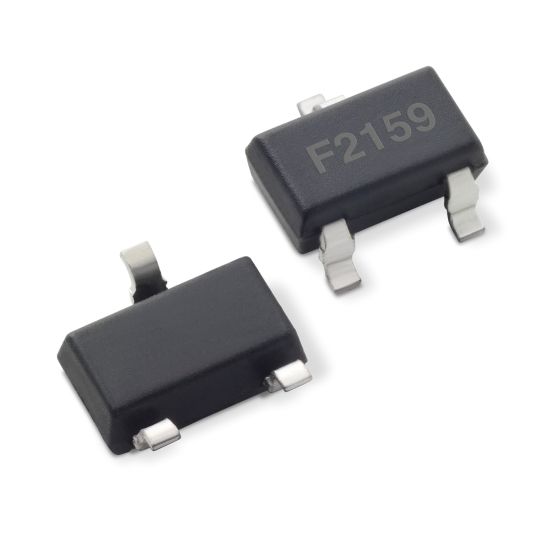
Littelfuse’s newest TMR switches include the LF21112TMR omnipolar switch and the LF11215TMR bipolar switch. Image used courtesy of Littelfuse
LF21112TMR Omnipolar Switches
The LF21112TMR is an omnipolar TMR switch, meaning it responds to the detection of either a north or a south magnetic pole. This inherent flexibility simplifies system design by relaxing the requirements for precise magnet alignment and polarity control, which is particularly beneficial in space-constrained and compact designs.
The omnipolar switch’s primary feature is its extremely low typical current draw of 200 nA. This quiescent current level is suitable for devices requiring continuous magnetic monitoring with minimal impact on the overall power budget, such as long-life battery-powered sensors.
LF11215TMR Bipolar Switches
The LF11215TMR is a bipolar digital TMR switch, which provides directional detection. This switch is typically triggered by one magnetic polarity and reset by the opposite, making it suitable for applications requiring rotational or directional sensing.
The LF11215TMR maintains ultra-low current consumption at 1.5 µA, while offering high magnetic sensitivity, requiring only 17 Gauss for activation. This combination of low power and high precision enables reliable sensing over greater air gaps or in systems with limited magnetic field strength.
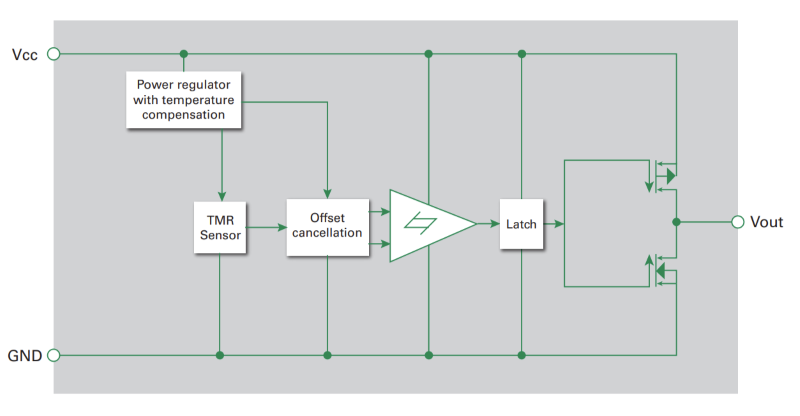
Functional block diagram of Littelfuse’s new TMR switches. Image used courtesy of Littelfuse
System Integration and Design Considerations
Both the LF21112TMR and LF11215TMR are housed in the industry-standard compact SOT23-3 package, facilitating integration into existing circuits or space-limited PCBs. They feature a wide operational voltage range of 1.8 V to 5.0 V, providing compatibility across various power architectures.
From a system noise perspective, the switches incorporate Schmitt trigger inputs, enhancing reliability and signal integrity by providing hysteresis that reduces false switching due to noisy or slow-moving magnetic signals. The output stage is a push-pull CMOS design, enabling clean, digital interfacing directly with microcontrollers.
A key engineering distinction when transitioning from Hall-effect designs is the sensing orientation. While many Hall-effect sensors are sensitive to the magnetic field along the z-axis (perpendicular to the sensor face), the TMR technology utilized here is activated by the magnetic field along the x-axis (parallel to the sensor face). Designers must account for this change in magnet placement and field orientation when replacing Hall-effect devices with TMR switches. Both devices are also specified for excellent thermal stability and robustness against external magnetic interference.
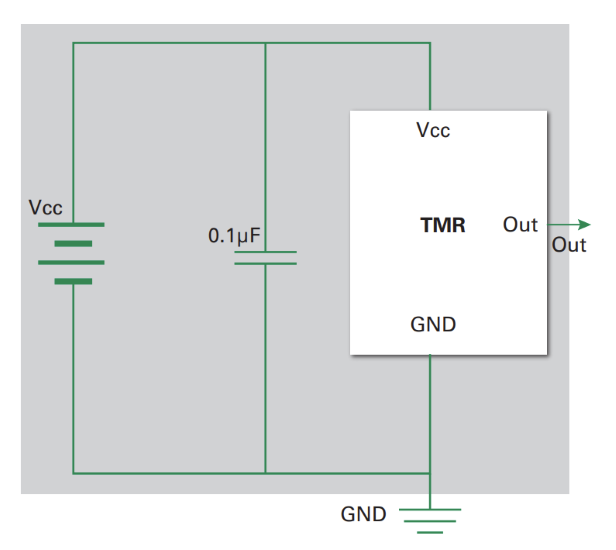
Schematic of Littelfuse TMR switches in a standard application. Image used courtesy of Littelfuse
Energy-Efficient Magnetic Sensing
Littelfuse’s new LF21112TMR and LF11215TMR TMR switches represent a step forward in magnetic sensing efficiency, directly addressing the power constraints of modern electronics by offering quiescent current in the sub-microampere range. The device’s incorporation of high-sensitivity TMR with low-power CMOS design provides a reliable alternative to traditional Hall-effect switches, particularly where maximizing battery life is paramount. These design characteristics make the new TMR switches well-suited for applications such as smart utility meters, battery-powered IoT devices and wearables, tamper detection in building automation, and precise rotary and linear position sensing in light industrial equipment.


