
Microchip Expands 10BASE-T1S Lineup With New Transceivers and Endpoints
Fresh silicon pairs a compact three-pin interface with optional system-level features, letting designers connect eight or more nodes to a single shared bus.
Microchip has widened its 10BASE-T1S offering with two transceivers and a family of single-chip endpoints, all aimed at pushing Ethernet out to the very edge of automotive, industrial, and robotics networks. Leading the announcement are the LAN8679 and LAN8680, a pair of Physical Medium-Dependent (PMD) transceivers; joining them is the LAN8660X/1X/2X family, each with a transceiver on board. The new parts build on Microchip’s VelocityDRIVE portfolio.
The motivation will sound familiar to anyone working on zonal architectures. As systems drift toward fully Ethernet-based networks, designers are pressed to trim wiring complexity and to simplify how edge nodes join the network. Since 10BASE-T1S is a multidrop technology, several nodes (typically eight or more) can share a single bus line. This arrangement also enables lighter cabling, lower system cost, and no gateway standing between sensors or actuators and the network.
Multidrop Wiring, Minimal Pins
The LAN8679 offers a standardized Open Alliance 3-Pin (OA3P) interface in an 8-pin VDFN package. A short pin list matters when board space is scarce, and the interface lets the device connect directly to a microcontroller using very few pins. The transceiver conforms to the Open Alliance TC14 3-pin PMD specification and supports TC10/TC14 low-power wake and sleep, as well as topology discovery.
Diagnostics and robustness also get their share of attention. It supports cable fault detection for open and short conditions, Signal Quality Indication, and EtherGREEN technology for energy efficiency. Beyond enhanced EMC and EMI performance, the mixing-segment wires tolerate shorts to ground or to a 48 V battery. Both transceivers are AEC-Q100 qualified from −40°C to +125°C and support ISO 26262 ASIL B functional safety.
While the LAN8679 remains a pure transceiver, the LAN8680 adds System Basis Chip (SBC) features on the same foundation. It adds power management, system wake and sleep control, and watchdog supervision, with watchdog reset and limp-home behavior for safety-critical designs. Low-dropout regulators can also supply voltage to external devices. That extra integration is reflected in the package: a 16-pin VDFN, double the pin count of its sibling.
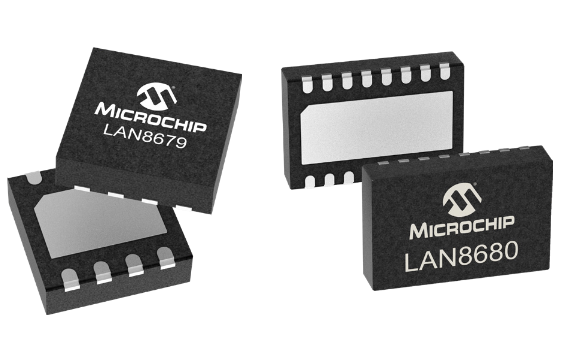
Both transceivers carry the same OA3P interface; the LAN8680 spends its extra pins on power management and watchdog supervision. Image used courtesy of Microchip
Endpoints and Availability
Rounding out the launch, the LAN8660X/1X/2X endpoints fold a PMD transceiver into a single-chip Remote Control Protocol (RCP) solution. With no external PHY required, designers can assemble compact edge nodes for control systems, lighting, and audio from fewer parts. The LAN8679, LAN8680, and LAN8660X/1X/2X are available in limited sampling, and Microchip directs interested designers to its sales representatives.
All told, pairing a three-pin interface with optional SBC integration offers a tidy way to carry one network from the zonal controller all the way down to a lone sensor or actuator. Automotive zonal architecture is the headline use case, yet industrial automation, robotics, and aerospace and defense systems sit squarely in the crosshairs as well. For anyone sketching a gateway-free, all-Ethernet layout, it’s an intriguing set of parts to have on the bench.


