
New TVS Diode Family for Automotive Applications
TI released its new TSDxx-Q1 family of unidirectional transient voltage suppression (TVS) diodes with reverse stand-off voltages from 12 to 36 V.
Designed to provide robust protection against electrical transients, the new TVS diodes from Texas Instruments are specifically engineered for use in demanding automotive environments. With a focus on safeguarding critical data and power lines, the TSDxx-Q1 series offers a compelling solution for electrical engineers designing for in-vehicle networks and other sensitive automotive systems. There are options for reverse stand-off voltages of 12, 15, 18, 24, and 36 V.
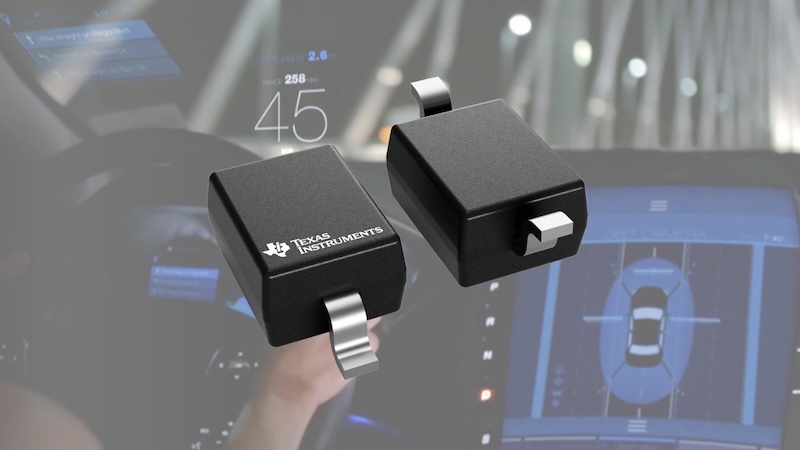
TSDxx-Q1 unidirectional TVS diodes are automotive qualified. Images used courtesy of TI.
Addressing the Harsh Automotive Environment
Modern vehicles are a complex ecosystem of interconnected electronic control units (ECUs) and sensors, all of which must operate reliably in a harsh electrical environment. This includes exposure to electrostatic discharge (ESD) events, as well as high-energy surges from phenomena like load dumps and lightning strikes. The TSDxx-Q1 family is built to withstand these challenges, providing a critical layer of protection for downstream components.
The diodes are AEC-Q101 qualified, a key certification that confirms their reliability for automotive applications. They offer ISO 10605 ESD protection with a rating of up to ±30kV for both contact and air gap discharge. This robust ESD performance also meets the maximum level (Level 4) specified in the IEC 61000-4-2 international standard. Furthermore, the devices provide IEC 61000-4-5 surge protection, with the ability to handle surge currents from 7A to 60A (8/20µs waveform), depending on the specific model.
Key Technical Specifications
The TSDxx-Q1 family includes a range of voltage options to suit various design requirements. For example, the TSD24-Q1 has a reverse working voltage (VRWM) of 24V and a breakdown voltage (VBR) of 24.8V (min). Its low clamping voltage of 39V at a peak pulse power of 250W helps ensure that sensitive components remain within their safe operating limits during a transient event.
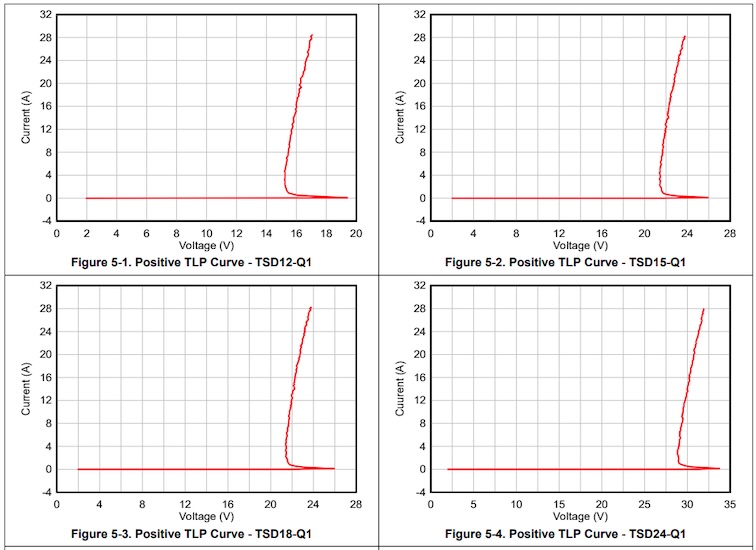
TSDxx-Q1 TVS diodes are available with multiple reverse stand-off voltage options. Images used courtesy of TI.
A standout feature is the devices’ low I/O capacitance, which is typically less than 20pF. This is particularly important for high-speed data lines, as it helps minimize signal distortion and maintain signal integrity. In applications such as automotive infotainment or advanced driver-assistance systems (ADAS), where data is transmitted at high frequencies, this low capacitance is a significant advantage.
Another critical parameter for automotive applications is leakage current. The TSDxx-Q1 family boasts an ultra-low maximum leakage current of just 50nA, which helps conserve power and reduces thermal stress on the device itself. This is especially beneficial for battery-powered systems or in applications where quiescent power consumption is a key design consideration.
Compact Design and Ease of Integration
TI has packaged the TSDxx-Q1 family in the industry-standard SOD-323 leaded package. Measuring just 2.65mm x 1.3mm, this compact form factor is a good choice for designs with tight space constraints, common in modern automotive ECUs. The leaded package also facilitates easier solderability and visual inspection, which can simplify manufacturing and quality control processes.
The unidirectional polarity of the diodes is optimized for clamping performance on single-ended data lines and power rails, offering a straightforward implementation path for engineers. By combining robust clamping, low capacitance, and a small footprint, the TSDxx-Q1 family presents a highly integrated solution for protecting against the most common electrical threats in automotive systems.


