
Rivian Develops Armv9-Based RAP1 Autonomy Processor for Vehicle AI Interface
A custom RAP1 chip using Arm Cortex-A720AE cores forms the core of Rivian’s third-generation autonomy platform for EVs, enabling efficient AI compute and safety-focused vehicle processing.

The Rivian Gen 3 Autonomy Computer
In December 2025, Arm and electric vehicle maker Rivian unveiled a major step forward in autonomous vehicle computing with the introduction of Rivian’s third-generation autonomy platform. This platform is grounded in a custom Rivian Autonomy Processor (RAP1) built in close collaboration with Arm, designed to meet the demanding compute and safety needs of next-generation autonomous driving and physical AI applications.
At the core of this architecture is a custom chip leveraging Arm’s advanced processor technology, enabling high-performance, energy-efficient processing for understanding environments, running AI workloads, and making rapid decisions in real time on the vehicle.
RAP1 Custom Autonomy Processor Architecture
The central silicon in Rivian’s autonomy compute stack is the RAP1 (Rivian Autonomy Processor 1), built with Arm’s cutting-edge Armv9 instruction-set architecture. This chip integrates:
- The design team utilizes Arm Cortex-A720AE CPU cores for core computing and orchestrating AI tasks.
- Specialized processors with safety capabilities of real-time monitoring and fail-safety.
- The electric cars are dependent on a design orientation to energy efficiency, which allows high throughput without high power consumption.

Rivian Rap1 SoC
Physical AI and Autonomous Compute
The automotive world is rapidly shifting from rule-based systems to physical AI intelligent systems that interact directly with their surroundings. The platform of autonomous control at Rivian accepts this change with a large on-board compute, which can analyze sensor data, make predictions, and perform control functions in milliseconds.
This platform is also used in contrast to off-board or cloud-dependent platforms that extend the essential processing functions of the vehicle onto the vehicle itself, where high reliability and low latency are required.
Safety and Reliability
Safety runs through the entire compute pipeline. With dedicated processing blocks that operate independently from high-performance compute, Rivian’s platform ensures that core real-time and safety-critical functions continue even under fault conditions, a must for autonomous systems operating in unpredictable environments like public roads.
Scalability, Efficiency and Performance
One of the merits of the ARm-based platform is the performance and power efficiency. The design philosophy of Arm puts high instructions-per-watt operation in the first place, and this assists Rivian:
- Maintain or extend vehicle range despite heavy on-board AI workloads.
- Scale the autonomy compute architecture across future vehicle models.
- Deliver a software-defined edge compute, which can scale alongside changing AI functions.
Such performance and power balance enable the platform to be applicable in the real-world autonomous driving, where sustained compute and a limited energy budget are decisive factors.
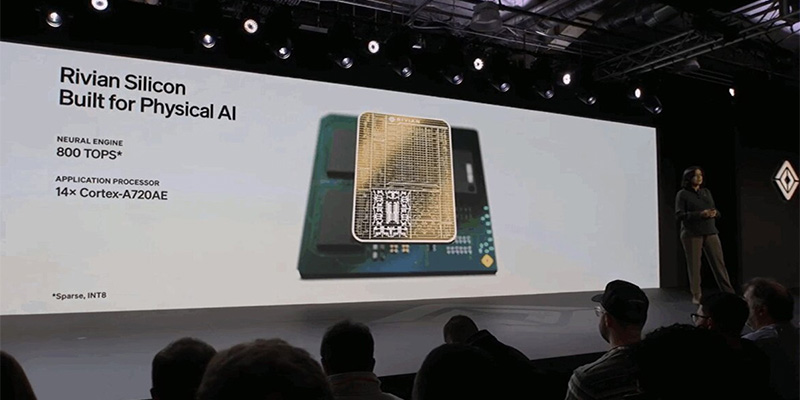
Inside the RAP1
Impact and Future Prospects
The case of Rivian is indicative of a larger trend of increasing automotive systems vertical integration in the form of an AI and autonomy stack. By developing custom silicon co-designed with Arm’s mature compute platform, Rivian positions itself to:
- Minimise reliance on outside vendors for autonomy processing.
- Higher degrees of driving automation may become possible, with the increasing capabilities of software and hardware.
- Construct a computing base that is not only in vehicles but also in other autonomous and intelligent machines.
As per the press release, the platform can also be used to form the basis of upcoming AI-enabled capabilities, safety-critical applications, and improved perception systems as the autonomous capabilities evolve in the future.
Images used courtesy of ARM.


