
RP2350B BellsNWhistles Board Adds Onboard Debugger and HDMI
Designed for rapid prototyping, this open-source platform features dual USB-C ports, MicroSD storage, optional PSRAM, and a built-in RP2040 to eliminate external probes.
While browsing Tindie for new and interesting projects, we came across an open-source board that caught our attention. Created by hardware developer Riktw, the RP2350B BellsNWhistles is a development board that integrates an RP2040-based Picoprobe debugger directly onto the PCB, which eliminates the need for a separate Raspberry Pi Debug Probe during firmware development and debugging.
The board includes an HDMI connector compatible with PicoDVI-based projects, a microSD card slot for removable storage, optional PSRAM expansion, and access to all of the RP2350B’s GPIOs. The combination makes it suitable for embedded development, graphics experiments, and rapid prototyping while reducing the amount of external hardware typically required.
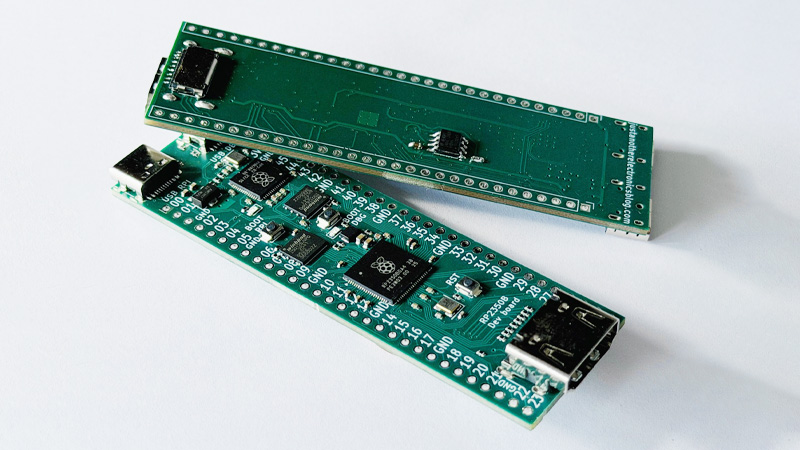
Front and rear views of the RP2350B Bells&Whistles development board.
RP2350B Bells&Whistles Specifications
- MCU: Raspberry Pi RP2350B
- Dual-core Arm Cortex-M33 @ up to 150 MHz with Arm TrustZone
- Dual-core Hazard3 RISC-V @ up to 150 MHz
- Two cores active simultaneously (either Arm or RISC-V pair)
- 520 KB on-chip SRAM
- External Memory:
- 4 MB SPI Flash
- Optional 8 MB PSRAM
- Storage: MicroSD card slot (GPIO20-GPIO23)
- Video Output: HDMI connector (PicoDVI-compatible)
- USB:
- USB Type-C for RP2350B programming and power
- USB Type-C dedicated to the onboard debugger
- Debugging: Integrated RP2040 running Picoprobe firmware
- Expansion: Two 30-pin headers with acces to 46 GPIOs
- Misc:
- Separate RESET and BOOT buttons for both MCUs
- User LED (GPIO46)
- UART is internally connected to the onboard debugger
- Power: 5V via USB Type-C; 3.3V, 5V, and GND pins
- Dimensions: 87 × 26.5 mm
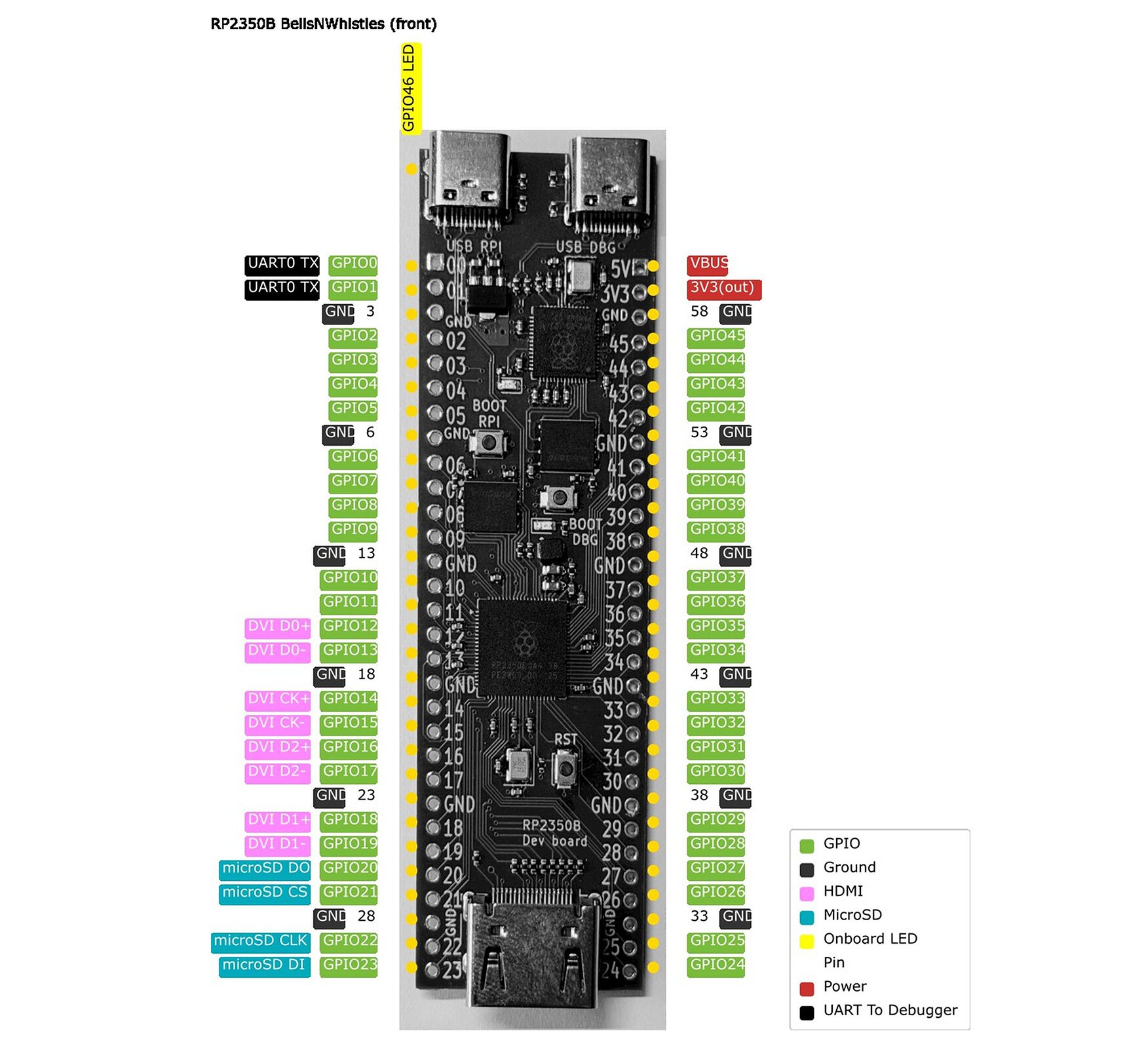
RP2350B Bells&Whistles pinout showing GPIO assignments, HDMI, microSD, power, and debug interfaces.
On the software side, the HDMI connector is wired to GPIO12-GPIO19, matching the pinout used by the Adafruit DVI Sock and PicoDVI library, allowing existing PicoDVI-based applications to run on the board with minimal or no modification. The onboard RP2040 runs Picoprobe firmware and provides SWD programming and UART communication through its dedicated USB Type-C port.
The RP2350B BellsNWhistles board is completely open-source, with the KiCad schematics, PCB layout, and other design files published on GitHub under the MIT license. The board is available on Tindie as a fully assembled PCB, with an optional factory-installed 8 MB PSRAM configuration.
Images used courtesy of Tindie


