
Ruuvi Air Crams Seven Sensors into Open-Source IAQ Monitor
The all-in-one smart sensor provides real-time, comprehensive indoor air quality monitoring and Bluetooth Low Energy connectivity.
Finnish sensor company Ruuvi has unveiled the Ruuvi Air, a new all-in-one smart sensor designed to provide comprehensive indoor air quality (IAQ) monitoring. Targeting the growing awareness of health impacts from indoor pollutants, the device integrates a suite of seven sensors into a compact, USB-C powered unit, broadcasting data via Bluetooth Low Energy for real-time analysis.
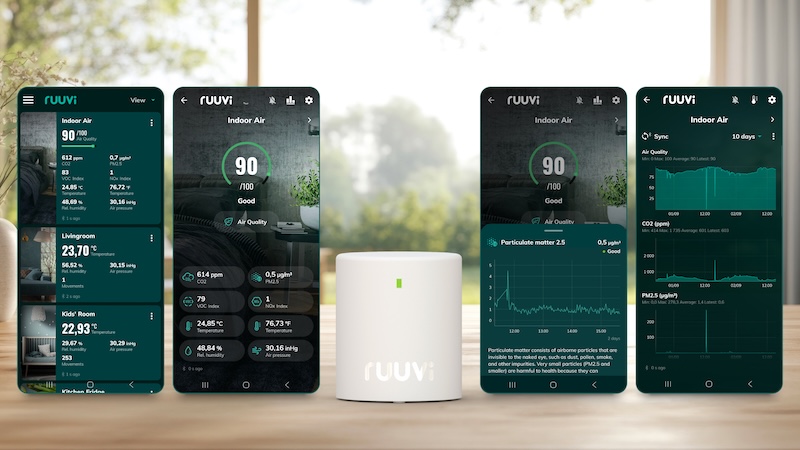
The Ruuvi Air provides real-time, comprehensive indoor air quality monitoring and Bluetooth Low Energy (BLE) connectivity.
For engineers and technically-minded users, the device stands out due to its use of specific, high-quality sensor components and its open-source firmware, inviting customization and deeper integration.
A Multi-Sensor Approach to Air Quality
The core of the Ruuvi Air is its ability to measure a wide array of environmental parameters simultaneously. The device continuously tracks:
- Carbon dioxide (CO2)
- Particulate matter (PM1, PM2.5, PM4, and PM10)
- Volatile Organic Compounds (VOC index)
- Nitrogen oxides (NOx index)
- Temperature
- Relative air humidity
- Air pressure
This data is processed on-device to calculate a proprietary Ruuvi Indoor Air Quality Score (IAQS). The IAQS is a single 0-100 metric designed to give users an at-a-glance understanding of their environment, primarily weighted by fine particulate matter (PM2.5) and carbon dioxide (CO2) levels. The device features a multi-color LED to visually represent this score.
“At heart, we at Ruuvi are a team of enthusiastic engineers who love designing the best solutions to life’s daily challenges, and making them as simple to use as possible,” says Lauri Jämsä, Founder and CEO at Ruuvi. “Despite the sophisticated sensors, Ruuvi Air is not a complicated gadget. It’s a helpful home companion that’s got your back, day and night.”
Under the Hood: The Hardware Breakdown
The technical specifications reveal a design centered around well-regarded components. The unit is powered by a Nordic Semiconductor nRF52840 SoC, a popular choice for low-power wireless applications. This chipset manages the device’s logic and its Bluetooth Low Energy connectivity, which features a +8 dBm transmitting power for a typical range of 10-200 meters.
The sensing capabilities are primarily driven by a Sensirion SEN66 module, which handles the measurement of CO2, particulate matter, VOC, NOx, temperature, and humidity. Air pressure sensing is managed by a separate Infineon DPS368 sensor.
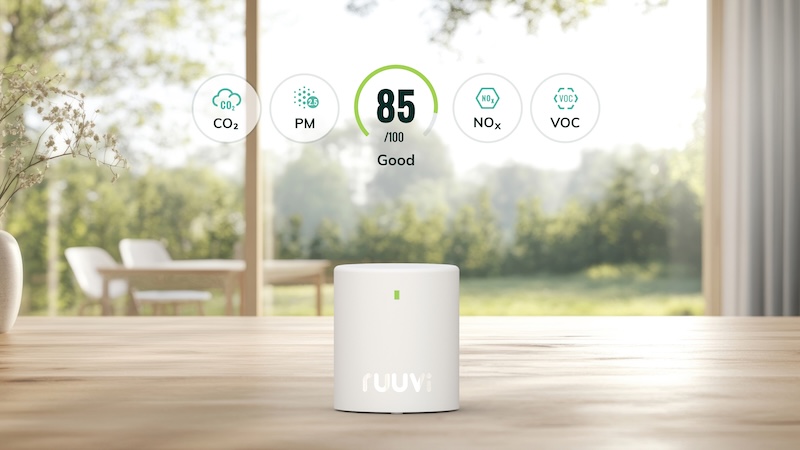
The Ruuvi Air monitors four types of air pollutants, plus temperature, humidity, and pressure.
Key performance specifications include:
- Particulate Matter (PM1, PM2.5): The sensor has an output range of 0 to 1,000 μg/m3. Mass concentration precision for levels up to 100 μg/m3 is ±5 μg/m3+5% of the measured value.
- Carbon Dioxide (CO2): The device measures CO2 from 0 to 40,000 ppm with a resolution of 1 ppm. In the critical 400 to 1,000 ppm range, accuracy is rated at ±(50 ppm+2.5% of the measured value).
- Air Pressure: The Infineon sensor provides a relative accuracy of ±0.06 hPa and an absolute accuracy of ±1 hPa. The firmware limits the output range to 500-1155 hPa.
- Temperature: The temperature sensor offers a resolution of 0.01∘°C with a typical accuracy of ±0.45∘°C at 25∘°C and 50% relative humidity.
The device is powered via a USB-C jack and requires a power source capable of at least 1 A, with typical consumption ranging from 150-250 mA and peaks of 500 mA. It also features internal storage capable of holding 10 days of history at a 5-minute logging interval.
From Raw Data to Actionable Insights
While the hardware provides a stream of high-resolution data refreshed every second, Ruuvi’s goal is to translate these complex metrics into simple guidance. The company’s free mobile apps for Android and iOS provide real-time measurements, historical data browsing, and alerts.
“Everyone deserves simple, actionable insights into the air in their homes and workplaces. That’s the opportunity Ruuvi Air unlocks,” says Henri Hakunti, Co-founder and COO at Ruuvi. “By bringing the same helpful clarity people love in wearables to indoor spaces, we make air quality understandable for everyone.”
The open-source nature of the firmware and electronics schematics is a significant feature for the engineering community, allowing for custom applications, integration into other smart home systems, or independent data analysis beyond the provided Ruuvi Station app.


