
SECO Rolls Out COM Express Type 6 Module for Mission-Critical Designs
The new COM is powered by Intel Core Ultra Series 3 processors, delivers up to 180 platform TOPS AI acceleration, and features industrial-grade specifications for next-generation embedded applications.
SECO announced the availability of its SOM-COMe-BT6-PTL, a COM Express Type 6 module built around Intel’s newly released Core Ultra Series 3 processors. The module targets embedded systems requiring significant AI processing capabilities while maintaining the thermal and physical constraints typical of industrial deployments.
SECO’s new COM Express Type 6 module is based on Intel Core Ultra Series 3 processors. Image used courtesy of SECO
COM Express Type 6 Module
SECO’s new SOM-COMe-BT6-PTL adheres to the COM Express Type 6 basic specification. This compliance ensures compatibility with existing carrier board designs and allows system integrators to leverage established thermal and mechanical solutions. The module exposes connectivity through the COM Express pinout, including PCIe Gen4 and Gen5 lanes for high-speed peripheral expansion, USB 4.0 with Thunderbolt support, and integrated 2.5 GbE networking.
The module’s memory expansion is handled through dual So-DIMM sockets supporting up to 128 GB of DDR5 memory. Display output options include embedded DisplayPort, DisplayPort++, and HDMI interfaces, enabling multi-monitor configurations for HMI applications. The module’s design accommodates optional industrial-temperature-range operation (-40°C to 85°C), extending its applicability to environments beyond standard commercial temperature specifications (0°C t0 60°C).
Processor Architecture and AI Performance
The SOM-COMe-BT6-PTL is powered by Intel Core Ultra Series 3 processors, which represent an architectural evolution from previous generations. The hybrid core design incorporates up to 16 CPU cores, combining performance and efficiency cores in a restructured topology. The most significant addition for AI workloads is the Intel NPU 5, a dedicated neural processing unit delivering up to 50 TOPS of AI acceleration. When combined with CPU and GPU capabilities, the platform can achieve up to 180 TOPS of total AI processing power.
The GPU’s integrated Xe3 architecture provides enhanced graphics and imaging performance compared to prior generations. This combination of processing elements makes the module suitable for applications requiring parallel AI inference, computer vision, and real-time image processing. The architecture supports high-speed LPDDR5x and DDR5 memory configurations, essential for bandwidth-intensive AI and imaging workloads.
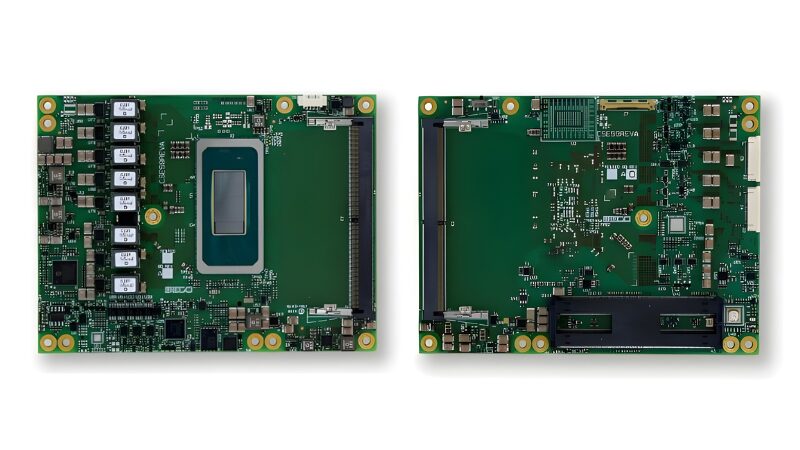
The SOM-COMe-BT6-PTL works with Clea OS 2.0 for device monitoring. Image(s) used courtesy of SECO
Software Integration and System Management
SECO has integrated its new module with the Clea software framework, specifically Clea OS 2.0, which is based on the Yocto Project. This embedded Linux distribution provides device management capabilities, including remote deployment, monitoring, over-the-air updates, and security management at scale. The framework addresses requirements outlined in EU cybersecurity regulations, including the Cyber Resilience Act (CRA) and Radio Equipment Directive (RED).
The software layer enables remote fleet management and facilitates the deployment of AI applications at the edge. System integrators can leverage these tools to manage distributed embedded systems without developing proprietary device management infrastructure.
Power and Thermal Considerations
While specific TDP values were not disclosed in the announcement, the Intel Core Ultra Series 3 processors are designed for mobile and embedded applications where power efficiency is critical. The hybrid core architecture allows for dynamic power scaling based on workload characteristics, with efficiency cores handling background tasks and performance cores engaging for demanding computational workloads.
The COM Express Type 6 form factor provides standardized thermal interface options, and SECO’s design includes provisions for industrial temperature operation. System designers will need to consider thermal solution requirements based on their specific processor SKU selection and anticipated operating conditions.
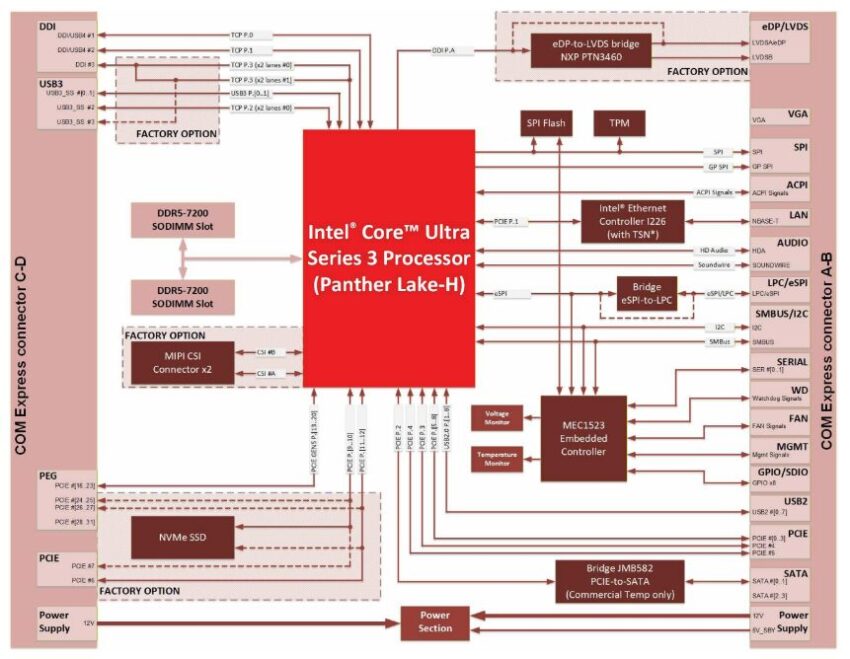
Block diagram of the SOM-COMe-BT6-PTL. Image used courtesy of SECO
Next-Generation AI Acceleration
The SOM-COMe-BT6-PTL addresses applications that require local AI processing for latency, bandwidth, or privacy reasons. The combination of NPU, CPU, and GPU acceleration supports diverse workloads, including real-time video analytics, predictive maintenance systems, quality inspection, autonomous systems, and medical imaging equipment. The industrial temperature option and long-term availability commitment make the module suitable for deployments with extended operational lifetimes.
Multi-camera vision systems benefit from the parallel processing capabilities and multiple display outputs. Smart retail applications can leverage the AI acceleration for customer analytics and automated checkout systems. Industrial automation scenarios requiring real-time decision-making and advanced HMI capabilities align with the module’s specifications. The medical imaging sector can leverage enhanced GPU and AI capabilities for diagnostic equipment that requires local processing of imaging data.


