
Waveshare RP2350-USB-C – A Compact Dev Board with Dual USB-C Ports
Powered by the Raspberry Pi RP2350A MCU, this tiny castellated module features 2MB flash, 15 GPIOs, and a PIO-driven Type-C connector for flexible host or device applications.
Waveshare has recently launched the RP2350-USB-C, a mini RP2350 dev board built around the RP2350A SoC. Measuring just 33.00 × 17.50 mm, the board features a castellated edge design, making it suitable for both breadboard prototyping and surface-mount (SMD) integration into end products.
The main feature of this board is its two USB Type-C ports. One port is used for power and simple drag-and-drop programming, and the other port is used for USB 1.1 in both host and device modes. The second port is a PIO-based USB port that uses the RP2350’s programmable I/O to work as either a USB host or device. It also has built-in CC resistors, so it can switch between power input and output modes by configuring the resistors. It exposes 15 GPIOs and multiple peripherals, including SPI, I2C, UART, ADC, and PWM, as well as 12 PIO state machines for custom interfaces. Additional features include an onboard temperature sensor, accurate timers, an RGB LED, and more, making it suitable for applications such as IoT nodes, embedded control systems, custom peripherals, and low-power edge devices.
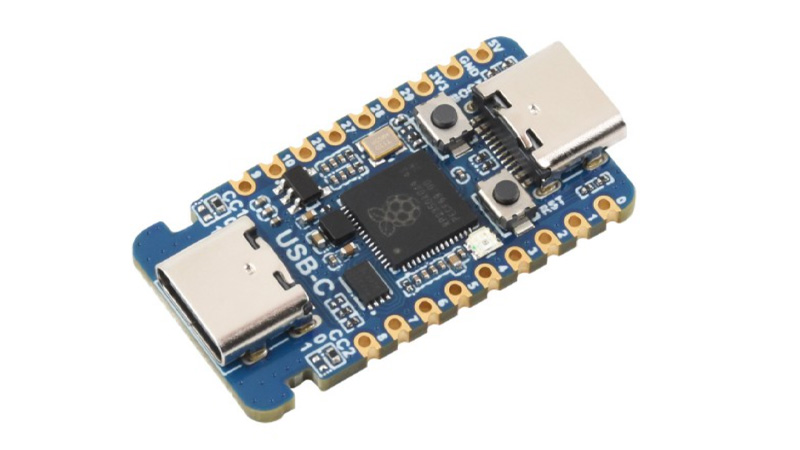
Waveshare RP2350-USB-C board with castellated edges, and dual USB-C ports
Waveshare RP2350-USB-C Specifications:
- MCU: Raspberry Pi RP2350A featuring a dual-core, dual-architecture design (dual-core ARM Cortex-M33 OR dual-core Hazard3 RISC-V processors) @ up to 150 MHz with 520KB on-chip SRAM
- Storage: 2MB onboard NOR Flash (W25Q16JVUXIQ)
- USB
- 1x USB Type-C port for programming, data, and power (USB 1.1 with Host/Device support)
- 1x PIO-USB Type-C port acting as a USB host or device via PIO, featuring CC pull-up/pull-down resistors for Sink/Source configuration
- Expansion:
- 15x multi-function GPIO pins (available via through-holes and castellated edges for surface mounting)
- Up to 2x SPI, 2x I2C, 2x UART, 4x 12-bit ADC, and 14x controllable PWM channels
- 12x Programmable I/O (PIO) state machines for custom peripheral support
- Misc:
- BOOT and RUN (Reset) buttons
- WS2812 RGB LED
- Built-in temperature sensor
- Accurate on-chip clock and timer
- Power:
- 5V input via USB Type-C
- RT9013-33GB 500mA low-dropout (LDO) regulator
- Compatibility with PD-only USB-C power adapters
- Support for low-power sleep and dormant modes
- Dimensions: 33.00 x 17.50 mm
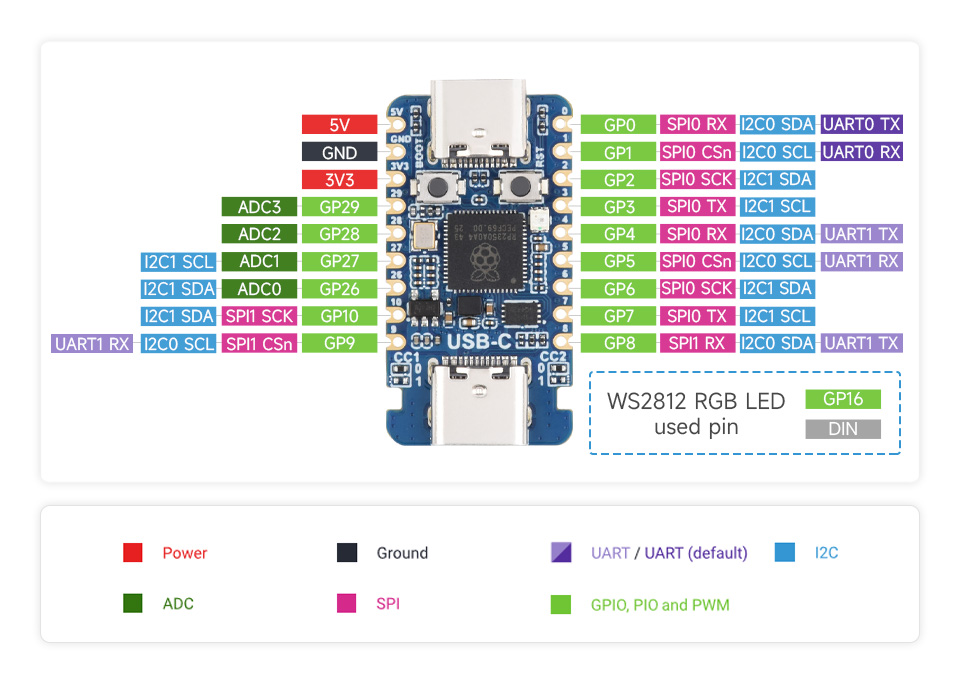
Pinout diagram of the RP2350-USB-C board showing power, ADC, SPI, UART, I2C, GPIO, and RGB LED connections.
The module includes PIO-USB CC pull-up and pull-down resistors, supporting Sink/Source switching via resistor configuration. This allows the USB 1.1 interface to function as either a USB host or device using PIO.
The board supports C/C++, MicroPython, and Arduino, so it’s easy to program using common tools. You can upload code by simply dragging and dropping files over USB, similar to other Pico boards. It also has low-power sleep and dormant modes, which help reduce power usage in battery-powered projects.
The Waveshare RP2350-USB-C is now available on waveshare store for $5.49 for single units, with volume discounts for higher quantities. Detailed documentation, schematic diagrams, and SDK resources are available on the Waveshare Wiki.
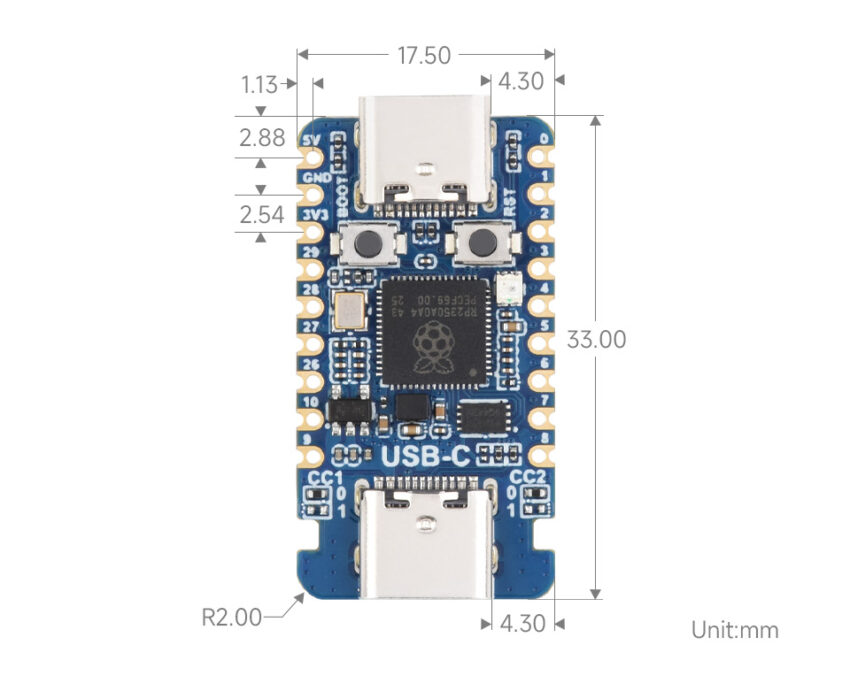
Mechanical drawing showing board size (33 × 17.5 mm) and layout details.
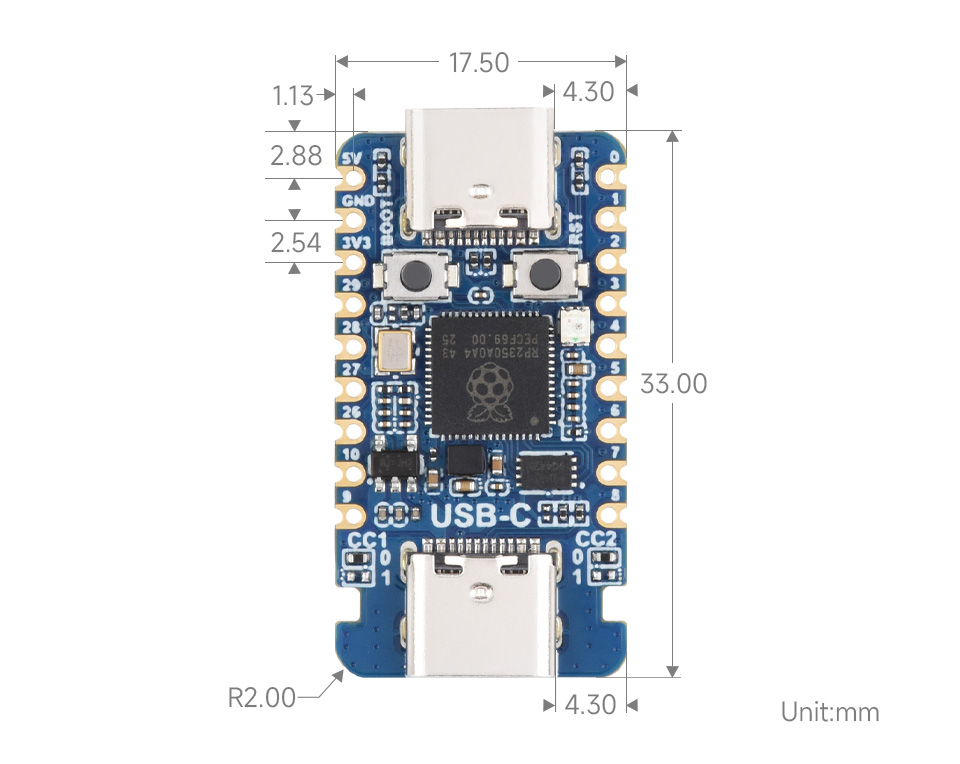
Images used courtesy of Waveshare


