
Arduino UNO Q Merges MCU Control with Qualcomm SoC for AI Edge Computing
Powered by Qualcomm QRB2210 and STM32U585, the UNO Q supports dual MIPI CSI, Wi-Fi 5, Bluetooth 5.1, and USB-C video output for advanced embedded AI applications.
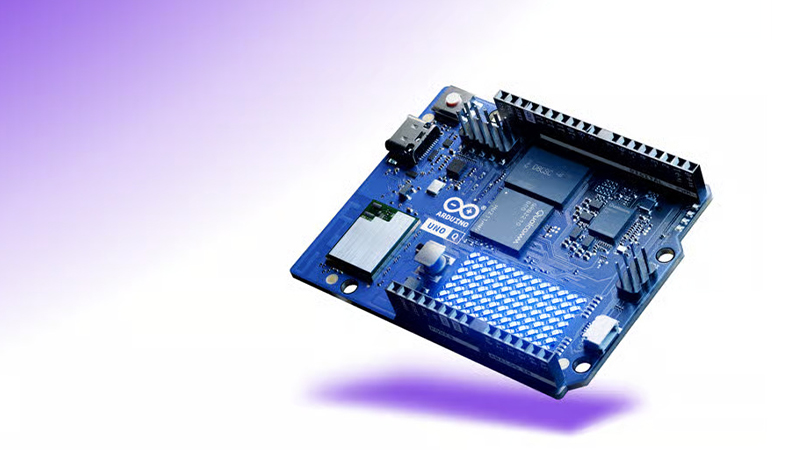
Arduino UNO Q development board
The Arduino UNO development board remains a key platform in electronics prototyping and education. Known for its straightforward design and hardware flexibility, it enables hobbyists, students, and engineers to create a wide range of electronic systems — from simple LED circuits to advanced IoT and automation projects. Its open-source hardware ecosystem, broad peripheral support, and compatibility with various shields make it one of the most adaptable tools for embedded development.
In October 2025, Arduino expanded this legacy with the introduction of the Arduino UNO Q, a hybrid development board that combines microcontroller-level control with microprocessor-grade computing. The board integrates a Qualcomm QRB2210 SoC for Linux-based AI and edge computing tasks alongside an STMicroelectronics STM32U585 MCU for real-time processing. This dual-core architecture bridges low-latency hardware control and high-performance data processing, positioning the UNO Q as a next-generation platform for intelligent embedded systems.
In March 2025, Arduino expanded its lineup with the launch of India-made boards — Arduino UNO R4 WiFi and Arduino UNO R4 Minima. We’ve also covered related models, including the Arduino UNO R4, UNO R4 Minima, UNO R4 WiFi, and UNO Mini. You can check out those articles if you’re interested in exploring these boards further.
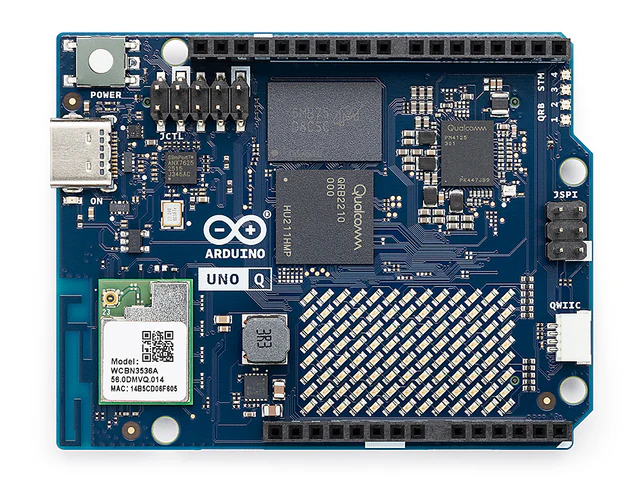
Arduino UNO Q development board Top side
Arduino UNO Q development board Specifications:
- Application Processor (SoC): Qualcomm QRB2210
- Quad-core Arm Cortex-A53 CPU @ up to 2.0 GHz
- Adreno 702 GPU @ 845 MHz with OpenGL ES 3.1, Vulkan 1.1, and OpenCL 2.0 support
- Hexagon QDSP6 v66 DSP for signal processing
- VPU supporting 1080p@30fps encode/decode
- Dual Image Signal Processors (ISP) supporting up to 2x 13MP or 1x 25MP camera @ 30 fps
- Real-time MCU: STMicroelectronics STM32U585
- Arm Cortex-M33 @ 160 MHz
- 2 MB Flash, 786 KB RAM
- Handles GPIO, timing, and low-latency control tasks
- Memory and Storage:
- ABX00162 SKU: 2GB RAM, 16GB eMMC
- ABX00173 SKU: 4GB RAM, 32GB eMMC
- Display and Graphics:
- Video output via USB-C or HDMI (through USB-C dongle)
- MIPI DSI interface available on header
- Wireless Connectivity: Dual-band Wi-Fi 5 and Bluetooth 5.1 via WCBN3536A module
- USB and I/O Interfaces:
- 1x USB Type-C port for power, programming, and video
- Qwiic I2C connector for easy sensor/module integration
- Expansion and I/O:
- Arduino UNO headers and JMISC connector for STM32 MCU
- 47x GPIOs (22x Arduino headers + 25x JMISC)
- 6x PWM, 16x interrupts
- 3x USART, 2x UART, 4x I2C, 3x SPI
- 1x FDCAN bus
- 1x PSSI, 2x SAI, 6x 14-bit ADC, 2x 12-bit DAC, 2x OPAMP
- Qualcomm connectors (JMISC + JMEDIA):
- Up to 12x GPIOs
- MIPI DSI for display, dual MIPI CSI for cameras
- Microphone IN / Headphone OUT / Line OUT / Ear OUT for audio
- Arduino UNO headers and JMISC connector for STM32 MCU
- Power Supply:
- 5V DC up to 3A via USB-C
- 7V–24V DC via Vin pin
- Electrical Characteristics:
- I/O voltage: +3.3V (MCU, 5V tolerant) and +1.8V (MPU)
- Max current per I/O: 20 mA
- Debug and Control:
- JCTL MPU Remote Debug connector
- Dedicated power button
- LED Indicators
- STM32 side: 2x RGB LEDs + 13×8 RGB LED matrix
- Qualcomm side: 2x RGB LEDs
- Dimensions: 68.58 x 53.34 mm (standard Arduino UNO size)
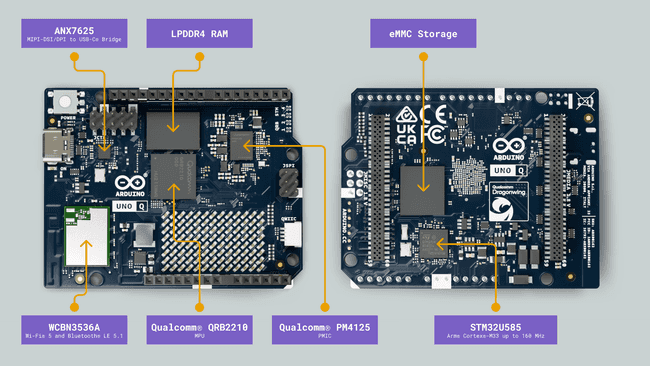
Arduino UNO Q’s main components
The Arduino UNO Q works seamlessly with Arduino App Lab, a visual development platform designed to simplify the creation of embedded AI applications. It allows developers to build intelligent systems by combining prebuilt functional modules, known as Bricks, with custom AI models for quick and intuitive prototyping. In addition to App Lab, the board supports Arduino IDE for traditional C++ sketches and Python, giving developers the flexibility to choose their preferred programming workflow.

Arduino App Lab
Staying true to Arduino’s open-source philosophy, the Arduino UNO Q design files and Gerber layouts are released under the CC-BY-SA 4.0 license. The board is priced at $44 USD internationally, €47.60 in Europe, and around ₹4,699 in India. It is currently available for pre-order on the official Arduino Store, with shipments expected to begin soon through distributors such as RS Components, DigiKey, Mouser, and Robu (India), which lists tentative delivery starting October 24, 2025. More technical and purchase details can be found on the official product page and press release.
Images used courtesy of Arduino.


