Affordable Open-Source Voice Assistant for Smart Homes- An Affordable Open-Source Hardware for Smart Homes with Cloud Option
Nabu Casa has recently introduced the Home Assistant Voice "Preview Edition", a compact, ESP32-powered device that brings open, local, and private voice assistant capabilities to smart homes. Built specifically for Home Assistant, it offers easy setup via USB-C and features advanced audio processing with dual microphones, an XMOS audio chip for echo cancellation, noise removal, and auto gain control.

Nabu Casa has recently introduced the Home Assistant Voice “Preview Edition”, a compact, ESP32-powered device that brings open, local, and private voice assistant capabilities to smart homes. Built specifically for Home Assistant, it offers easy setup via USB-C and features advanced audio processing with dual microphones, an XMOS audio chip for echo cancellation, noise removal, and auto gain control.

The device supports fully local voice processing for privacy or cloud-based speech processing for low-powered hardware. It includes a tactile rotary volume dial, a physical mute switch for guaranteed privacy, and a multicoloured LED ring for visual feedback. Expandability options include a Grove port for sensors and a 3.5mm audio jack for high-quality audio output. It is an open-source firmware and modifiable design that allows customization and integration with AI providers or local language models. A wide range of languages is aimed to be supported by controlling smart home devices, setting timers, managing shopping lists, and more in applications.
To use it, you’ll need a Home Assistant setup that is already running on another device. For fully local speech processing, it’s best to use a system powered by an Intel N100 or higher. If lower-powered devices like the Home Assistant Green or hardware based on a Raspberry Pi 4 are being used, we recommend a Home Assistant Cloud subscription for smoother speech processing. Assist, the open-source voice control feature of the Home Assistant platform manages the voice assistant functionality regardless of the setup.
Previously, Espressif Systems introduced an AI voice development kit built around the ESP32-S3 SoC for monitoring smart IoT devices– ESP32-S3-BOX. We have also learned that Nabu Casa’s Zack Barett announced on Twitter back in June 2022, about the SkyConnect USB Stick, a physical radio adapter and dongle hardware.

Home Assistant Voice Preview Edition specifications:
- Model Number: NC-VK-9727
- SoCs:
- ESP32-S3 with 16 MB FLASH storage
- Memory: 8 MB octal PSRAM
- Storage: 16 MB FLASH
- Audio:
- Input:
- Internal dual-mic array
- Output:
- 3.5 mm (⅛”) stereo headphone jack
- TI AIC3204 DAC with 48 kHz sampling rate
- Input:
- Connectivity:
- 2.4 GHz Wi-Fi
- Bluetooth 5.0 Low Energy
- Audio Processing: XMOS XU316 with:
- Echo cancellation
- Stationary noise removal
- Auto gain control
- Material:
- Polycarbonate plastic enclosure
- Colours: White and semi-transparent
- Microphone and Speaker:
- Internal speaker
- Internal dual-mic array
- Dedicated I2S lines for audio in and out
- Expansion:
- Grove port for sensors or accessories
- Easy-to-open design with screws (no clips)
- Exposed PCB pads for modding
- Misc:
- Multipurpose button
- Rotary dial for volume and input
- Hardware mute switch (cuts power to microphones)
- Power and Data: USB-C, 5 V DC, 2 A
- Dimensions and Weight:
- Device: 84 x 84 x 21 mm, 96 g
- With box: 94 x 94 x 30 mm, 120 g
- Environmental Conditions:
- Indoor use only
- Temperature: 0 °C to 30 °C (32 °F to 86 °F)
- Non-condensing humidity; keep in a dry, dust-free environment
- Certifications: CE, FCC (FCC-ID: 2A8ZEO2)
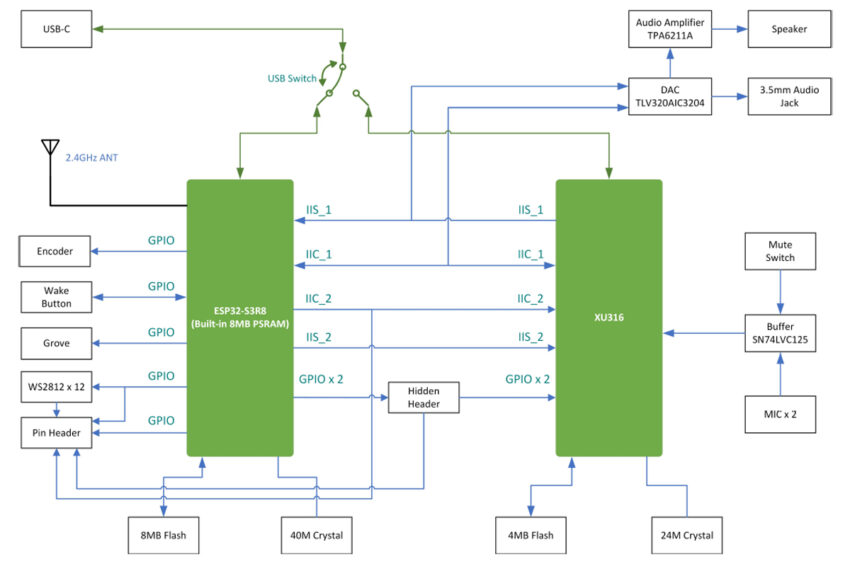
According to the company, it comes with ESPHome preloaded, ensuring seamless integration with the Home Assistant ecosystem. Both the ESP32 and XMOS chip firmware are fully open-source, allowing users to customize and adapt the device to their specific needs, fostering a transparent and flexible user experience.
English, Spanish, and Portuguese are fully supported for both local processing and the cloud service. However, support for other languages may vary. For instance, Thai and Chinese (Mandarin) are currently not supported on the device, and further development is needed for their inclusion in the cloud service. To confirm if your language is supported, visit the Home Assistant Voice Control page. The documentation provides detailed guidance on setting up and using the kit.
The Voice Preview Edition is available for purchase at a recommended price of $59/€59. For more details, you can visit the product page.