
Waveshare ESP32-P4-WIFI6 Development Board Features Wi-Fi 6, BLE, and Multimedia
The ESP32-P4 development board, paired with the ESP32-C6, adds Wi-Fi 6, BLE, camera, display, audio, and security features for HMI, AI, and multimedia applications.
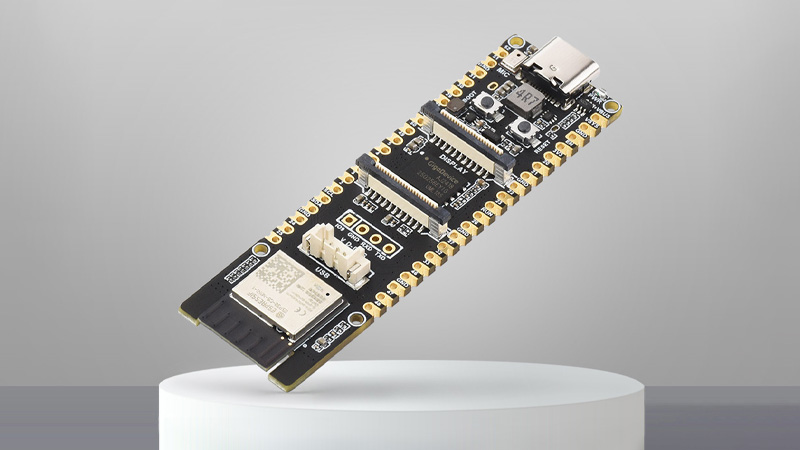
ESP32-P4-WIFI6 High-Performance Development Board
The Waveshare ESP32-P4-WIFI6 is a high-performance development board built around the ESP32-P4, which also features an ESP32-C6 for Wi-Fi 6 and Bluetooth 5/BLE. Designed for multimedia, HMI, and edge computing applications, it combines secure RISC-V processing with extensive connectivity and expansion options, making it suitable for human-machine interaction, AI speech, and multimedia development.
The board integrates a dual-core 400 MHz RISC-V CPU, up to 32 MB PSRAM, 32 MB NOR flash, and rich multimedia interfaces such as MIPI-CSI (with ISP), MIPI-DSI, H.264 encoder, JPEG codec, and audio I/O. It also includes USB 2.0 OTG HS, SDIO 3.0, a microphone, a speaker header, and a 40-pin GPIO header compatible with some Raspberry Pi Pico HATs. Security features include Secure Boot, Flash Encryption, TRNG, and cryptographic accelerators. Optional accessories include a 10.1-inch capacitive DSI display and a 5MP OV5647 camera, making it well-suited for HMI, IoT, AI speech, and multimedia applications requiring low power, high integration, and secure wireless connectivity.
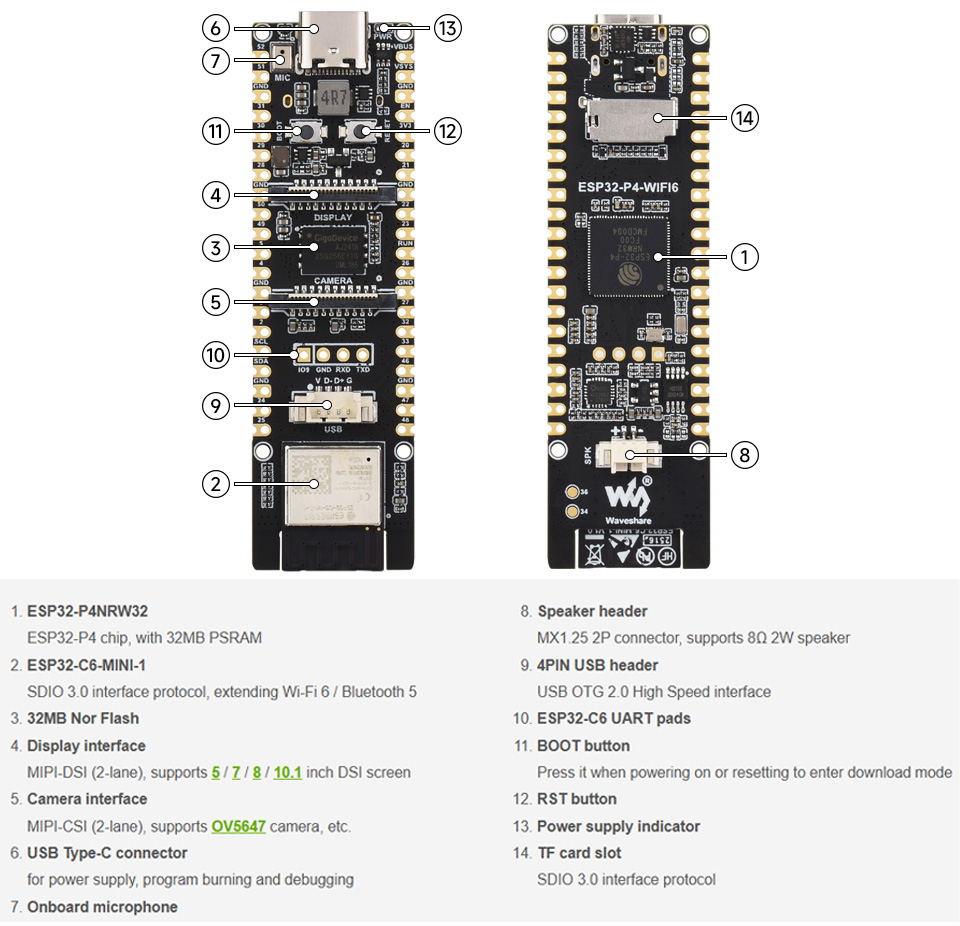
ESP32-P4-WIFI6 Development Board Hardware Overview
Waveshare ESP32-P4-WIFI6 Development Board Specification:
- Core module: ESP32-P4-WIFI6
- Main SoC – Espressif Systems ESP32-P4
- CPU:
- Dual-core 32-bit RISC-V HP (High-performance) CPU @ up to 400 MHz with AI instructions extension and single-precision FPU
- Single-RISC-V LP (Low-power) MCU core @ up to 40 MHz with 8KB of zero-wait TCM RAM
- Memory:
- 768 KB HP L2MEM (for dual-core CPU), 32 KB LP SRAM, 8 KB TCM (for LP MCU core)
- 32MB PSRAM
- Storage: 128 KB HP ROM, 16 KB LP ROM
- GPU: 2D Pixel Processing Accelerator (PPA)
- VPU: H.264 and JPEG codecs support
- CPU:
- Wireless SoC: ESP32-C6 WiFi 6, Bluetooth 5, and 802.15.4 (Zigbee/Thread) connectivity
- Storage: 16MB NOR flash
- Antenna: PCB antenna
- Main SoC – Espressif Systems ESP32-P4
- Storage:
- 32 MB NOR Flash
- MicroSD card support
- Display I/F: 2-lane MIPI DSI connector for 5, 7, 8, 10.1-inch displays
- Camera I/F: 2-lane MIPI CSI for OV5647 and similar cameras
- Audio:
- I2S Support
- Onboard microphone
- MX1.25 2-pin speaker header (supports 8Ω 2W speaker)
- USB:
- USB 2.0 Type-C port for power and programming
- Onboard USB header
- Expansion: 2x 20-pin headers with 27x GPIOs, UART, SPI, I2C, I2S, ADC, RMT, PWM, MCPWM, TWAI; compatible with some Raspberry Pi Pico HATs
- Security: Secure boot, Flash encryption, hardware encryption accelerator, hardware random number generator, etc…
- Misc:
- Reset and Boot buttons
- Power LED
- Power Supply:
- 5V via USB-C port
- Optional PoE (Power-over-Ethernet) support via 6-pin header
- Dimensions: 71.05 x 21 mm (Raspberry Pi Pico compatible header)
The ESP32-P4-WIFI6 development board is supported through Espressif’s ESP-IDF and the Arduino IDE, providing access to the full range of peripherals, including MIPI-CSI/DSI, USB OTG, and security engines. Developers can leverage AI speech interaction frameworks with integration for platforms such as DeepSeek and Doubao, while standard libraries enable image, audio, and connectivity functions. The ESP32-C6 wireless subsystem is fully supported under ESP-IDF with Wi-Fi 6 and Bluetooth 5/BLE protocol stacks, ensuring compatibility with existing ESP32 software workflows and secure IoT application development. More information can be found on the company’s Wiki page.
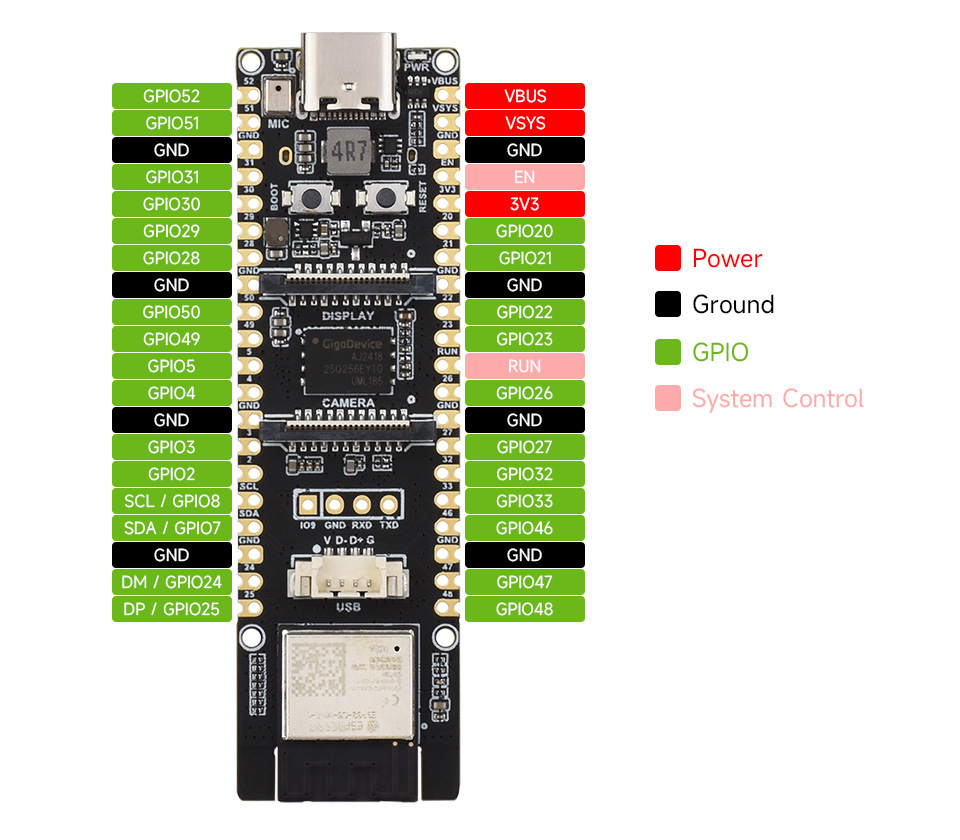
ESP32-P4-WIFI6 Pinout
Previously, we have written about other ESP32-P4 development boards like the FireBeetle 2 ESP32-P4, the FireBeetle 2 ESP32-P4 AI Board, the ESP32-P4-MINI development board, and the Waveshare ESP32-P4-Module Development Board. You can check those out if you are interested in the topic.

ESP32-P4-WIFI6 Dimensions
The ESP32-P4-WIFI6 board comes in four variants, where the standard board comes in either bare or with pre-soldered headers. There is also Kit A, which includes the board plus a speaker for AI voice interaction, and Kit B, which adds a 10.1-inch capacitive touchscreen display along with the speaker. Both Kit A and Kit B support the optional Raspberry Pi Camera (B) for imaging applications. The board is priced between $13.99 and $69.99, depending on the selected version, and can be purchased directly from Waveshare’s online store.
Images used courtesy of Waveshare


